

Hidden Tracks: Black
He told himself it was the paint.

Hidden Tracks takes its titles from songs I heard when I was the right age to let them all the way in. Then it drags them somewhere darker than the lyrics were ever willing to go. You don’t need to know the songs to get the stories. But if you do, they’re going to sit differently after this.
See all Hidden Tracks stories →
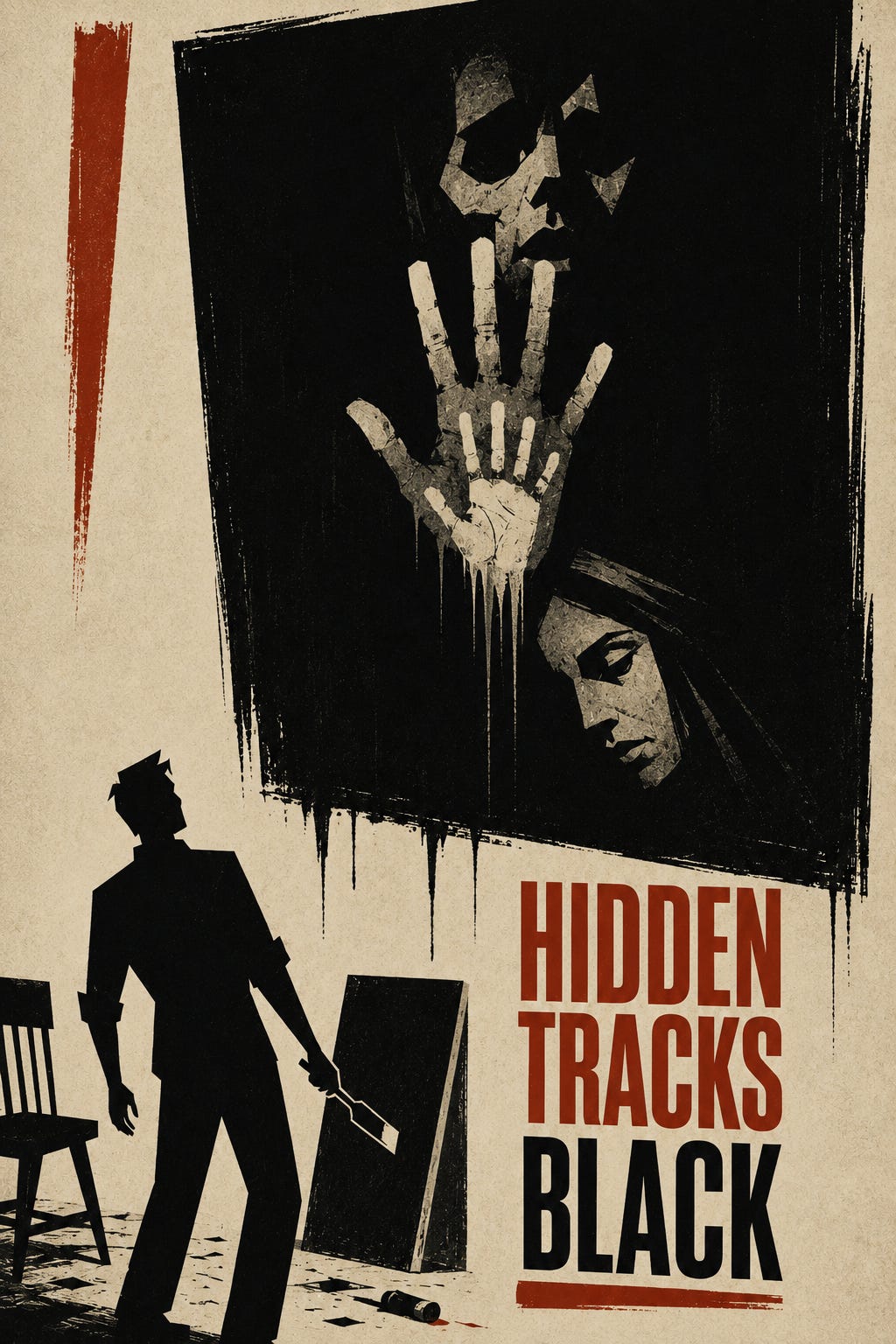
By November, Jeremy had ruined every canvas in the house.
He kept buying more.
After a while the guy at the art supply place quit asking what he was working on. He just rang up the stretched linen, the oil sticks, the blocks of clay, the palette knives, and gave Jeremy the kind of look that said he didn’t want the answer. Same look you’d give a man buying rope and bleach at ten on a Tuesday.
At home Jeremy leaned the blank canvases against the dining room wall and laid the clay out on the table to soften. Every morning he told himself the same thing. He was going to make Sam right this time.
Younger he could fake. Prettier too. What he wanted was right.
The crease beside her mouth when she was tired. The dent in her left eyebrow from wrecking her bike at eleven. The notch in her front tooth.
He was good at hands. He’d taught Sam hers.
That was the part that kept coming back to him when he got tired enough to hate himself properly. He had taught her damn near everything else, too.
How to stretch a canvas without warping it. How to wedge the air out of clay. How to hold a brush near the end so your wrist stayed loose. How to squint until a face quit being a face.
She learned quick.
Quicker than he had.
She left in February with a suitcase by the door and her brushes still soaking in the jar by the sink.
He noticed that before he noticed she was really going.
Sam would leave dishes stacked up for a day and a half, but never her brushes. She used to say soaking ruined the point.
“I can’t keep being the thing you look at instead of the world,” she told him.
He remembered thinking it sounded practiced, like she’d said it once already in the car with the radio on low, just to hear how it came out.
Three weeks later she died on Route 33 when a delivery truck came across the median in freezing rain and folded her Honda hard enough they had to shut down both lanes.
That much was real.
Jeremy painted her for seven months after that.
The first ones looked good.
Better than good.
Sam by the studio window with weak afternoon light on one cheek. Sam turning away from him, smiling at something out in the yard. Sam with her hair tied up in an old blue rag, clay dust on her forearm, about to say something smart and a little mean.
He worked until his hand cramped around the brush and his lower back felt like somebody had driven a rusty tent peg into it.
Then he went to bed.
By morning the black had come.
It showed up from under the paint, which was the worst part. It bled through in skinny dark threads, spreaing. On one canvas it took the mouth first. On another it filled in an eye. On the third it climbed her throat in a greasy stain and kept going until all that was left was the shape of her under there, like something caught below pond ice.
He told himself it was the paint. Cheap pigment. Bad primer. Moisture in the walls. Some dumb chemical reaction he didn’t understand yet.
He switched brands.
He primed the canvases himself.
He moved out of the studio and worked in the dining room.
He wrapped finished pieces in old bedsheets.
He locked one in the hall closet like he was trying to keep a dog from getting into the trash.
It was black by morning anyway.
He smashed the first few with a hammer. Slashed the next two. Burned one out back in the rusted fire ring that came with the duplex. The smoke rolled up thick and greasy and smelled like hot metal and burnt hair.
He stacked the rest in the spare room with their faces to the wall and shut the door.
He didn’t tell anybody.
Outside, life went on in that stubborn, insulting way it has. Kids in the other half of the duplex hollered in the yard after school. A woman across the street had wind chimes that sounded like cheap silverware in a garbage disposal every time the weather shifted. A guy in a Browns hoodie walked the same beagle every morning at seven-fifteen, rain or shine. On Thursdays a woman jogged past with a stroller and the same hard red face.
The world kept being the world.
Jeremy started taking that personally.
One afternoon he stood at the sink with a glass of water in his hand and watched the duplex kids draw hopscotch squares on the cracked stretch of sidewalk by the fence. One of the girls laughed so hard she had to squat down and hold her stomach.
He squeezed the glass without meaning to.
It shattered in his hand.
He looked down at the blood slipping between his fingers and dropping into the basin.
Out in the yard, the little girl stopped laughing.
She looked up at the kitchen window.
Her eyes were fixed on the space over his shoulder.
Jeremy turned.
The kitchen was empty. Table. Fruit bowl. Two soft apples. The slab of clay under a damp towel by the microwave.
When he looked back, she was still watching.
Then she smiled.
That night he went into the spare room and turned the paintings around.
There were fourteen of them.
Fourteen black rectangles leaning against the walls and each other, dead as old televisions.
If he tipped one the right way and caught the light, he could still see Sam under there.
The newest one had fingerprints in the black.
Jeremy stood there a long time looking at them.
They weren’t his. His fingers were broader, knuckles rougher. These were narrow and long and left a drag mark where the paint was still tacky.
Down in the corner where he usually signed, somebody had written one word.
LOOK
He did not sleep that night.
At three in the morning he was in the studio with every light on, kneading clay hard enough to make his wrists ache. The old heat pipe in the wall gave its usual one-knock complaint. The refrigerator motor came on in the kitchen. Somewhere outside a car rolled past too fast over wet pavement.
Then he heard bare feet in the hall.
He froze with both hands buried in the clay.
The steps came to the studio door.
Stopped there.
Jeremy waited.
Nothing touched the knob. Nothing crossed under the crack. He stood there so long his shoulders began to burn.
Then he wiped his hands on his jeans, crossed the room, and pulled the door open.
The hall was empty.
At the far end hung the mirror Sam had brought home from a flea market because, in her words, “it looks like it knows something.” The silver backing had gone bad around the edges, so everything in it looked a little drowned.
Jeremy saw himself in the doorway. White face. Clay up to his elbows. Eyes too open.
And behind him, in the studio chair, sat Sam.
He saw her hands first, folded in her lap.
Then one shoulder.
Then her face, pale and blurred, like a photograph left too long in water.
Jeremy’s skin went cold.
Her mouth moved.
The voice came from the clay.
“You got the hands wrong again.”
Jeremy spun.
The chair was empty.
He stood there breathing. The chair was just a chair. Paint-stained arms, a crack in the left leg he’d been meaning to fix for two years. Just a chair.
Then he looked at the armature.
He’d only roughed in a bust before he heard the steps. Neck. Jaw. The start of a skull. Now it was almost her.
The damaged eyebrow.
The notch in the tooth.
The hair pulled back over one ear.
The eyes open.
He stumbled backward into the shelf by the workbench. Jars rattled. A wooden tool hit the floor and spun away. The clay face looked at him with the expression she’d worn in the bad months before she left. Worn out. Fed up.
“Sam?”
Its mouth opened.
A wet sucking sound came out, like mud letting go of a boot.
The head smiled.
A crack opened in one cheek.
Something black and shiny seeped out. More leaked from the nostrils, the corners of the eyes, the edges of the mouth. It ran down onto the table in thick slow threads.
From the spare room came the sound of canvases turning over.
All fourteen of them.
Jeremy ran.
He got as far as the front door before he understood he wasn’t trying to leave forever. He was trying to get back to something ordinary. Porch boards. Cold air. Chain-link fence. Sidewalk. Dead grass. Anything still dumb enough to belong to the living.
His bloody hand slipped on the deadbolt.
Behind him, bare feet crossed the hall again. Slow this time. Taking their time. Knowing where he was going.
He got the door open and fell out onto the porch hard enough to skin his knee through his jeans. The air hit his face like cold water.
Across the yard, the little girl from next door stood by the fence in her socks and a nightgown with cartoon strawberries all over it.
She should not have been awake.
She looked at him the way grown people sometimes look at roadkill. No pity in it. No disgust either. Just interest.
Then she spoke in Sam’s voice.
“Squint until it quits being a face.”
Jeremy stared at her.
The girl raised one chalky finger and pointed toward the house.
He turned.
The windows had gone black. Black like somebody had painted them from the inside.
Something wet and thick pressed against the glass. As he watched, shapes slid through it. Hands. Faces. The corners of canvases. A woman turning away.
When he looked back, the little girl was already walking toward her own back door.
She went inside and shut it.
By morning the house was empty.
Jeremy was gone. So were the paint, the clay, the canvases from the spare room.
The deputies called it a walk-off.
One of them said Jeremy had been sliding downhill since the wreck. Split with the girlfriend, then the death, then the isolation. He said it standing in the kitchen like he’d said versions of it a hundred times before and expected to say it a hundred more. The other deputy stayed too long in the studio without speaking, then came back out and asked the landlord if he had any plywood on the property.
By noon the studio window was boarded over.
A week later the family in the other half of the duplex moved out.
The landlord repainted everything twice.
In spring, a young couple moved in with a baby and two ferns and bright prints in cheap white frames. They turned Jeremy’s old studio into a nursery. The woman did freelance design work at the dining room table and brought home charcoal pads and sample boards and little stacks of color swatches held together with brass pins.
She was good at it. She could tell you the difference between a warm white and a cool white just by holding them up to the window. She did it constantly, holding things up to the window.
In June she started sketching while the baby napped.
Her husband found the first drawing behind the nursery rocker, face-down on the floor.
The paper had been worked so hard the charcoal shone. At first it read as black. Then he tipped it toward the window and a man appeared in it, one hand pressed flat against the inside of the glass.
Over his hand, smaller, was a child’s palm print.
The charcoal was still soft when he touched it.
He turned around.
The baby was awake in the crib. Had been for a while, by the look of it. Just lying there quiet, facing the wall where the window used to be before they drywalled it over.
One hand raised.
Fingers spread.
Waiting for something to press back.
The liner notes are below. Song, schematic, what got cut.
01 — The analog connection
The song is already past tense
“Black” isn’t about loss. It’s about the specific moment you realize you’ve already lost something while you were still standing next to it.
Vedder isn’t at the funeral. He’s at the kitchen table watching someone he loves become someone he doesn’t recognize, past tense already baked into the present tense. “I know someday you’ll have a beautiful life.” Not might. Know. The leaving is done before the song starts. He’s just describing the shape of the hole while he’s still inside it.
That’s Jeremy and Sam before the truck ever crossed the median. She had a suitcase by the door and her brushes still soaking, which is how you know the leaving was real. Jeremy noticed the brushes first because the brushes told him what the suitcase hadn’t yet confirmed. The song clicked in at that detail. Sam was already gone. The accident just made it impossible to argue with.
The black in the paintings isn’t grief. It’s Sam coming back through the only medium they ever shared, correcting his work. That’s not a haunting. That’s a collaboration that didn’t end when she did.
02 — The technical schematic
The armature
An armature is a metal skeleton. Wire and rod and aluminum foil, built to hold the clay in place while the sculptor works around it. It has no artistic value on its own. It’s infrastructure. The whole point is that you can’t see it in the finished piece.
Jeremy roughs in a bust before he hears the footsteps. Neck, jaw, the start of a skull. He leaves it unfinished and goes to the door. When he turns around, it’s almost her. The damaged eyebrow. The notch in the tooth. The eyes open.
The wrongness isn’t supernatural smoke. It’s the labor. Somebody finished the work. The armature is still inside. The infrastructure that was supposed to be invisible is now holding something that shouldn’t exist, and it’s doing its job perfectly. Holding the weight. Keeping the shape. Not caring what shape that is.
Jeremy taught Sam how to wedge the air out of clay. How to build an armature that wouldn’t buckle. She learned quick. Quicker than he had. The schematic here isn’t what’s wrong with the piece. It’s who built it.
03 — Riff/beat alignment
The outro and the ending that isn’t Jeremy’s
The song’s outro runs almost three minutes. Vedder stops singing words and starts making sounds. It goes past where a song is supposed to end and keeps going, past resolution, past the point where you expect it to close out. It doesn’t stop because it’s finished. It stops because someone eventually had to turn off the tape.
“By morning the house was empty. Jeremy was gone. So were the paint, the clay, the canvases from the spare room.”
The story doesn’t end with Jeremy. That was the structural decision that took the longest to commit to. The deputies, the landlord, the repaint, the new couple, the baby, the charcoal drawing behind the rocker. The story keeps going past Jeremy the way the outro keeps going past the last lyric. Because it was never about Jeremy. He was the current host. The transmission was running before him and it runs after. The new woman holds things up to the window the same way Jeremy would have. She’s already sketching. The baby is already facing the wall where the window used to be.
The outro told me not to cut the ending off at Jeremy walking out the door. Let it run. See what’s still moving after he’s gone.
04 — The Stephen King ledger
The girl at the fence
Version I killed
“The girl opened her mouth and what came out was Sam’s voice, thin and wrong in a child’s throat, saying the thing Sam used to say in the studio when he was overworking a piece.”
Version I kept
“Then she spoke in Sam’s voice. ‘Squint until it quits being a face.’”
The first version is doing the reader’s job for them. “Thin and wrong in a child’s throat” is me being nervous the image won’t land, so I’m annotating it. The second version trusts that if you’ve been reading for six thousand words, you don’t need me to tell you it’s wrong. You need me to tell you what she said. The line itself is the horror. Jeremy taught Sam that. Sam taught it back through a seven-year-old in cartoon strawberry pajamas at two in the morning. The transmission completed. That’s the whole story in one sentence and it didn’t need a tour guide.
05 — For paid subscribers
Think about a skill somebody taught you that you still use. Something specific, the way you hold a tool, the way you read a room, the way you know when something’s finished. Now think about whether you could actually separate that skill from the person who gave it to you, or whether every time you use it the transmission is still running. What would it mean if the thing they taught you kept going after they couldn’t?
I am sooooo here for these author's notes! Miles, am i going crazy, they weren't there when I first read this? When did you start adding this? (I'll ask you in about 30 mins lol.)