

Hidden Tracks: Little Fighter
You were one of a kind

Hidden Tracks takes its titles from songs I heard when I was the right age to let them all the way in. Then it drags them somewhere darker than the lyrics were ever willing to go. You don’t need to know the songs to get the stories. But if you do, they’re going to sit differently after this.
See all Hidden Tracks stories →
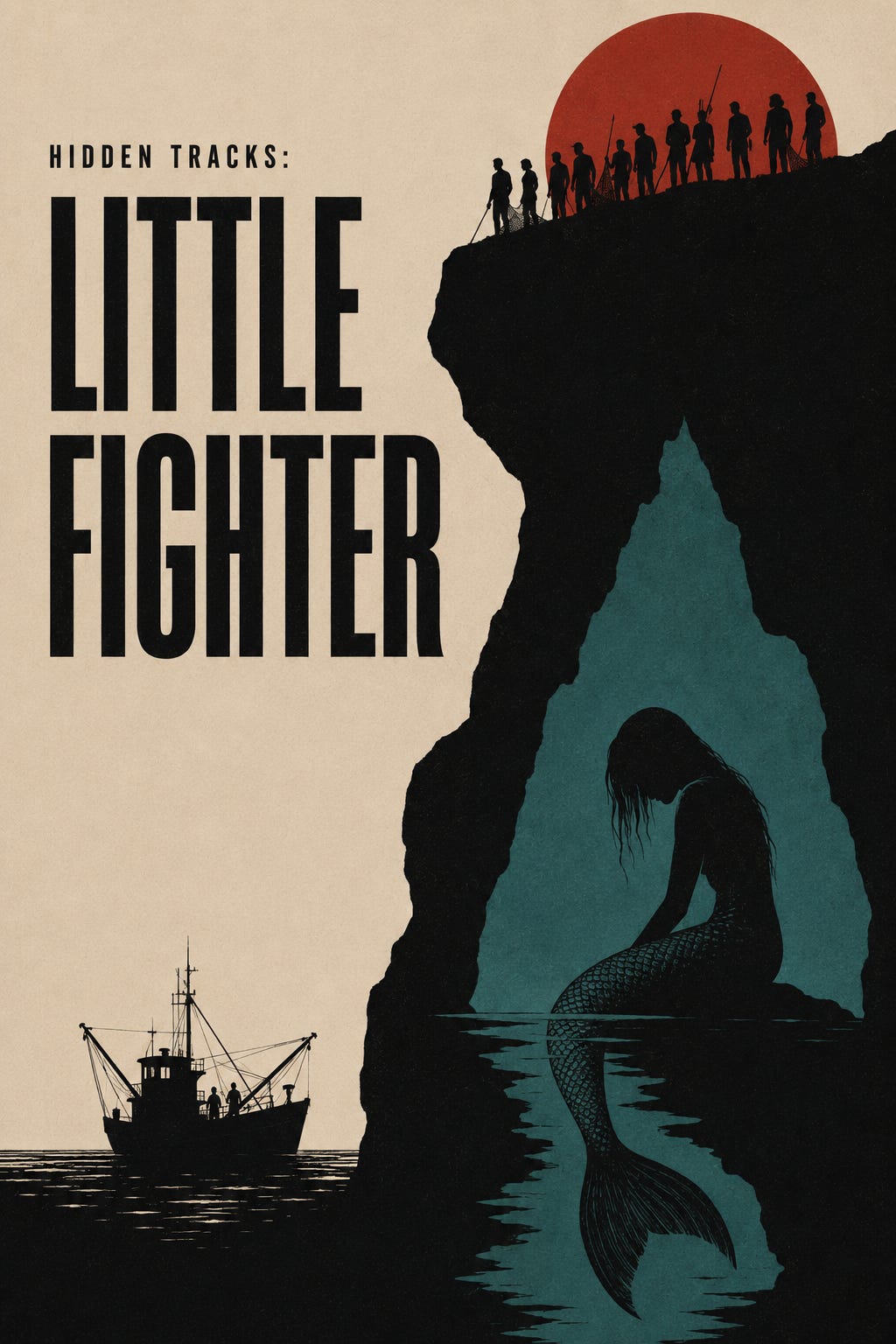
The summer we killed the mermaid, the town called it a miracle.
Mara Bennett went into the ground on a Tuesday under six inches of bad February snow. By Friday the town Facebook page was already calling her kind, devout, and a daughter of Blackwater Cove. Nobody mentioned Mercy Point. Nobody ever did. Last time we spoke, Mara told me there was no point stirring all that up now. Friday morning I watched people praise her under a picture taken twenty years too late, and I thought of the ropes on wet stone and decided she’d been wrong about that too.
So I’m writing this down.
That is not what happened on Mercy Point.
What happened was smaller and meaner than that.
I was fourteen the summer of 1988. My mother worked the register at Harker’s Bait & Tackle, and my father fished out of a stern trawler called the Annalee, though “fished” is the nice word for what he and most of the men in Blackwater Cove did by then. They took what they could haul and called the empty water somebody else’s problem. There had been bad seasons before, but that year felt ugly early. Nets came up torn. Traps went missing. Engines stalled in calm water for no reason anybody would admit to. Men who ran heavy lines in breeding grounds came back cussing about something under the boat. The smaller catches they blamed on luck. The bigger ones they called blessing. Everything in between they blamed on whoever wasn’t standing there to argue.
By July, half the town had a story.
Mrs. Bell said something grabbed her husband when he leaned over to clear a line. Tommy Pierce swore he heard a woman singing outside the channel markers during a storm and found his bow pointed toward shore with nobody at the wheel. Reverend Vale, who never met a roomful of fear he couldn’t dress up as certainty, started talking in church about old things in the deep that wore a pleasing face because the Devil understood marketing. That got a laugh the first time. Not a good one. After that, people started bringing him their stories like tithes.
Nobody said mermaid at first.
That came later, after the point had blood on it and the town needed a word it could put on postcards.
I found her three weeks before they killed her.
A storm had come through hard the night before, bad enough to throw lobster floats up on the road. I went down to Mercy Point the next afternoon to look for tackle washed in off the rocks. Kids did that then. Still do, probably. The cave below the point only opened at low tide, a black slice in the stone that breathed cold air even in August. I heard coughing from inside and thought at first it was some drunk or one of the summer people sleeping it off.
Then I saw the tail.
It was caught in a snarl of monofilament and kelp, silver-gray where the light hit it, darker where it disappeared into the cave water. The rest of her looked, from the waist up, too much like a girl for my brain to sort out quick. Dark hair plastered to her shoulders. Thin arms. Ribs showing. A long cut down one side with old hook scars puckered white around it. One wrist wrapped in ghost line so tight it had chewed the skin raw.
She saw me and tried to go deeper into the cave, but there wasn’t anywhere to go. She was weak and tangled up bad. When she bared her teeth, they were just a mouth full of small sharp human-looking points that told me she could bite if she wanted. She didn’t.
I should tell you I ran for help.
I didn’t.
I climbed down into the cave and cut the line away with my bait knife while she watched me like I was one more stupid animal. The whole place smelled like salt and old weeds and blood gone cold. When I got the last of the line off her wrist, she jerked away and hit the back wall hard enough to hiss. Then she stayed there, breathing fast, eyes on me.
I said, “I’m Owen.”
That was a dumb thing to say to something impossible, but I was fourteen and still thought names helped.
She didn’t answer. Not then.
I brought food the next day. Bread from the kitchen, two apples, and three sardines stolen from the bait freezer. She ignored the apples, ate the sardines whole, and turned the bread over in her hands like she was studying it. Her hands were scarred too. Small white lines across the knuckles. A notch missing from one finger. More hook damage around the heel of the thumb.
I came back the day after that and the day after that.
It became a routine. I’d cut behind Harker’s after lunch, tell my mother I was headed to the jetty, and take the path down to Mercy Point with whatever I could steal or carry. Sometimes she let me sit close. Sometimes she stayed in the water and watched me from ten feet away. Once she took my wrist, turned my hand palm-up, and traced the callus where I held a rod. Once she laughed, a short wet sound that scared the hell out of me because it was so normal.
She learned my name before I learned anything about her.
“Owen,” she said one afternoon, careful with it. Not mystical. Not spooky. Just trying the sound out.
I nearly jumped out of my skin.
I asked her name back, but she only tilted her head. Maybe she didn’t have one I could say. Maybe she didn’t think I’d earned it. Either way, that was as far as language got us.
What I remember now, what I did not understand then, were the things she kept in the back of the cave.
A drift of cut net. Rusted hooks. Propeller-shaved boards. A pile of dead fish she’d laid out on the stone. Twice she pushed them toward me and made a low angry sound in her throat. I thought she was trying to scare me. I thought a lot of things a fourteen-year-old boy thinks.
There was a long white seam down her side, old and ugly, like a propeller had opened her and she’d kept going anyway. There were holes healed over near her shoulder that looked made by spear tips. Scars on scars. Whatever she’d been doing out there, she’d been doing it alone.
Mara Bennett thought I was meeting another girl.
In a way, I guess I was.
Mara and I weren’t together. We weren’t anything. But I’d walked her home from the Fourth of July bonfire. I’d let her write our initials in the fog on the bait freezer door at Harker’s and didn’t wipe mine away. I liked being liked. That’s the cleanest way to say it. I was kind to her in all the vague little ways boys are kind when they want the warmth of being wanted without the work of answering it honestly.
Then I started disappearing every afternoon.
She followed me on a Thursday.
I didn’t hear her on the rocks above the cave. Didn’t know she was there until I looked up and saw her staring down into the dark. The girl in the water had one hand around my wrist. Mara’s face changed by degrees. First confusion. Then hurt. Then the kind of embarrassment that turns mean before you can stop it.
“Who is that?” she asked.
The hand around my wrist tightened.
“Nobody,” I said.
It was the worst thing I said that summer, and I said worse later.
Mara looked at me for a second like she didn’t know who I was anymore. Then she turned and climbed back up the rocks so fast she slipped once and barked her shin hard enough to curse.
That night she told her mother.
Kids hand things to adults all the time because they still think adults know what to do with them.
By breakfast her mother had told Reverend Vale. By noon there was money on her head.
Men who had whispered all summer suddenly got loud. They had a cause now. They had a reason to be ugly in public.
Mara came to our yard just after lunch, already crying.
“I only told my mother,” she said. “Owen, I didn’t know.”
Behind her, down at the marina, I could hear men shouting to each other and somebody laughing too hard.
I said, “You should go home.”
She grabbed my arm. “Tell them it isn’t true.”
But it was true. That was the problem. There was something in the cave. I had seen her. I had fed her. She knew my name.
I shook Mara off and ran for Mercy Point.
They were already there.
Reverend Vale stood above the rocks in shirtsleeves with his Bible tucked under one arm like he’d been invited to bless a boat. Earl and my father had a seine net stretched across the mouth of the cave. Pete Sutherland, who was older than God and twice as tired, stood off to one side with his hands in his pockets and wouldn’t meet my eye. Half the town was behind them. Men from the docks. Women from church. Kids I went to school with. Mrs. Bennett with one hand locked around Mara’s wrist so tight it had turned the skin white.
Nobody looked like they thought they were at a killing.
That’s the part that still turns my stomach.
They looked like they were at a job.
The tide was low enough to show wet black rock all the way down. The cave breathed in and out under the point. Earl shouted for the men to haul, and they did. The net came up heavy. For one second nothing happened. Then she hit it from inside hard enough to make all six men stagger.
Somebody in the crowd screamed.
“Hold fast,” Reverend Vale said, like he was talking through a difficult birth.
They hauled again.
She came out in a knot of net and spray, thrashing only to get back to the water. No claws. No weapon. No song. Just panic. My father got the rope around the tail and jerked hard. Earl jammed the hook into the mesh to keep her from sliding free. She hit the rocks shoulder-first and made a sound I still hear in my teeth some nights.
The crowd went dead quiet.
Up close, she looked smaller than I remembered. More hurt. There were fresh cuts where the net had bit into her. Her hair covered half her face. One of the old scars along her ribs had split open again.
Pete Sutherland said, “Jesus, Earl. Leave it.”
Not loud enough to matter.
Earl ignored him. My father put a boot on the rope. Reverend Vale started praying.
She clawed for the water. Her nails tore bloody on the stone. Earl’s hook pinned the net. My father pulled the rope tighter.
I wish I could tell you I ran to her.
I wish I could tell you I shouted.
What I did was stand there with my face burning and my stomach gone hollow while she looked through all of them and found me.
Then she said my name.
“Owen.”
Nobody else on that beach knew she could talk.
Shame hit so hard I thought for a second I might be sick right there between the church ladies and the bait coolers. Not guilt. That came later and kept coming. Shame was quicker. Hotter. Cleaner. She knew exactly how they had found her, and so did I.
They dragged her far enough up the rocks that the tide couldn’t take her back. They held the rope when she bucked. Earl kept the hook in the net. Reverend Vale prayed louder when she made sounds he didn’t like. My father hit her once with the flat of an oar when the tail nearly worked free. After that the fight went out of her in pieces. The breathing got higher, thinner. The hands stopped clawing. The eyes stayed open.
Mara was crying openly by then. So was I, though I didn’t make a sound. Pete Sutherland walked away before it ended. Everybody else stayed.
By the time the tide turned, she was still.
The first person to call it a miracle was Reverend Vale.
He said it right there on the rocks with the blood not yet washed away.
By Sunday he was preaching deliverance. By Labor Day there were out-of-towners buying Polaroids of Mercy Point from the drugstore. The town put up a plaque ten years later that said, in bronze, SITE OF THE MERCY POINT MIRACLE, AUGUST 1988.
The first year after, the boats came in heavy.
That’s important too.
Men slapped each other on the back and said the Lord had broken a curse. Nets came up full. The point stopped taking gear. Nobody heard singing in storms because there was nobody left to hear it from. My father bought a newer engine. Earl Dunphy got a second truck. Reverend Vale said obedience brought reward.
Then the years after that started adding up.
The breeding fish got thin. The schools moved. The worst boats went farther out and came back with less. Storms chewed bigger bites out of the shore. The water near the point went brown some summers and lay there stinking. Kids still fell off the jetty now and then. None of them washed up alive with stories about a hand at their back.
I learned slowly. The way stupid men learn anything that matters. One pattern at a time.
The nets she cut had belonged to the men taking too much. The gear that vanished was set in nursery ground. The boats that lost power were the ones that ran past the markers in spawning season. The dead fish in the cave were not trophies. They were warnings. She had not been hiding from us because she was afraid of people in general.
She had been standing in our way.
I was old enough to help kill her before I was old enough to understand what she’d been trying to save.
Mara and I spoke about it once.
It was years later, behind Saint Jude’s after my mother’s funeral. People were inside eating ham sandwiches off paper plates and talking too loud because death makes some folks hungry. Mara had a cigarette in one hand and her purse tucked under the other arm like she meant to leave before anybody asked her to stay.
She asked if I still lived out by the point.
I said yes.
She nodded toward the road. “I can’t go down there anymore,” she said.
I waited.
After a minute she said, “Funny, the things people used to believe around here.”
Not happened. Not did. Believed.
“She said my name,” I told her.
Mara flinched. Just once. Then she dropped the cigarette, crushed it out with the toe of her shoe, and said, “We were kids. People got worked up. There’s no point stirring all that up now.”
I understood exactly why she said it. That was the worst part. By then I’d spent half my life doing the same thing in quieter words.
So no, I did not hate Mara more than I hated myself.
She handed the match to the wrong people because she was hurt and fourteen and I had made an idiot’s mess of her heart. I stood there on the rocks because I was ashamed and fourteen and too scared of my father to put my own body between hers and the town.
They turned it into a crusade. They gave it a reason. They blessed it and sold it and set it in bronze.
That is Blackwater Cove’s miracle.
Here is mine, if I get one.
She was real.
She fought a war none of us had the decency to understand.
They took her life and called that salvation.
They were wrong.
Because she did not vanish.
The water kept telling the truth after she was gone. In empty breeding grounds. In brown tide. In storms that came harder. In the dead quiet where something had once pushed back. All these years later the town still tells the story like it saved itself from a monster.
Mara is buried. My father is buried. Reverend Vale is buried. Earl Dunphy went into the harbor drunk in 2003 and never came back up. The plaque is still there. Tourists still take pictures. Kids still dare each other to climb down to the cave at low tide.
If you go, you won’t find bones.
The sea keeps what belongs to it.
The liner notes are below. Song, schematic, what got cut.
01 — The analog connection
The only hair metal song that filed a report
Mike Tramp wrote “Little Fighter” about seal hunting. That’s it. That’s the whole thing. No metaphor, no romantic subtext, no girl in a red dress. An animal being killed by people who don’t understand what they’re destroying, and a singer who watched it happen and couldn’t stop it and wrote the song anyway because that was the only thing left to do.
In 1989 that made White Lion the weird earnest kids at the party. The song doesn’t fit the genre. It’s too direct. Too specific. The rest of the album is standard-issue arena rock. Then track eight drops and Tramp is just standing there telling you what happened.
Owen is doing the same thing. Mara is in the ground, the town is writing the lie in bronze for the second time, and Owen is sitting down to file a deposition. Not a eulogy. Not a confession designed to make himself feel better. A factual correction to the public record. “That is not what happened on Mercy Point.” He’s not being poetic. He’s being precise. The song told me exactly what register the story needed to live in. Earnest. Specific. Too direct for the room it’s in.
The song is also about accountability that arrives too late to change anything. Tramp can’t unclub the seal. Owen can’t unstand on those rocks. The report gets filed anyway. That’s the whole frequency.
02 — The technical schematic
The plaque
SITE OF THE MERCY POINT MIRACLE, AUGUST 1988. Cast bronze, mounted to stone, installed by the town of Blackwater Cove ten years after the fact.
The plaque functions perfectly. It identifies the location. It names the event. It anchors the story the town decided to keep. Tourists photograph it. Kids dare each other past it. The Polaroids moved product at the drugstore for years.
The wrongness isn’t in the plaque. It’s in the word miracle. A miracle is an intervention from outside the natural order. What the town did on those rocks was entirely inside the natural order. Entirely human. They hauled the net. They held the rope. They hit her with the flat of an oar. They stood there and watched. The plaque marks the spot where that happened and calls it something else, and it does so in a material specifically chosen because it doesn’t corrode. Bronze outlasts the people who commissioned it. The lie is load-bearing infrastructure now. That’s the schematic. A device doing exactly what it was designed to do, which is make forgetting official.
03 — Riff/beat alignment
The bridge at 3:10 and the moment she says his name
The song drops almost completely out at 3:10. The guitars pull back. Tramp stops pushing. Four or five seconds where the track just breathes before the final chorus comes back in at full weight. It’s the moment where the song stops performing grief and just holds it.
“She looked through all of them and found me. Then she said my name. ‘Owen.’ Nobody else on that beach knew she could talk.”
Everything in that scene is loud and moving until that sentence. The men hauling, Earl’s hook, Reverend Vale praying louder over sounds he doesn’t like. Then she finds Owen in the crowd and says his name and the whole story stops. One word. Three lines. Then the scene keeps going because it has to, because the tide doesn’t stop and neither does shame.
I cut two sentences of Owen’s interiority that had been sitting between “she said my name” and “nobody else on that beach knew she could talk.” They explained too much. The bridge in the song doesn’t explain anything. It just holds the space open long enough for you to feel the weight of what’s coming. Owen’s explanation could wait. The three lines needed room.
04 — The Stephen King ledger
The ending and why it stays
Version I killed
“If you go down to the cave now, you won’t find bones or evidence or anything the town could point to. The sea reclaims what belongs to it, and she had belonged to it longer than any of us had belonged to anything.”
Version I kept
“If you go, you won’t find bones. The sea keeps what belongs to it.”
The first version is Owen explaining his own ending, which is the thing Owen has been doing his whole life instead of acting. He’s a man who understands things a beat too late and then describes his understanding carefully. The story earns that voice because it’s honest about it. But at the end he doesn’t get to editorialize about what she deserved. He gets two sentences. The first one answers the practical question. The second one is the only claim he’s earned the right to make. She belonged to the sea. Full stop. Everything else is the town’s voice, not his. Kill the receipt. Keep the verdict.
05 — For paid subscribers
Think about something in your town, your neighborhood, your industry, that has an official name for what happened. A plaque, a designation, a founding story everybody repeats. Now think about what the thing that got cleared away to make room for that story would say if it could file its own report. Not the monster version. The accurate version. What was it actually doing before it became the thing that needed to be dealt with?