

Hidden Tracks: It's Not Love
Why baby, why?

Hidden Tracks takes its titles from songs I heard when I was the right age to let them all the way in. Then it drags them somewhere darker than the lyrics were ever willing to go. You don’t need to know the songs to get the stories. But if you do, they’re going to sit differently after this.
See all Hidden Tracks stories →
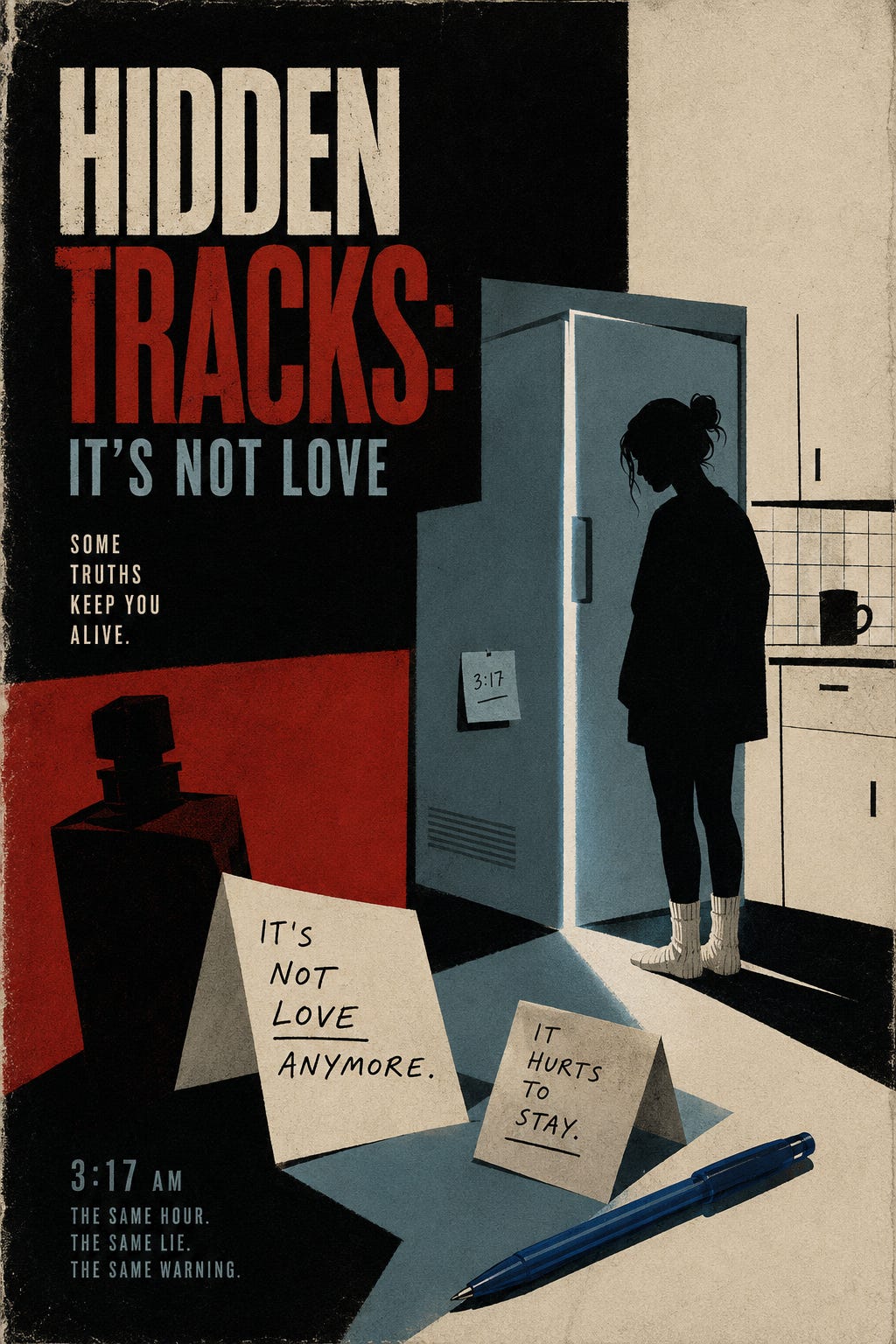
The note was under her coffee mug.
She saw it the way she saw everything at 6 a.m., through the wrong end of herself.
The bottom of the mug was wet. The note stuck to it as she picked it up.
The kitchen smelled like damp wool and that heavy sweet cologne Donny bought by the gallon. It sat in the back of her throat.
It hurts to stay.
She read it twice. Her handwriting. Blue pen, the one she kept by the phone. Block letters, which she only did when she was being careful.
She stood there in her socks on the kitchen tile, heel damp where she’d stepped in last night’s dishwater and never wiped it up. The refrigerator hummed.
Outside, someone was already leaving for work, footsteps in the hall moving away.
I don’t remember writing this.
She folded it in half, put it in the junk drawer, and made her coffee.
The lab was twenty minutes by bus. She liked the bus. Nobody talked to her and she could watch the city happen through scratched plexiglass, separate from it without trying.
Donny used to say she had a gift for disappearing in plain sight. She’d written it in her journal that night, Donny says I have a gift, and only later, much later, understood what he meant.
At work she ran a standard antibody panel, nothing complicated. A number sat outside the expected range.
She ran it again, same sample, same panel.
Perfectly inside range.
She looked at what she’d written the first time. Compared it to the rerun.
You just got lucky, Donny said, from three weeks ago, from inside her head.
She documented the final result and moved on.
She slept badly and woke at 3:17.
The apartment was cold. She could feel it on her face while the rest of her stayed under the blanket.
The refrigerator light was on. The door looked shut anyway. A thin white line leaked from under it.
Her mouth tasted like pennies.
She got up and checked the junk drawer. The note was still there, folded in half. Her handwriting. Blue pen.
She closed the drawer and went back to bed.
She did not sleep again until 5.
She found the second note on Thursday.
This one was in her coat pocket. The good coat, the wool one she only wore on cold mornings. She put it on and pushed her hands into the pockets and stood there in the doorway with a piece of paper between her fingers before she understood what she was holding.
There's nothing left to take.
Her handwriting. Blue pen. Block letters.
She stood there long enough to miss the 7:40 bus and had to wait for the 8:05 and she was twelve minutes late to the lab, which had never happened, not once. Her supervisor, Dr. Paulson, looked at her and she said car trouble and her supervisor nodded and that was that.
She didn’t own a car. She didn’t even have a license. Donny drove. Donny always drove.
His car was still in their lot. It hadn’t moved in three weeks.
That night she couldn’t find the blue pen.
She looked in the junk drawer, by the phone, in her work bag, in the cup on her desk where she kept pens.
Nothing.
She had other pens. Red, black. No blue ones.
She sat at the kitchen table for a while with her hands flat on the surface.
Then the smell hit her. Faint and wet-sweet, like something left too long in a closed place.
Drakkar Noir. Donny’s cologne.
Her mouth filled with spit and she swallowed it back.
She checked the door. Locked. She checked the windows. Locked. Then she stood in the middle of the apartment and breathed through her mouth and waited for her heart to do something reasonable.
The refrigerator hummed.
She went to bed with the light on and woke at 3:17 and the apartment was cold and the refrigerator light was on again.
She did not check the junk drawer.
On Friday she mislabeled a sample.
Nobody was hurt, but it was still the kind of mistake that required an incident report and a conversation with Dr. Paulson.
“You seem tired, Lisa.”
“I’m fine.”
“Everything okay at home?”
She thought about the notes in her handwriting. The blue pen she couldn't find. Waking at 3:17 every night for three weeks, since Donny stopped answering, and how the apartment ran cold. She thought about the fridge light. She thought about the lie forming in her mouth like it lived there now.
“Yes,” she said.
Dr. Paulson wrote something down without looking at the form. His pen scratched once, paused, then scratched again.
That weekend she pulled everything out of the junk drawer and laid it on the kitchen table. Batteries, expired coupons, a broken watch, three pennies, a thumbtack, a key she couldn’t place, the folded notes.
She sat with them closed for a while.
Then she unfolded them flat.
You know it wasn’t real.
You made me.
There was a third one she didn’t remember seeing before. Didn’t remember putting in the drawer. It was tucked inside the first note. Folded into it.
It's not love anymore.
Lisa sat with them for a long time. Outside it was Saturday and the city was doing Saturday things. In here, it was very quiet and very cold and she was looking at her own handwriting, trying to remember the last time she’d been certain about something.
The lab. She’d been certain at the lab.
Until Friday.
She got up and went to the desk in the corner of her living room where she did her bills. She looked in the cup and saw the blue pen.
It was there.
Same chewed cap. Same faint smear of ink near the clip that she’d never been able to scrub off. It sat in her fingers like it always had, familiar enough to make her angry.
She stood at the kitchen counter and uncapped it.
She watched from slightly outside herself. Her hand moved slow and careful, the way it moved when she was labeling vials. She understood, standing there, that she would fold this one and put it somewhere and find it later and not remember. That was how it worked. That was how it had been working for longer than she wanted to admit. Something had slipped, some gear jumped its track, and now she could see the mechanism.
Seeing it changed nothing.
Her hand stopped.
She looked at what she’d written long enough to know she’d gotten it right. Then she folded it before she could read it again.
She capped the pen and put it back in the cup and slid the note into her coat pocket, the good wool coat hanging by the door.
The refrigerator hummed. The light under the door stayed on.
Under the hum, the air held that faint wet-sweet edge again, just for a second.
Outside someone was leaving, footsteps in the hall moving away, and she didn’t know their name and it didn’t matter.
Lisa went to bed.
She woke at 3:17 and the apartment was cold.
She didn’t check the pocket.
She already knew what it said.
The worst part was how relieved she felt.
This time, she’d gotten the wording right.
This time, she’d gotten lucky.
The liner notes are below. Song, schematic, what got cut.
01 — The analog connection
Still making the case
“It’s Not Love” is a breakup song where the singer already knows the answer and can’t stop arguing against it. He says it’s not love in the title, in the chorus, in every hook the song has, and he’s still there. Still in the apartment. Still in the loop. The song is the argument a person makes when they already know they’ve lost it but leaving requires admitting that out loud and they’re not ready to do that yet.
Lisa is living in that loop and the loop has a 3:17 timestamp and smells like Drakkar Noir. Donny stopped answering three weeks ago. His car hasn’t moved. The apartment runs cold. She wakes at the same time every night and checks the same drawer and finds the same notes in her own handwriting. She knows what’s happening. She can see the mechanism. Seeing it changes nothing. She folds the note anyway and puts it in the coat pocket and goes to bed.
The song clicked in on the journal entry. Donny says I have a gift for disappearing in plain sight, and she wrote it down because he said it like a compliment, and only much later understood what he meant. That’s the whole Dokken song in one sentence. The story is about what happens when you finally read it at the right angle and fold the note anyway.
02 — The technical schematic
The blue pen
Standard ballpoint. Blue ink. Chewed cap. Faint smear near the clip she’s never been able to scrub off. She keeps it by the phone. It’s her pen. Not Donny’s. Hers.
She loses it after the second note. Looks in the junk drawer, by the phone, in her work bag, in the cup on the desk. Nothing. She has other pens. Red, black. No blue. She sits at the kitchen table with her hands flat on the surface and the smell of Drakkar Noir comes in and her mouth fills with spit.
Then on Saturday it’s in the cup. Same chewed cap. Same ink smear near the clip. It sits in her fingers like it always has, familiar enough to make her angry. She didn’t put it there. She’s fairly certain she didn’t put it there. The pen is the instrument of the haunting and it belongs to her, which is the whole problem. She can’t keep Donny out because Donny isn’t coming in from outside. He’s coming out of her. The pen goes missing when she needs to not write. It comes back when she’s ready. The schematic isn’t the haunting. It’s the pen deciding when she’s ready.
03 — Riff/beat alignment
The chorus that always comes back and 3:17
The song’s structure is a loop. Verse builds, chorus lands, bridge offers a different angle, chorus comes back anyway. Nothing the bridge says changes where the song ends up. The chorus was always coming back. The bridge just gave you somewhere to stand while you waited for it.
“She woke at 3:17 and the apartment was cold. She didn’t check the pocket. She already knew what it said.”
3:17 is the song’s chorus. It comes back every time. Cold apartment. Refrigerator light. Same drawer, same notes, same handwriting. Lisa can see it coming now. She knows the structure. She knows where the chorus lands. She doesn’t check the pocket because checking it is the bridge and the bridge doesn’t change the chorus. It just uses up time between loops.
I had a version of the ending where Lisa actually reads the final note. Two drafts in a row ended with the contents of the note on the page. Both wrong. The chorus doesn’t need to be transcribed again. It’s been playing the whole story. The reader already knows what it says. Lisa already knows what it says. The horror is that she got the wording right this time and folded it anyway. Showing the note again is the bridge. Cut the bridge. Let the chorus land.
04 — The Stephen King ledger
The last two lines
Version I killed
“The worst part wasn’t the notes or the cold or the smell of him still in her apartment three weeks after. The worst part was the relief she felt when the wording finally came out right, like something had been solved, like getting the language right was the same as getting out.”
Version I kept
“The worst part was how relieved she felt. This time, she’d gotten the wording right. This time, she’d gotten lucky.”
The first version explains the relief and then explains what the relief means and then explains what getting the wording right is a substitute for. It does all of Lisa’s thinking for her. The second version just lands the relief as a fact, names the wording, names the luck, and stops. “Lucky” echoes the lab. The rerun that came back inside range. You just got lucky, Donny said, from inside her head. Now she’s applied that language to herself, to her own escape attempt, to the note she wrote and folded without reading again. She got lucky. Same way she got lucky at the lab. The reader has been in the story long enough to know what that means. Three sentences. No tour guide.
05 — For paid subscribers
Think about something you’ve written down in the last year that you knew was true when you wrote it and then put away without acting on. Not a to-do list. Something that required language to become real, that you found the language for, and then folded up and slid into a drawer or a pocket or a note on your phone you scroll past. Think about what it cost to find the wording. Then think about why finding the wording was enough, and what would have had to be different for it not to be.