
Hidden Tracks: Cherry Pie
Guess where we're going if we swing real fast?

Hidden Tracks takes its titles from songs I heard when I was the right age to let them all the way in. Then it drags them somewhere darker than the lyrics were ever willing to go. You don’t need to know the songs to get the stories. But if you do, they’re going to sit differently after this.
See all Hidden Tracks stories →
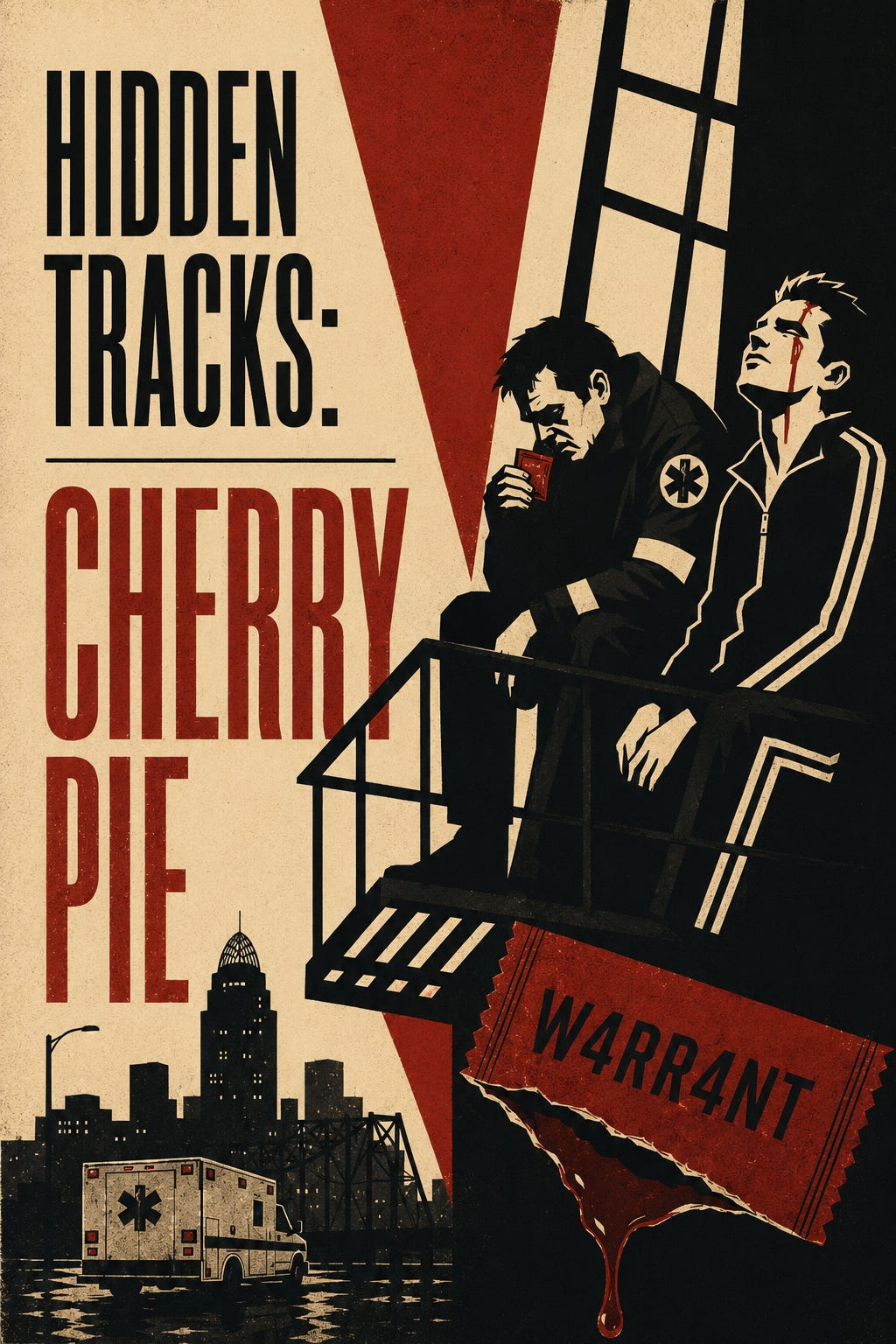
It was 3:00 a.m. in Cincinnati.
Vance sat in the driver’s seat of Rig 14 with a back that had been forty-five for the last six years. Snowmelt hissed under the tires. The heater coughed dry air at his knees. He reached into the diagnostic kit on the dash, past the sterile gauze, the Narcan, the trauma shears.
In the bottom corner sat a small red sachet.
It looked like a packet of fast-food ketchup. No brand name. Just a white label stamped with a string of alphanumeric code ending in W4RR4NT.
Vance didn’t open it. He pressed his thumb against the plastic and felt the soft give inside.
He imagined cinnamon. Warm crust. Sugar bubbling at the edges. Something sweet enough to drown out the smell of piss, road salt, and old ambulance vinyl.
That was all. Just the thought of it.
Enough to keep the gray from swallowing him whole for another few minutes.
“Dispatch says we got a Swinger in OTR,” Miller said.
Miller was new. He still had the shine. He still wore his jacket zipped all the way up like the job might respect him back. He still thought the Bitter spray was a life-saving tool instead of a weapon.
“Which street?” Vance asked.
“Vine. On a fire escape. Caller says he’s been rhythmically head-butting a brick wall for twenty minutes.”
Vance put the rig in gear.
“Hell of a hobby.”
The wipers dragged across the windshield. Storefront gates. Dirty snowbanks. Neon reflected in black slush. Cincinnati in winter looked like a city that had been left out too long and brought back in anyway.
Miller checked the canister on his belt. “Figures it’s OTR.”
Vance glanced at him. “What’s that supposed to mean?”
Miller shrugged. “Known area. High utilization. We’ve run this block three times this month.” He said it the way someone reads a memo. Already written off.
Vance looked back at the road. “Careful. City might put that on a brochure.”
Miller laughed once, thinking he’d scored something.
“You think he’s deep in it?” he asked.
Vance turned onto Vine. “Nobody calls us when they’re having a good night.”
They found him three stories up.
Thin tracksuit. No coat. No gloves.
He stood on the fire escape landing, rocking on his heels with the patience of a metronome. Forward. Back. Forward. Back. Every few seconds he tipped into the brick wall in front of him.
Thud.
Creak.
Thud.
Creak.
Vance climbed first. The metal stairs shook under his boots. The man didn’t turn.
Up close, he looked younger than Vance had expected. Late twenties maybe. His forehead was split open in a wet red crescent. Blood ran down the bridge of his nose and over his lips. His eyes were wide and leaking clear, steady streams of tears.
His mouth was stretched into a smile so wide it showed every tooth.
Pink foam clung to the corners.
“Sir,” Vance said, calm and low, “you need to stop moving.”
The man gave a little shiver, like someone had spoken to him from far away. His tongue slipped out and caught one of the tears running down his cheek. He smiled wider.
“Hit him with the Bitter,” Miller shouted from below.
Vance looked down. Miller was on the sidewalk with one hand on the rail, already reaching for his own canister.
“Vance.”
“I heard you.”
He pulled the spray from his belt anyway.
The Bitter was a sensory overwrite. Department issue. Pressurized silver canister with a black trigger and a warning label wrapped around the middle. It tasted, according to training, like copper and burnt hair. In the field it usually tasted vomit and betrayal.
Officially, it interrupted euphoric dissociation.
Unofficially, it brought people back to the part of the world that hurt.
Vance looked at the man again.
The man looked back this time, really looked at him, and his face changed. Not recognition. Not fear.
Gratitude.
He smiled so hard the skin split at the corners of his mouth.
A fresh thread of blood ran down his chin.
“Why aren’t you spraying him?” Miller called.
“He’s concussed,” Vance said.
“He’s frying. Use the protocol.”
Vance kept hold of the canister, but his thumb eased off the trigger.
The man rocked forward.
Thud.
He rocked back, laughing soundlessly now, eyes wet and shining.
Thud.
Vance saw the red sachet in his mind. Saw his own thumb pressing into it. Saw the ugly little mercy of it.
Ten years of overdoses. Ten years of bad apartments and back alleys. Ten years of screaming mothers and dead bathrooms. Ten years of winter in a city that could make concrete look tired.
Somewhere in a building with good windows, someone was reading a quarterly report they liked. Clean saves, tallied in a column, converted into something that bought a view of a different city entirely.
Dirty, rotten, filthy, stinking rich.
Below him, Miller barked, “Vance.”
The man on the landing whispered something.
Vance leaned closer. “What?”
The man’s lips trembled. His teeth were pink.
“She said,” he whispered, “there’d be enough for everybody.”
Vance had heard that before. Not those words exactly. The promise under them.
Enough for everybody.
Gone before you understood what you’d swallowed.
He had her in his pocket.
Then the man tipped forward again.
Vance caught him by the shoulder before his forehead hit the brick. The tracksuit was soaked through and ice cold. Under Vance’s hand, the pulse was rapid and irregular.
“Why aren’t you spraying him?” Miller said again, and now there was anger in it. Fear, too. The kind that always dressed itself up as procedure.
Vance looked over the rail at him.
“He’s happy, Miller.”
“He’s dying.”
“Yeah.”
“Then do your job.”
Vance stared at the Bitter canister in his hand.
He thought about all the times he’d used it. The way people came back gasping, clawing, sobbing, their heaven burned out of them in one breath.
Like dragging someone back into misery counted as a clean save.
Vance holstered the canister.
Then, slowly, he sat down beside the man on the landing.
The metal grumbled under his weight.
The man turned and looked at him with that same wrecked, grateful smile.
Vance matched his rhythm.
Forward.
Back.
Forward.
Back.
Below them, Miller swore. “Vance, what the hell are you doing?”
Vance kept rocking.
“Nobody calls us when they’re having a good night,” he said.
The man didn’t answer.
Below them, the city kept going.
After a while, the man’s eyes fluttered. His smile loosened. His head sagged against the brick.
Vance reached into his jacket pocket.
He felt the small red sachet between two fingers and pulled it out.
Even in the dark it looked cheap. Stupid. Bright as a toy.
Down on the sidewalk, Miller squinted up at it.
“Vance,” he said. “What is that?”
Vance turned the packet over in his hand. White label. Black code. W4RR4NT.
He pinched the corner.
Miller saw the motion and went still for half a beat.
Then he started up the stairs.
“Vance, don’t.”
The metal steps rang under his boots.
Vance tore the packet open with his teeth.
The smell hit him first.
Cinnamon. Butter. Hot sugar. Something fresh from an oven that did not exist anywhere in this city.
Miller climbed faster. “Vance.”
Vance closed his eyes.
His shoulders dropped.
His mouth filled with saliva.
On the landing beside him, the man made a small sound.
Vance tipped the sachet into his palm.
Dark red syrup glistened under the fire escape light.
“Don’t do that,” Miller said, closer now, voice gone thin. “Jesus Christ, Vance, don’t.”
Vance touched one finger to the syrup.
“Vance.”
He put the finger on his tongue.
Miller lunged the last two steps, hand out, but too late.
The city vanished.
The liner notes are below. Song, schematic, what got cut.
01 — The analog connection
The thumb on the plastic
“Cherry Pie” is pure appetite. No consequences, no morning after, no weight to any of it. Jani Lane wrote it in fifteen minutes on a napkin because the label wanted a hit and he delivered one and spent the rest of his life being defined by it. The song is about wanting something sweet and taking it and that being the whole story.
Vance has been carrying the sachet for months. Small red packet. White label. Black code. W4RR4NT, because somebody in the supply chain thought that was funny. He presses his thumb into the plastic during the bad runs and imagines cinnamon and warm crust and sugar bubbling at the edges. He doesn’t open it. That’s the song sitting in the diagnostic kit. The song is what’s inside. The story is the thumb on the plastic, and then one night on a fire escape in OTR it’s the teeth on the corner of the packet.
The story clicked in on the label. W4RR4NT. The joke is in there twice, the band name and the word warrant, authorization, official permission. Vance has been waiting for somebody to authorize what he already knows. The sachet is his own permission slip, cheap and stupid and bright as a toy, sitting in the bottom corner of a kit designed to keep people alive.
02 — The technical schematic
The Bitter spray
Department issue. Pressurized silver canister, black trigger, warning label wrapped around the middle. Sensory overwrite. Interrupts euphoric dissociation. According to training it tastes like copper and burnt hair. According to field experience it tastes like vomit and betrayal, which is the most honest thing in the story and it’s in parentheses.
The Bitter brings people back to the part of the world that hurts. That’s the function. The department calls this a clean save. The quarterly report converts it into a number in a column that buys someone a view of a different city entirely. The canister works perfectly. It does exactly what it was designed to do. Vance has used it for ten years and he knows exactly how it works and what it costs the person on the receiving end.
The wrongness is entirely in the accounting. A clean save is defined as bringing someone back. It is not defined as what they come back to. The canister has no column for that. Miller reaches for his when things get uncertain, the way people reach for procedure when the actual question is too heavy to hold. Vance holsters his. That’s the schematic. Two men, same tool, completely different understanding of what it’s for.
03 — Riff/beat alignment
The title drop and sitting down on the landing
The song’s title drop is its whole move. Lane just says the thing directly, no apology, no setup, no metaphor. Cherry pie. That’s it. The song commits to its own appetite without hedging and that commitment is what makes it what it is, absurd and irresistible in equal measure.
“Vance holstered the canister. Then, slowly, he sat down beside the man on the landing. The metal grumbled under his weight. The man turned and looked at him with that same wrecked, grateful smile. Vance matched his rhythm. Forward. Back. Forward. Back.”
That’s the story’s title drop. No more procedure. No more canister. No explanation to Miller, no internal monologue, no thesis statement about the system. Vance just sits down and matches the man’s rhythm. Four words, repeated twice, doing the work of everything the story has been building toward. The song commits without hedging. Vance commits without hedging. Miller is still on the sidewalk yelling about protocol and neither of them is listening anymore.
I had three sentences after “Forward. Back.” that explained what Vance was feeling in that moment. Cut all of them. The rhythm explains itself. Anything after it is the story losing its nerve.
04 — The Stephen King ledger
The clean save problem
Version I killed
“He thought about every time he’d used it. The way people came back into their pain like they’d never left, gasping for air in a world that had been waiting to resume billing them the whole time he’d had them under.”
Version I kept
“He thought about all the times he’d used it. The way people came back gasping, clawing, sobbing, their heaven burned out of them in one breath. Like dragging someone back into misery counted as a clean save.”
The first version is Vance being articulate about systemic failure, which is not how Vance thinks. Vance thinks in ten-year increments and winter cities and the smell of old ambulance vinyl. “Waiting to resume billing them” is policy language dressed up as feeling. The second version stays physical. Gasping. Clawing. Sobbing. Heaven burned out in one breath. Then the thesis lands plain and ugly. “Like dragging someone back into misery counted as a clean save.” That sentence is Vance at his most articulate and it’s still blunt enough to bruise. The first version was me writing around the thought. The second version is the thought.
05 — For paid subscribers
Think about a job you did, or watched someone do, where the official metric for success didn’t match what success actually looked like on the ground. Not the dramatic version. The ordinary one. The call center script that didn’t cover what the caller actually needed. The discharge paperwork signed before anyone was ready. The quarterly number that looked clean from a conference room and meant something else entirely at street level. Think about the gap between the column and the reality, and whether anybody in the building with good windows ever asked about it.