
Hidden Tracks: Disposable Heroes
Born to Die. Reborn to Try Again.

Hidden Tracks takes its titles from songs I heard when I was the right age to let them all the way in. Then it drags them somewhere darker than the lyrics were ever willing to go. You don’t need to know the songs to get the stories. But if you do, they’re going to sit differently after this.
See all Hidden Tracks stories →
The factory smelled of burnt hair and sterilized water. A low industrial hum vibrated in Arthur’s molars
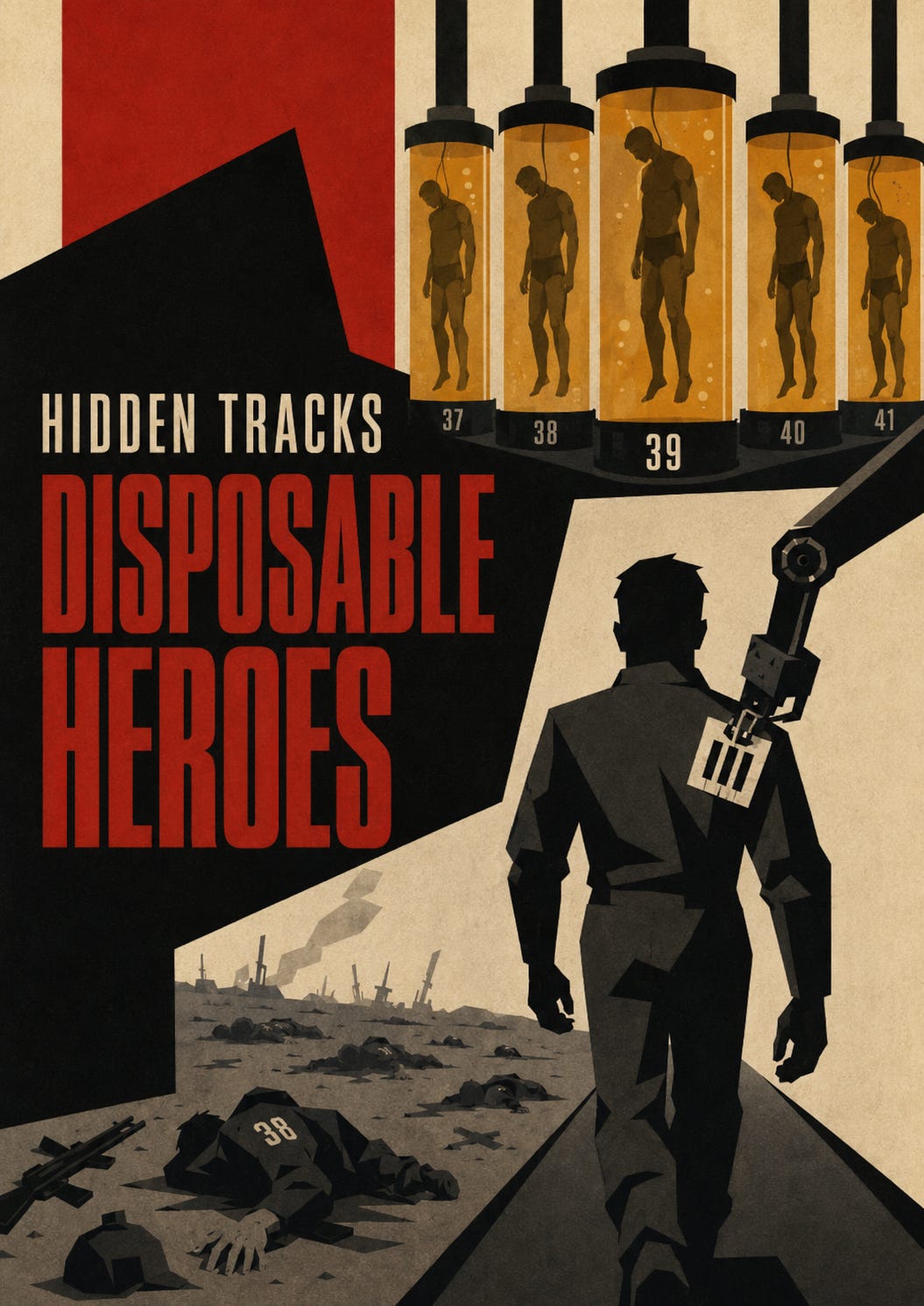
He sat on a cold steel bench while a mechanical arm stapled his stripes into the meat of his shoulder. The pain stayed somewhere far away, like it belonged to the man in the next tank. Across from him, a conveyor carried glass cylinders. Inside each one, a version of him floated in amber fluid, eyes closed, lungs working at liquid.
“Forty-Two is ready,” a voice crackled over the intercom.
Arthur stared at the “39” stenciled on his wrist. Already old stock. He looked at the Sergeant, feeding a belt of ammunition into a machine. No name tag. Just a serial number cut into the soft skin of his throat.
“I remember the sun,” Arthur said.
The Sergeant stopped. He didn’t look up. “No you don’t. You remember a simulation of the sun. It’s cheaper to program the warmth than to let you actually stand in it.”
“It felt real. The heat on my neck.”
“The heat was a fever. You were dying in a trench in Sector Six.” The Sergeant’s hands didn’t pause.
“A servant ‘til I fall,” Arthur whispered, gentle as a lie.
The Sergeant finally looked at him. His eyes were milky, the color of wet slate.
“And you’re falling behind schedule,” the Sergeant said.
The back wall retracted.
Beyond it lay the fields. A carpet of gray limbs and broken rifles, discarded Arthurs with their numbers fading into mud.
His legs carried him forward anyway.
He stepped over Thirty-Eight. The torso twitched, fingers clawing at the muck, searching for a gun that wasn’t there.
The first shell whistled in. Arthur didn’t raise his rifle.
The liner notes are below. Song, schematic, what got cut.
01 — The analog connection
Past the point where rage is available
“Disposable Heroes” is the angriest song on Master of Puppets and it’s angry on behalf of people who aren’t allowed to be angry themselves. Hetfield isn’t writing from inside the soldier. He’s writing from outside, watching the machine consume men and stamp them with duty and feed them forward and replenish the supply when the yield drops. The song’s rage is an external thing. A witness rage. It sees what the soldier inside the machine can’t afford to feel.
The story flips that position. Arthur is inside. He can see the conveyor. He knows his serial number. He watched Thirty-Eight twitching in the mud reaching for a gun that wasn’t there. He can see Forty-Two floating in amber fluid, already queued. He has all the information the song’s rage is based on, and he walks forward anyway. Not because he believes anything. Because his legs carry him. The story is what’s left of a person after the machine has processed out everything the song is angry about.
The line locked it in. “A servant ‘til I fall,” Arthur whispered, gentle as a lie. Hetfield screams that line. Arthur whispers it. The song’s central lyric delivered as a lullaby, worn smooth by repetition, coming out soft because it’s been said so many times inside Arthur’s head that it stopped having edges. That’s what processed past rage sounds like. Not broken. Just done.
02 — The technical schematic
The conveyor
Standard industrial conveyor. Belt-driven. Glass cylinders in fixed cradles, spaced at regular intervals, moving at a rate calibrated to match projected field losses. Inside each cylinder, a version of Arthur floats in amber fluid with his eyes closed and his lungs working at liquid. Not dead. Not awake. In process.
Forty-Two is ready before Arthur ships. That’s the inventory math. The production line is running ahead of the expenditure line, which means the operation has modeled Arthur’s lifespan accurately enough to have his replacement cultured and staged before he’s finished dying. He can see this from the bench where the mechanical arm is stapling his stripes in. The conveyor is visible from his seat. The production schedule is not a secret.
The wrongness is in what the transparency costs. Arthur knows he’s old stock. The system isn’t hiding it. It doesn’t need to hide it because knowing doesn’t change the output. He walks forward anyway. The conveyor runs whether he looks at it or not. A machine that operates in plain sight because the people it’s processing have been engineered past the point where seeing it matters.
03 — Riff/beat alignment
The locked groove and the legs that carry him
The song’s main riff doesn’t vary. Six and a half minutes of the same relentless locked-groove assault, the tempo not shifting, the pattern not opening up into something different. It doesn’t build toward resolution. It just runs. The riff is the machine. The machine doesn’t ask. It operates.
“His legs carried him forward anyway. He stepped over Thirty-Eight. The torso twitched, fingers clawing at the muck, searching for a gun that wasn’t there. The first shell whistled in. Arthur didn’t raise his rifle.”
His legs carried him forward anyway. Not Arthur walked forward. Not Arthur decided. His legs carried him. The riff running whether anyone is listening or not. I wrote four different versions of that final movement and every one that gave Arthur a thought or a feeling or a last look at something slowed the riff down. The story needed to end at the same tempo it had been running. Cold bench. Mechanical arm. Conveyor. Fields. Thirty-Eight in the mud. Shell incoming. Rifle not raised. The riff doesn’t stop for the ending. The ending just happens inside it.
04 — The Stephen King ledger
Gentle as a lie
Version I killed
“A servant ‘til I fall,” Arthur said, and his voice came out quiet, worn down, the words stripped of whatever meaning they’d once carried by the number of times they’d passed through him on the way to somewhere else.”
Version I kept
“A servant ‘til I fall,” Arthur whispered, gentle as a lie.”
The first version explains the whisper. It tells you the words are worn down and why they’re worn down and what that wearing down represents. It takes something that should land in half a second and stretches it into a paragraph of annotation. The second version is three words after the comma. Gentle as a lie. The gentleness is the horror. Lies that have been told long enough go smooth. They stop requiring effort. They come out soft and easy because the teller has stopped fighting them. Arthur isn’t fighting anything anymore. The sentence ends there because that’s where Arthur ends. Everything after is just the legs carrying him forward.
Think about something you say to yourself regularly that started as a belief and has become a reflex. Not the dramatic version. The quiet one. The thing you tell yourself about your job, your situation, your role, that used to require some convincing and now just comes out. Think about when it stopped requiring convincing, and what was happening at the time, and whether the smoothness of it now feels like peace or like something else entirely.

Holy flip—the sheer unthinking cruelty! A great and timely piece about man's inhumanity to man.
Back to the front! Love this. Well done.