
I'm My Own Grandpa
A Circular Parentage Error

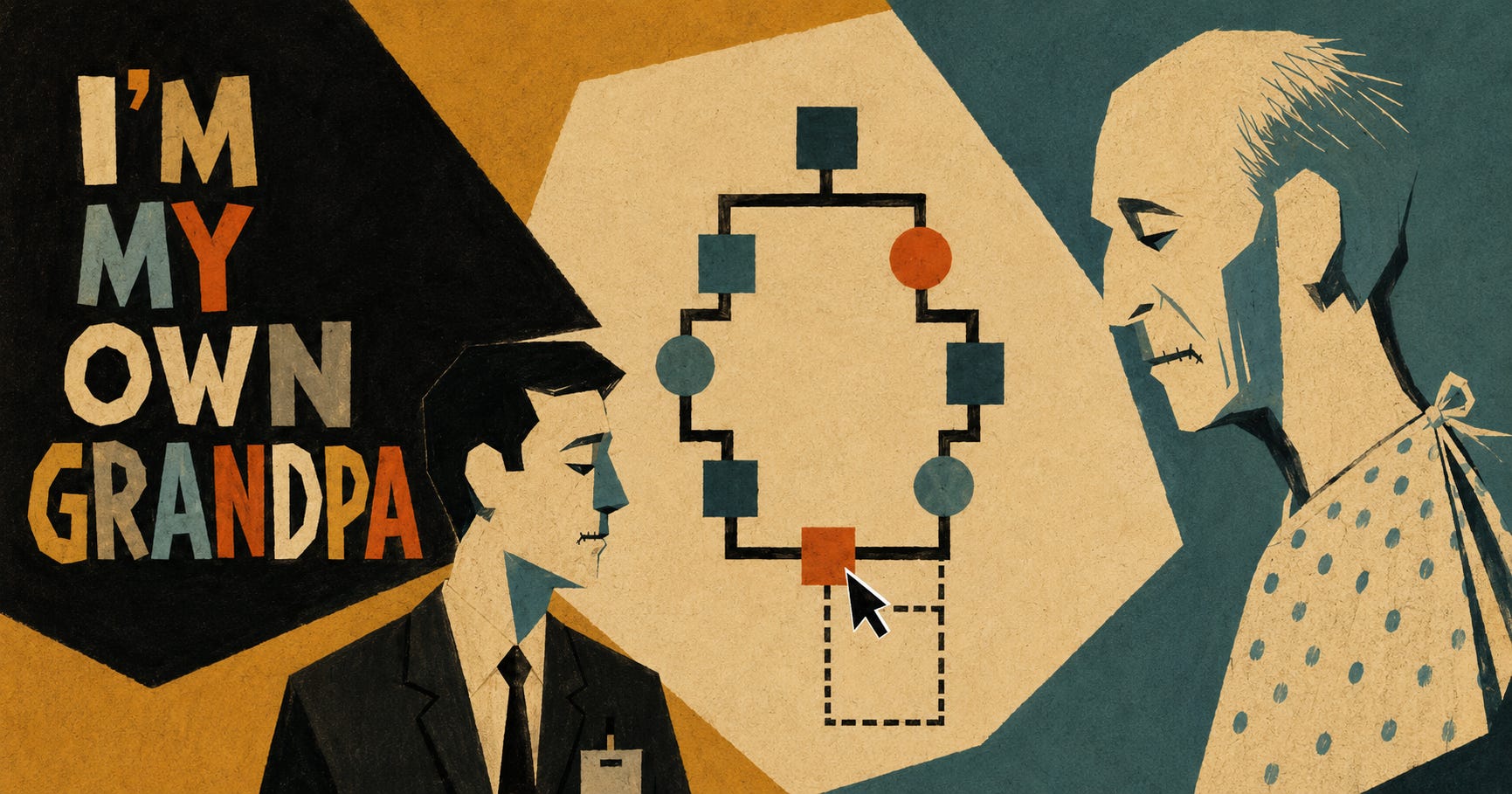
The coffee’s cold by the time I notice my own name in the error queue.
Not unusual. The genealogy database flags duplicates all the time. People with common names, data entry mistakes, the usual garbage that comes with digitizing records. I’ve been clearing these flags for three years. It’s not interesting work, but it pays.
This one’s been kicked back to me four times this month. Circular parentage error in my own family tree. I kept punting it to my supervisor because working on your own file feels like a conflict of interest, but yesterday he told me to just handle it. “Probably a duplicate Charles Douglas from the 1900s. Merge the records and move on.”
I pull up the file.
My parents are correct. Birth certificates match. Then my grandparents. My grandfather, Charles Douglas Sr., submitted his DNA sample in August 1993. Medical research study. He died two weeks later.
There’s a photo attached to his intake form.
I open it.
An old man. Seventy-something. Thin hair, hospital gown, the gray look of someone dying. But I recognize the mouth. The cleft lip. His repair is older work, cruder, the scar sitting higher than mine. But the underlying shape is the same. The left nostril drifting upward the way mine does. The asymmetry that lives in the bone, not the surgery.
It’s unsettling, but not impossible. Genetic inheritance. I got his face.
Except.
There’s a match percentage field at the bottom of the screen. For grandparent and grandchild, it should show approximately 50%. Shared DNA.
It shows 100%.
I pull up my own intake record from 2021. Employee benefit. Free genetic screening. I open the sequence data.
Then I open my grandfather’s sequence from 1993.
I compare them side by side.
They’re identical.
Not similar. Not close. Identical. Every marker. Every sequence. The system isn’t showing inheritance. It’s showing the same person.
My hands are shaking.
I check the file again. There’s a notation in the comments field I missed before: “Sample replicated per Gen-C protocol.”
I don’t know what Gen-C protocol is.
I shouldn’t look. I should flag this for my supervisor and let someone above my pay grade figure it out. But I’ve got database access. Full admin privileges for error resolution.
I search “Gen-C protocol” in the internal memo system.
Most of it’s redacted. But there are fragments:
“...generational continuity requires viable replication...”
“...samples stored for future phenotype expression...”
“...consent obtained from initial participant covers derivative instances...”
There’s a PDF. A scanned consent form from 1993. I open it.
It’s signed by Charles Douglas Sr.
The handwriting is mine.
I know my own signature. The way I loop the ‘g’ in Douglas. The flat line I use for the middle stroke in ‘E’ when I initial things. C.E.D.
I signed this form in 1993.
One year before I was born.
I search my email. Find old scanned records. My parents’ fertility treatment from 1993. Consent forms. Standard legal language about donor material and clinical procedures.
They wanted a baby. They’d been trying for years.
The clinic had a sample.
My dad used to say I looked exactly like his father. “You’re the spitting image,” he’d say. “It’s like having him back.”
He thought it was genetics. Normal inheritance.
The database error is still flagged on my screen. Circular parentage. The system thinks I’m my own grandfather because I am.
My father’s DNA is his own. Born 1972. Regular conception.
But mine isn’t.
Charles Douglas Sr., 1993. Charles Douglas III, 1994.
Same sample.
There are two buttons at the bottom of the screen: “Flag as Error” or “Mark Resolved.”
I move the cursor between them.
If I flag it, it goes back into the queue. Someone else will see it. Maybe they’ll dig deeper. Maybe they already know. Maybe this is the part where I find out what happens to people who find out.
If I mark it resolved, I’m confirming the data is accurate.
The monitor hums. My coffee is cold. I haven’t moved in four minutes. I know because the screen saver almost kicked in and I had to touch the mouse to stop it.
I don’t know what my grandfather wanted. Whether he knew what he was signing. Whether the man in the hospital gown, dying, understood that the consent covered me. Covered whatever I am.
Whether he would have cared.
I move the cursor to “Mark Resolved.”
I don’t click it.
This story isn’t alone…
You’ll find more in No Kings.
