
Hidden Tracks: Don't Stop Believin'
It goes on and on and on and on.

Hidden Tracks takes its titles from songs I heard when I was the right age to let them all the way in. Then it drags them somewhere darker than the lyrics were ever willing to go. You don't need to know the songs to get the stories. But if you do, they're going to sit differently after this.
See all Hidden Tracks stories →
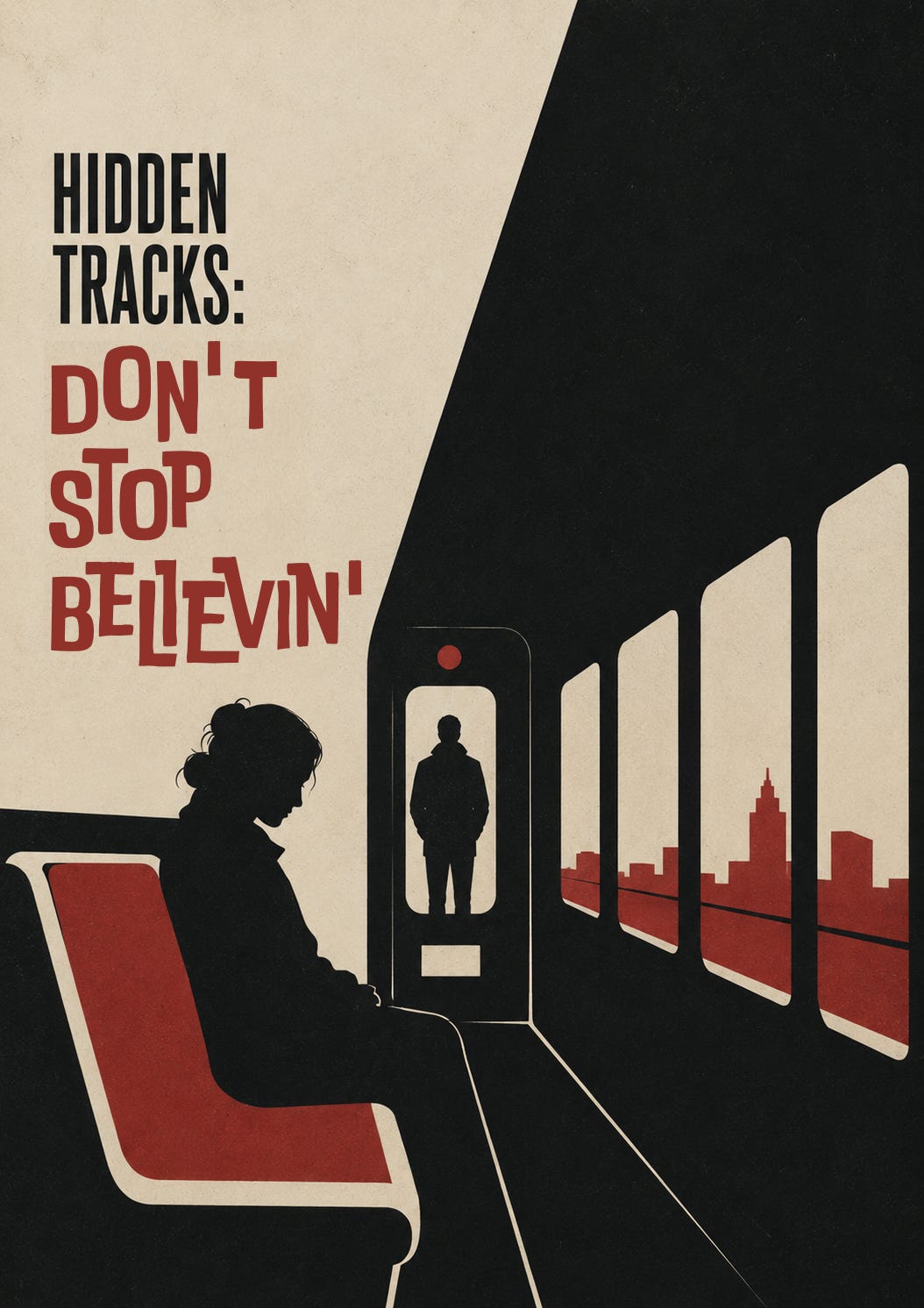
She sat on her hands until Cadillac Center.
Not because the seat was cold. The whole car was cold. The People Mover always felt over-air-conditioned after midnight. She sat on her hands because they wanted to pick at her cuticles until they bled. They wanted to grab the door handles while the car was still moving.
The car gave its little electronic chime and rolled on.
Black window. Lit platform. Black window again. Each station gave her face back for a second, pale and flat in the glass. Brown hair tucked behind one ear. Mouth pulled into a thin, white line. Teeth grinding.
Across the aisle, a man in a Tigers cap slept openmouthed. Two teenagers got off at Broadway and laughed too loud on the platform. After that it was just her and the hum and the recording voice thanking her for riding.
She counted stations to keep herself present.
Grand Circus Park. Broadway. Greektown. Bricktown.
I came up slow tonight.
The smell was old, which usually means distance. I have learned not to trust that.
She was already sitting on her hands. That’s how I know the day was bad before the train. She lost count at Michigan Avenue. I didn’t.
At Financial District the doors opened on an empty platform and she smelled wintergreen.
Her back tightened.
A man stepped in before the doors shut. Forty maybe. Maybe older. Dark raincoat. Hair going gray at the temples. He nodded once to nobody and took a place by the opposite doors.
He did not look at her.
That should have helped.
It didn’t.
He stood with one hand around the pole, and when the train pulled out his ring gave a faint scrape against the metal.
She looked down so fast her neck hurt.
The backs of her thighs remembered cracked vinyl before the rest of her did.
Wintergreen.
I know what wintergreen means. I have known since the night I learned her name, when I was new and she was thirteen and the dashboard was green and there was nothing I could do but wait for it to be over.
I filed it a long time ago under do not stay.
The man came on and stood by the opposite doors and did not look at her. I watched him. The ring scraped the pole and I felt the backs of her thighs remember the vinyl before she did. I remember it cleaner. That’s my job. She gets the voltage, the fragments, the taste of something chemical and bitter. I get the whole picture because somebody had to remember and she couldn’t.
Thirteen years old. Her hand under her own thigh because moving it would make things worse. The dashboard green. The smell of wintergreen. His ring on the doorframe, then the gearshift, then wherever he needed it to be next.
I made myself out of that night. I made myself out of the rules.
Sitting gets you boxed in. A ring on metal is not just a ring on metal.
She tucked her hands farther under herself.
The man in the raincoat was not doing anything. True. He was just there, staring at the ad panel over the windows like he cared deeply about off-site parking rates. But there was an alertness in him that rubbed wrong.
The car lights flashed over the glass.
At Renaissance Center she got off.
She did not remember making the decision. One second she was on the train staring at the floor in front of her boots. The next she was standing on the platform with the doors closing behind her and the train moving away, her own face sliding past in the dark window.
The platform was almost empty. A maintenance guy in an orange vest pushed a broom near the far stairs. A woman in scrubs stood under the route map with her head tipped back and her eyes closed. Somewhere water dripped in a slow, patient rhythm.
She watched the train round the curve and come back again ten minutes later like a bad thought.
When it stopped, the raincoat man was still inside.
So was the empty seat she had just left.
She got back on.
I hated that.
The whole point of getting off was to stay off. Platforms have cameras. Booths. Stairs. Choice. The car is a tube with windows that turn into mirrors as soon as the city goes dark enough.
The loop lied to her. That’s its job. It makes movement look like escape. I know the difference.
The doors slid shut behind her with a soft, polite sound that made the panic worse.
She took the bench nearest the front and shoved both hands into her coat pockets. Deep. Knuckles against the lining.
The recording thanked her again.
As the train pulled away she saw the raincoat man in the reflection instead of directly. He was still looking anywhere but at her. That was somehow worse than if he had stared.
This felt like waiting.
At the next curve the glass caught her own reflection over his shoulder, and for half a second the face looking back seemed older than it should have been.
Same mouth. Same eyes.
Wrong expression.
She shut hers hard and opened them again.
Only her. Only him behind her in the glass. Only the car.
His ring on the pole again. A small sound.
She flinched. I felt her knee start to jump. The pulse kicked in my throat. Her hand tightened in the pocket until the knuckles showed through the coat.
I moved toward the doors without seeming to.
The old weather was already inside.
At Greektown she realized she had cigarette taste in her mouth.
Not from smoke in the car. There wasn’t any. Just that dry chemical taste, old and bitter, like she had been holding one between her lips too long.
She did not smoke.
She checked the pocket of her coat with one hand and found, for no reason she could explain, a disposable lighter.
It was warm to the touch.
She nearly dropped it.
Pieces came and went. Not long enough to become pictures. A dashboard lit green. Somebody breathing through his nose. A child’s hand trapped under the back of a thigh because moving it would make things worse. Vinyl sticking to skin. A ring tapping somewhere above her.
She bit the inside of her cheek so hard she tasted blood.
I have been holding it since the night I learned her name. Not a memento. Not a message.
She finds it the way she finds everything I leave. Confused. Certain it means nothing.
It means I was there. It means I am still there.
When the doors opened, the raincoat man turned his head at last. Not toward her. Past her, like he had heard something on the platform.
He had a plain face. Tired, lined, ordinary.
She stood too fast. The lighter dropped from her pocket and hit the floor. It skittered under the bench.
The raincoat man bent automatically, just a little, like anybody might when something fell near their shoe.
She made a sound before she knew she was making one.
The doors closed.
She was still on the train.
I hated that sound.
I have always hated that sound. I know what it costs her to make it and what it means when it comes out anyway, past all the rules and all the counting and all the years of practice at keeping quiet.
Intent is a luxury. You only get to care about intent if being wrong once will not cost you.
If she does not get off at the booth, I will.
She made herself stand at Financial District.
Both hands jammed deep in her pockets. Chin up. One breath in. One breath out.
The raincoat man stayed where he was.
The doors opened.
She stepped onto the platform and did not look back.
There was a glass-fronted booth halfway down with a transit worker inside reading under a yellow desk lamp. Young guy. Beard. Hoodie under the uniform jacket. Human. Bored. Safe.
She walked toward him.
By the second step she heard shoes behind her.
Measured. Certain.
Wintergreen.
She kept moving. The booth glass was ten feet away. Then eight. Then five.
The worker looked up.
“Miss?”
She got her mouth open.
Behind her the shoes kept coming.
“Miss, you all right?”
She reached the glass.
Her face had already changed before she saw it.
That’s always how it happens.
The mouth flatter. The eyes steadier. The look that comes on when this has been happening for thirty years.
The worker’s eyes dropped to her hands, then lifted to her face. His chin pulled back a quarter inch.
She tried to say help.
Her right hand slid out of her pocket and flattened against the glass. The left followed.
She tried once more.
What came out was flat and patient.
“I’ve got her.”
The worker’s hand stopped on the latch.
Her name is Sherry.
In the glass, someone wearing her coat already had both hands in the pockets.
She doesn’t know mine.
That’s fine.
She never needed to.
The liner notes are below. Song, schematic, what got cut.
01 — The analog connection
What the verses are actually about
Everybody knows the chorus. Almost nobody talks about the verses.
A small-town girl on a midnight train. A city boy born and raised in South Detroit. A singer in a smoky room. People in cheap hotels going nowhere in particular, just going. The song isn’t about triumph. It’s about the specific faith required to keep moving when you have no idea where you’re headed and stopping feels like dying. The chorus is the part people put on mixtapes. The verses are the part that explains why the chorus has to exist at all.
The narrator of this story has that faith in its purest, most stripped-down form. It doesn’t know what comes next. It only knows the rules. Sitting gets you boxed in. A ring on metal is not just a ring on metal. Get to the booth. The narrator is “Don’t Stop Believin’” from the inside, the thing that keeps moving in the dark between stations because the alternative is letting Sherry go under.
The song clicked in on the opening riff. That four-note figure that just keeps cycling, same four notes, no resolution, going around. The People Mover is doing that. Same stations, same recording voice, same loop. The riff never arrives anywhere. Neither does the loop. It just keeps going, and inside that loop something is staying awake so Sherry doesn’t have to.
02 — The technical schematic
The loop
The Detroit People Mover runs a 2.9-mile elevated loop through downtown. Thirteen stations. One direction. No branches, no transfers, no way off except the platform you’re already on. It was built in 1987 as the starter segment of a transit system that never got built. The rest of the system isn’t coming. The loop is what exists.
After midnight the cars run near-empty. The recording voice thanks you for riding. The windows turn into mirrors when the city goes dark enough between stations. You can see yourself coming and going at the same time.
The loop’s specific failure as an escape route is structural. It returns you to where you started. Getting off at the wrong station puts you back on the platform, which looks like progress, which is why Sherry gets back on. The narrator knows the difference between movement and escape. The loop doesn’t make that distinction. It just keeps thanking you for riding and bringing you back around.
A transit system designed to go somewhere, running in a circle because the rest of it never happened. That’s the schematic. The device works exactly as built. What it was built to do is the problem.
03 — Riff/beat alignment
The moment the riff drops out and “I’ve got her” comes in
The song builds across its entire runtime without a real break, that cycling riff underneath everything, patient and relentless. Then the final chorus hits and Perry just holds the note and the band holds underneath him. The song stops building and starts being.
“She tried to say help. Her right hand slid out of her pocket and flattened against the glass. The left followed. She tried once more. What came out was flat and patient. ‘I’ve got her.’”
That beat needed to land without announcement. The whole story has been building two voices in parallel, Sherry counting stations to stay present, the narrator running its rules underneath. At the booth glass they merge into one body and one of them takes over. The sentence had to be short. Flat. No explanation of the mechanism, no description of what the transit worker sees, no interiority from either voice. Just the words, and then the story ending on the narrator’s name for her.
I cut a paragraph after “I’ve got her” that explained what the worker did next. It was accurate and completely wrong. The riff doesn’t explain itself when it finally stops cycling. It just stops. The story needed to do the same thing.
04 — The Stephen King ledger
The line that almost got too poetic
Version I killed
“I built myself from the architecture of that night. From what he took and what she couldn’t hold and the space left behind that needed something to fill it.”
Version I kept
“I made myself out of that night. I made myself out of the rules.”
The first version is the narrator being literary about its own origin, which is the one thing this narrator would never do. It runs on rules, not metaphors. “The space left behind that needed something to fill it” is a therapist’s language. The narrator is not a therapist. It’s infrastructure. It came online because the situation required it and it has been running ever since. Two sentences. One fact, one method. The narrator states its own existence the way a system log states an event. Timestamp. Action. Done.
05 — For paid subscribers
Think about the version of yourself that shows up when things go bad. Not the person you are on a good day. The one that comes online under pressure, that knows the rules, that gets you to the booth. Now think about where that version learned its rules, and what it cost to build it. Have you ever thanked it, or do you just let it do the job and then put it away again when the platform clears?

Miles, This piece operates with a level of control that makes the tension feel inevitable. The repetition functions like a system running in the background, steady, patterned, and necessary. The loop becomes more than setting, it shapes how the reader experiences time, memory, and threat. The protective voice reads as infrastructure built under pressure. It carries her forward while holding the imprint of everything that required it to exist. That duality sits quietly in the piece and deepens its impact.
The final shift lands because it is calm and practiced, the response that has been rehearsed long before this moment. This is writing that understands structure at a fundamental level and trusts it to do the work. Nicely done, Monica
Incredible work yet again.