
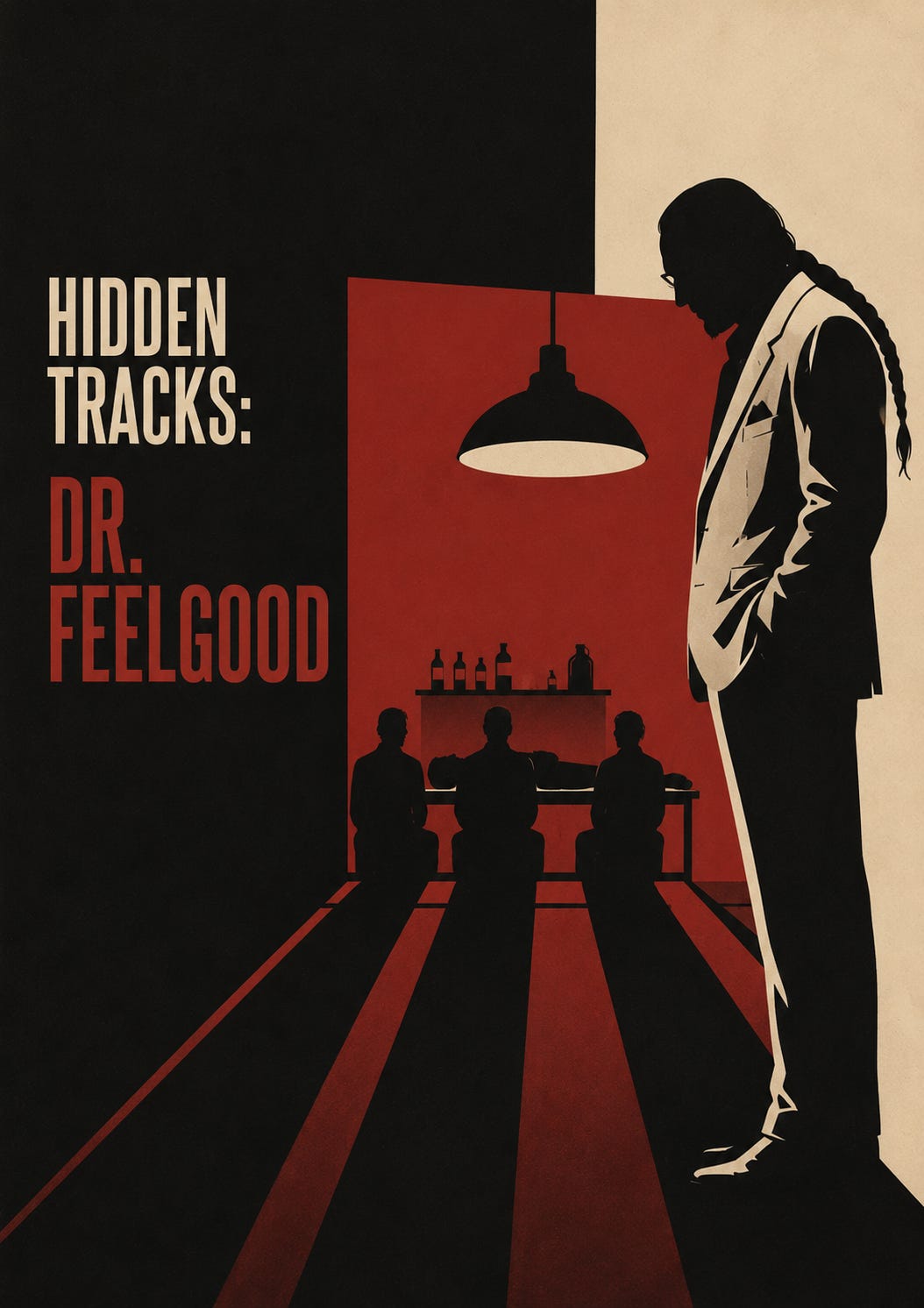
Hidden Tracks: Dr. Feelgood
They call this Jimmy's town.

Hidden Tracks takes its titles from songs I heard when I was the right age to let them all the way in. Then it drags them somewhere darker than the lyrics were ever willing to go. You don’t need to know the songs to get the stories. But if you do, they’re going to sit differently after this.
See all Hidden Tracks stories →
By the time I was fourteen, I knew three things about Orchard Street.
First, never buy meat from Ramos Market on a Tuesday.
Second, the cops on Bell Avenue only stopped cars if somebody higher up hadn’t been paid yet.
Third, if Rat-Tailed Jimmy offered to fix what hurt, you said no even when yes was the only word left in your mouth.
Especially then.
Nobody called him Rat-Tailed Jimmy to his face, only Dr. Feelgood.
The first time I saw him, he was standing outside the old body shop in a cream-colored suit gone shiny at the elbows, talking through the window of a black Monte Carlo idling at the curb. He had a long braid hanging down his back, thin as a whip. His hairline had started retreating years ago, but he kept the braid like a trophy.
He wasn’t much to look at. Narrow shoulders. Bad skin. Hands too delicate for the rest of him. But everybody on Orchard shifted when he moved. Men twice his size straightened up. Women looked away. Even the street seemed to make room.
If you stayed on Orchard long enough, you heard the stories.
That Jimmy had started out running powder up from the border in a primer-gray Chevy with flames painted on the hood.
That he sold out his own crew and bought half the precinct with the money.
That he kept a room in the back of the body shop where the walls sweated in summer and people came out lighter and smiling like mannequins.
The old men playing dominoes behind Ramos Market had the best version.
“He don’t sell drugs,” one of them told me when I was dumb enough to ask. “He sells tomorrow.”
“What’s that mean?”
The old man shrugged. “Means today starts charging interest.”
The body shop had once been Mendoza & Son Collision. By then the sign was gone and the windows were painted black from the inside. You could walk past at noon and hear nothing. At two in the morning there’d be a line out front that bent around the alley.
“Sugar to the sweet,” people said.
Like it was funny.
Like it wasn’t the kind of joke you made because you were afraid to say the real thing.
My brother Danny went there the summer he turned nineteen.
He’d been skinny already, but that July he changed shape. His cheeks hollowed out. His eyes got huge. He stopped eating at the table and started disappearing after dark. Mom cried in the bathroom with the faucet on. Dad pretended not to notice because pretending was his hobby.
Me, I watched.
That’s the curse of being the younger one. Nobody thinks you know anything, so they say everything in front of you.
“He’s running with Feelgood” Dad muttered one night.
Mom said, “Don’t say it like it’s a promotion.”
Dad drank beer from the can and stared at the TV. “Boy’s still breathing.”
That was how people measured success on Orchard.
Still breathing.
A week later I saw Danny coming out of the body shop at dawn.
He was grinning.
His mouth looked stretched wider than his face knew what to do with. He moved like he’d forgotten he was tired forever. Like every joint had been oiled. He saw me across the street and threw his arms out.
“Mikey,” he said. “You should try it.”
Try what, he wouldn’t say.
Just kept grinning.
Then he hugged me. His heart was hammering through his shirt.
That night he cleaned the whole apartment. I woke up to him singing and found him standing shirtless in the kitchen, staring at his reflection in the microwave door.
His back was covered in staples, running shoulder blade to shoulder blade in curved rows, each one catching the stove light.
I made a noise and he turned too fast.
For a second, I thought somebody else was in there wearing my brother’s skin.
Then he blinked and it was Danny again.
“What happened to your back?”
He smiled, smaller this time.
“Doc tuned me up.”
I thought of waking our parents. Instead I stood there in my underwear while Danny scratched at one of the staples until his fingernail came away pink.
“He’s making me better,” he said.
“Better for what?”
Danny looked at me like I was slow.
“For what’s next.”
Two weeks after I saw the staples, Danny stopped sleeping.
He’d sit on the couch with his knees bouncing, eyes open so wide you could see white all around. He started calling everybody sweetheart. Then one afternoon he grabbed my wrist and squeezed so hard my fingers went numb.
“You ever feel like there’s another you under there?” he asked.
“Under where?”
He tapped my chest. “Under the meat.”
I yanked my hand back. “Danny, cut it out.”
He leaned in, eyes bright and wet. “He can bring it out.”
That night Mom found him in the bathroom with a box cutter and a hand mirror.
He said he was trying to open the seam.
A lot of shouting after that. Danny fought like a dog in a sack, all noise and panic and wild strength. When Dad slammed him into the hallway wall, Danny’s shoulder hit hard enough to tear his T-shirt.
I saw the staples again.
Except now some of them had pulled loose.
Something pale and glossy moved underneath.
Not blood.
Something else.
Dad saw it too. For half a second his whole face emptied out. Then he did what men like him always do when the world presents something impossible.
He got mean.
The next morning Danny was gone.
Dad said he’d put him on a bus to our aunt’s in Dayton.
Mom acted like she believed it.
I didn’t.
Because that night I walked past the body shop and heard Danny singing inside.
I should have kept going. A smart kid would have gone home, locked the door, and spent the rest of his life pretending his family had one less son and that was all.
But Danny was my brother.
The alley beside the shop stank like antifreeze and fruit rot. There was a steel door in back with a little square window painted over in black. I heard voices inside. Men laughing.
“Everybody wants a second chance,” he said. “Few deserve it.”
I looked through a thumb-sized gap where the paint had peeled.
There were six people in the room.
Three of Jimmy’s boys. Jimmy himself. Danny strapped upright to a mechanic’s chair under a floodlamp. And a cop I recognized from Bell Avenue, still in uniform pants, counting money with one hand while the other rested on Danny’s shoulder like they were old friends.
Danny’s chest was open.
The skin hung in neat pale flaps. Metal brackets rode his ribs. Clear tubing ran under the breastbone and disappeared behind him. White packets had been packed into him wherever there was room, tucked beside organs, wedged under wire, stacked tight and careful like merchandise under a car seat at the border.
I could see his heart.
One of the packets twitched each time it beat.
Jimmy stood over him with a staple gun in one hand and something pink and wet in the other.
Danny was awake.
His eyes found the back door. Found me through the crack in the paint.
He smiled.
Jimmy lifted the staple gun. Pressed the edges of Danny’s skin together. Fired once.
Danny jerked hard against the chair.
The staple flashed silver.
Then another.
Then another.
I stumbled back from the door and hit the dumpster hard enough to rattle it.
Inside, the voices stopped.
The lock clicked.
The door opened.
Jimmy stood there in the alley light, cream suit glowing yellow under the bug lamp. Up close he smelled like hair tonic and menthol.
“Mikey” he said.
I’d never told him my name.
I backed up until my shoulders hit brick. “What did you do to him?”
Jimmy sighed, like I’d asked why a muffler needed replacing.
“Your brother came to me broken.”
“He was fine.”
Jimmy gave me a small look at that.
“No,” he said. “He needed help.”
Inside, Danny made a wet choking noise that turned into laughter.
“I’m calling the police.”
Jimmy glanced over his shoulder at the cop in the back room, still counting. Then he looked at me again.
“Go ahead.”
He reached into his jacket and took out a little white packet folded neat as church money.
“Here,” he said. “On the house.”
I stared at it. “What is it?”
“Something to help you understand your brother.”
“I don’t want it.”
“Everybody says that the first time.”
I slapped it out of his hand. It hit the wet pavement and burst.
The powder didn’t fall.
It moved.
Tiny white threads sprang up from the alley like roots finding water. They wriggled over Jimmy’s shoe. Turned toward me. In the yellow light they looked almost delicate.
Jimmy’s face changed.
Behind him, in the shop, I heard Danny start screaming.
Not in pain.
In recognition.
Jimmy looked back once, annoyed now, the mask slipping.
That was when I ran.
I heard him behind me at first. Then not behind me. Then somehow ahead, his voice coming from every darkened storefront on Orchard.
“He can help you too.”
I cut through the laundromat lot, jumped a chain-link fence, tore my hand open on the wire and kept going. I got home bleeding and half blind and found both my parents sitting in the kitchen like they’d been waiting.
Mom was crying.
Dad wouldn’t look at me.
On the table between them sat an envelope.
Dad said, “You went there, even after I told you not to.”
I looked from him to the envelope to Mom’s face.
“You knew.”
Nobody answered.
That was answer enough.
Mom started crying harder, “We were out of options.”
“No.” I looked at Dad. “You were out of money.”
He flinched like I’d spit on him.
“Watch your mouth,” he said, but there was nothing behind it. No father in it.
“How much?” I said. “What was he worth? Rent? Groceries?”
Mom said my name.
Dad stood up too fast, chair legs scraping the linoleum. “I said watch your mouth.”
“You knew what he’d do to him.”
“I kept this family afloat.”
“By letting that bastard pack him full of poison?”
Dad hit me.
He hit me like he’d been waiting to my entire life.
My head snapped sideways. The wall caught me behind the ear and the room flashed white.
Mom screamed.
Then Dad froze.
His hand stayed in the air a second too long, like even it didn’t belong to him anymore.
I tasted blood. Laughed once through it. The sound came out thin and ugly.
Nobody spoke.
Nobody said sorry.
The refrigerator kicked on.
Out on Orchard, a siren passed and kept going.
Dad lowered himself back into the chair like all his bones had come loose at once.
Mom kept staring at the envelope.
And that was when somebody knocked.
Three soft taps.
Nobody moved.
Three more.
Dad went gray.
Mom started praying under her breath.
I opened the door.
Rat-Tailed Jimmy stood there smiling, hands folded in front of him. Behind him, parked at the curb, was the old primer-gray Chevy with flames ghosting under bad paint. Danny sat in the passenger seat.
His skin looked waxy and tight. His eyes shone like fresh nickels. The staples across his throat and collarbone caught the porch light. He smiled at me with our mother’s mouth and somebody else’s patience.
Jimmy held out an envelope.
“We’re all settled now."
I looked past him at Danny.
Danny smiled at me. Then, very carefully, he lifted one hand to his throat and pressed two fingers against the line of staples there, like a man checking a tie knot.
He pushed one staple back in with his thumbnail.
My stomach turned over.
Jimmy said, “Take it.”
For a second nobody in the apartment moved.
Then I slammed the door on his hand and leaned into it. I heard something crack.
He pulled free and the door closed with a thud. There was no blood on the wood.
Then I heard him laugh, the sound of it moving away across the porch. A car door opened. Shut.
The engine turned over.
I stood there with my palm flat to the door, breathing hard.
Nobody in the kitchen said a word.
After a while I looked back.
Mom had both hands over her face.
Dad was staring at the envelope like it might still solve something.
I wanted Danny back.
Instead I locked the deadbolt.
That was twenty-two years ago.
Orchard’s different now. New condos pushing up where the old liquor store used to be. Coffee shops with Edison bulbs. Murals. Yoga. The body shop’s gone. Bell Avenue cops wear body cams and smile for neighborhood outreach photos.
But every city has a street that stays hungry after the buildings change.
Here’s what I know.
Every few months somebody starts talking about a man in an expensive suit doing private business out of a back room somewhere. Different neighborhood. Same pitch.
And sometimes, late, when traffic is thin, I see a primer-gray Chevy at a red light with flames under the paint and a passenger grinning through the glass.
The liner notes are below. Song, schematic, what got cut.
01 — The analog connection
The one person who never got in the car
“Dr. Feelgood” is a love song to a dealer. Tommy Lee and the boys are not interrogating the transaction. They’re celebrating it. He makes them feel good and that’s the whole arrangement and the song doesn’t ask what it costs or who paid for it upstream. The dealer is cool. The dealer is the best thing on the street. The song is written from inside the good feeling and it stays there for the entire runtime.
The narrator of this story is the one person in the song who never got in the car. Mikey watched everybody around him take the transaction at face value. Danny took it. The cop on Bell Avenue took it. Mom and Dad took it at kitchen-table rates, envelope on the formica, nobody making eye contact. Jimmy offered Mikey the same deal on the house and Mikey slapped it out of his hand. The story is what you see when you’re the one standing on the curb watching everybody else climb in.
The song clicked in on the old men behind Ramos Market. “He don’t sell drugs. He sells tomorrow. Means today starts charging interest.” That’s the song’s whole transaction described by two guys playing dominoes who already know how it ends. The song is the pitch. The story is the invoice.
02 — The technical schematic
The staple gun
It’s a pneumatic staple gun. Hardware store tool. Used for upholstery, insulation, subflooring. Drives a metal fastener through material and folds the legs flat on the other side to hold it closed. Fast, clean, reliable. The staples come in strips and load from the bottom.
Jimmy uses it for finish work. He presses the edges of Danny’s skin together, positions the tool, fires. One staple. Two. Three. Each one catches the light silver when it lands. Danny jerks against the chair with each shot and that’s the only sound in the room besides men laughing in the background.
The wrongness is entirely in the application. The gun is doing exactly what it was built to do. It’s closing an opening cleanly and holding it shut. The job is being done correctly. The tool has no opinion about what it’s closing or what’s been packed inside first. It just drives the fastener and moves to the next position. A piece of hardware performing its function with complete indifference to the context. That’s the schematic. Not a weapon. A finishing tool. The distinction is what makes it worse.
03 — Riff/beat alignment
The slide guitar drop and the powder that moves
The opening riff is slow and greasy. That slide guitar sounds like something unhealthy feeling good. It sets the story’s whole temperature, the warm amber of a street that runs on deals everybody pretends are mutual. The riff doesn’t resolve into anything clean. It just keeps sliding, patient and oily, until the band kicks in.
“I slapped it out of his hand. It hit the wet pavement and burst. The powder didn’t fall. It moved. Tiny white threads sprang up from the alley like roots finding water.”
The riff drops out at that moment. Everything before it runs on Orchard Street logic, the warm greasy slide of a neighborhood that has made its accommodations and keeps moving. Then the powder hits the pavement and the threads move toward Mikey and the temperature of the whole story changes. Cold now. Something other than what it was pretending to be. The song does the same thing when the chorus finally arrives at full weight. The riff was never comfortable. It was just familiar. The story runs on the same dynamic and the alley scene is where the familiarity runs out.
04 — The Stephen King ledger
Our mother’s mouth
Version I killed
“Danny smiled at me from the passenger seat, and in the porch light I could see our mother in the shape of his mouth, but behind his eyes there was nothing that belonged to our family anymore, nothing I recognized as my brother.”
Version I kept
“Danny smiled at me with our mother’s mouth and somebody else’s patience.”
The first version is Mikey doing a full inventory of what’s wrong. It takes a beat and a half and explains both the presence of the mother and the absence of the brother in two separate clauses. The second version puts them in the same sentence because that’s what Mikey sees simultaneously, not in sequence. The mouth is familiar. The patience is wrong. Those two things land at the same moment and the sentence ends there because Mikey doesn’t have anything else. He’s fourteen and his brother is sitting in a car with staples in his throat and their mother’s smile on a face that has been repacked from the inside. One sentence. Two pieces of information. No receipt.
05 — For paid subscribers
Think about a transaction your family made before you were old enough to be consulted. Not the dramatic version. The ordinary one. A decision about money, or safety, or what got sacrificed to keep something else running. Think about who in that transaction was standing on the curb watching, and who climbed in the car, and whether the people who climbed in ever explained it to the people who didn’t. Then think about whether the explanation would have changed anything.
Wow this was brutal! But very good. Extremely well written. I’ll never hear the song the same way again.