
Dying Hill

By the third morning, the dog had stopped barking.
That bothered Martin more than the rain.
Rain had rules. It came down, got into your socks, found the crack in your collar, made threats to your knees. Rain was old business. Rain had been filing complaints against his body for years.
But the dog had barked every morning from behind the Farleys’ fence since Martin moved to Ash Road. A thick-chested mutt with a gray muzzle and eyes like wet pennies.
Then three mornings ago, nothing.
Martin stood at the bottom of Dyer Hill with his hood up and his hands jammed into the pockets of his old work coat. The leash was looped around his left wrist, though no dog tugged at the other end.
Habit was a stupid animal. Hard to put down.
The hill waited in front of him.
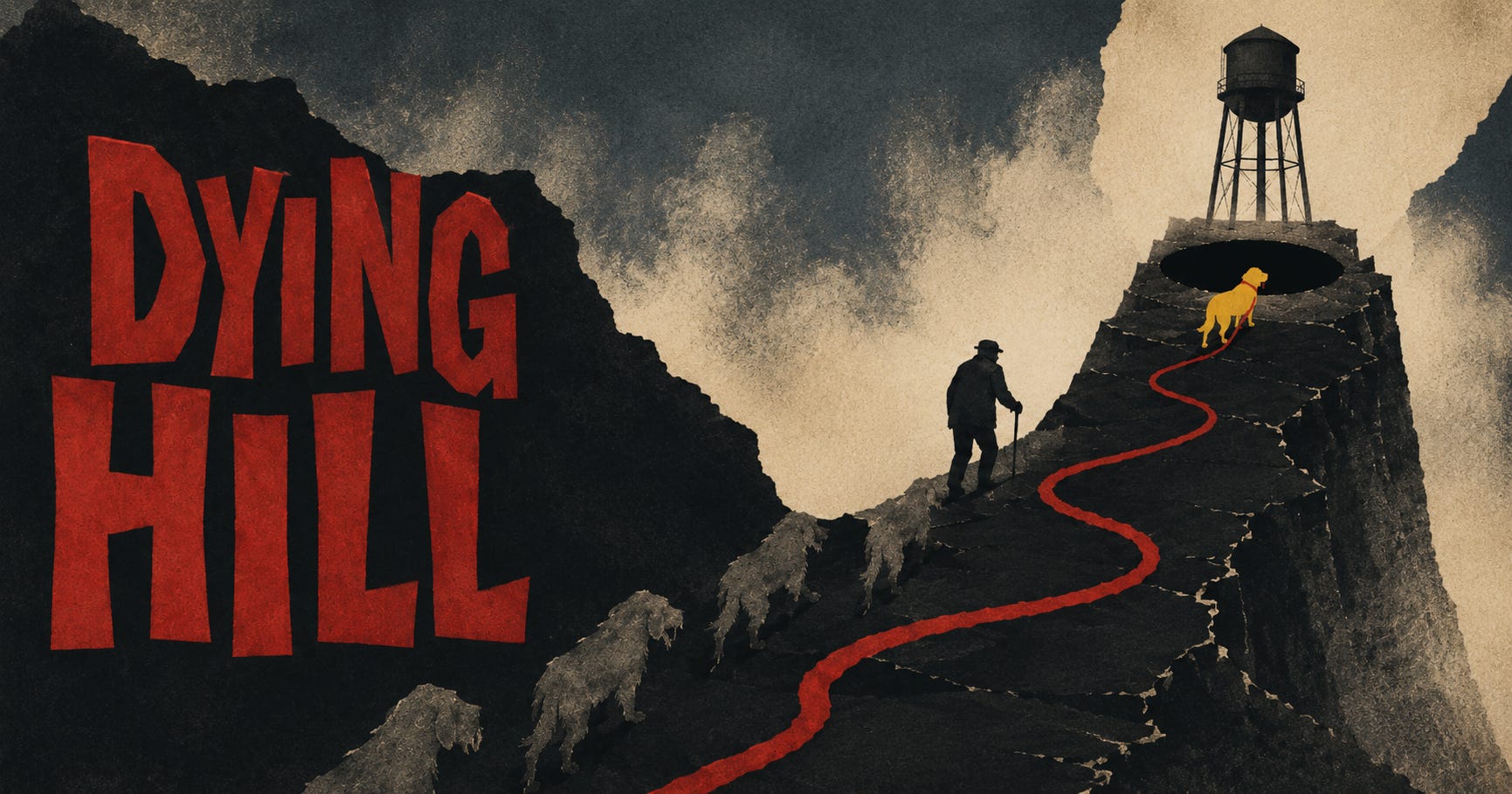
It rose between two rows of bare trees, blacktop cracked down the middle, rainwater running through the split. At the top, barely visible through fog, stood the old water tower. DYER MUNICIPAL was still painted on the side in faded blue letters, though nobody called it Dyer anymore. Not since the town folded into county maps and delivery systems and school districts that pretended no one had ever lived there.
People called it Dying Hill now.
At first it had been a joke. Kids said it because kids liked making the world uglier before it could do the job on its own. Then older folks started using it. Then GPS said it once, according to somebody at the feed store, and that settled it.
Martin flexed his fingers.
The leash slipped against his wrist.
“No reason to go up today,” he said.
The hill did not argue.
Sadie would have been pulling him forward by now. Big yellow mutt. Dumb as a tipped bucket. Loved that hill. Loved mud, deer crap, mailmen, thunder, and standing exactly where Martin needed to step next. In her good years, she’d dragged him up Dying Hill like gravity wasn’t a thing.
In her last year, she’d climbed beside him slow.
In her last month, he had carried her halfway.
The morning after the vet, Martin walked the hill. After that, he kept walking it. Every morning. Rain, frost, heat, fog. One dumb mile up, one dumb mile down.
The doctor said movement would help.
The doctor was thirty-one and had knees like freshly oiled hinges.
The first twenty steps were always lies too. His body pretended it could do this. The joints warmed, the spine unlocked, the breath settled into rhythm. For a little while, he was only a man walking up a road, not a man being audited by time.
At the first bend, the rain thickened.
A mailbox leaned beside the road. Number 14. The Farleys’ place. No lights in the windows. No truck in the gravel drive. The fence around back sagged inward.
No dog.
Martin’s steps slowed, the leash biting into his wrist.
Something moved behind the fence.
A shape low to the ground. Gray. Or maybe fog.
Martin waited for the bark.
Nothing came.
The thing behind the fence limped along the boards, each step wrong in a slightly different way. Shoulder too high. Head too low. Back legs stiff.
“Hey, buddy?” Martin called.
The shape stopped.
A wet nose pushed through a missing board.
Then an eye.
Not the Farleys’ dog. Not unless they had buried it.
The eye had gone pale and flat, the color of dishwater left overnight. It fixed on Martin with a patience that made his stomach tighten.
Martin stumbled forward, boot sliding on wet leaves. Pain shot from his hip to his lower back, bright and mean.
“Jesus.”
Behind the fence, the thing began to climb.
Not jump. Climb.
Paws hooked the boards. Nails scraped. A narrow head rose over the top, followed by shoulders under skin too loose for them. Its mouth opened.
No bark.
A sound came out anyway. A long, damp wheeze, not quite a howl, not quite breath.
Martin turned and walked faster.
The leash dragged behind him, whispering over the blacktop.
At the second bend, his lungs started complaining. Little paper cuts of air. The hill steepened here, as if somebody had folded the road while no one was looking.
A glance back cost him balance.
The fence was empty.
The road behind him was not.
There were dogs on it.
Three, maybe four, coming through the fog. Different sizes. Different shapes. One with no tail. One with ears chewed down to nubs. One dragging a back leg that left a black line in the rain. They walked without hurry.
Old dogs. Dead dogs. Forgotten dogs.
Every one of them looked at the leash around Martin’s wrist.
A laugh got loose from him. Small. Useless.
“Nope,” he said. “Absolutely not. I don’t do metaphors before coffee.”
The hill took that personally.
His right knee buckled.
Martin caught himself on a tree trunk, palm scraping bark. Pain bloomed through his hand. The dogs kept coming.
At the top of the road, the water tower groaned.
Metal shifting in weather. That was all.
Except the sound rolled down the hill like a command.
Climb.
Martin pushed off the tree.
His breath came harder now. Wet air. Old lungs. Heart thudding like a fist on a locked door. Each step pulled something out of him.
The third bend passed the old playground.
Rusty swings moved in the rain though no wind touched them. The chains creaked one at a time. Back and forth.
A hospital room came up without permission.
Laura’s hand in his. Careful pressure because bruises had started showing where his fingers rested too long. The machine beside her bed clicked and breathed. Her coffee mug waited at home in the cabinet, the the Myrtle Beach one. He had thought about throwing it away later. He had thought about using it. Both ideas had felt obscene.
A paw print appeared in the wet road beside his boot.
Then another.
Large. Fresh. Familiar.
“No,” he said.
A yellow shape moved ahead of him in the fog.
Not behind with the others.
Ahead.
Sadie stood in the road twenty feet up the hill, head lowered, tail still. Rain passed through her in silver threads. The white around her muzzle looked just as it had at the end. Her eyes did not.
They were young.
Bright. Idiot-bright.
Martin’s throat closed.
“Sadie?”
She turned and started climbing.
The other dogs were closer now. Nails clicked on stone and broken asphalt. They were not running. They didn’t need to. The hill was doing their work.
Martin climbed.
At the fourth bend, his left shoulder burned. His spine felt wound too tight, every muscle bracing against the next betrayal. The rain soaked through his coat, his shirt, the waistband of his jeans. Shoes heavy. Socks floating. Mouth full of metal.
Sadie waited near the ditch.
A branch had fallen across the road. The kind he would have stepped over without looking ten years ago.
His foot rose.
His knee refused.
The dogs behind him stopped.
All of them.
Even the rain seemed to pause, which was rude. Weather had no business being dramatic.
Martin gripped the leash in both hands.
“Come on,” he said.
Sadie watched him from the other side of the branch.
A dog behind him made that wet, ruined sound.
Martin stepped over the branch.
His foot came down wrong. Pain tore through his hip. He fell to one knee, hand slapping the road hard enough to split skin.
For a moment, he stayed there.
Rain tapped the back of his neck.
The leash lay across the road in front of him.
Sadie tilted her head.
Classic Sadie. No help whatsoever.
Martin laughed, and the laugh broke halfway through.
The dogs behind him began to move again.
He got up.
The last stretch to the water tower was the steepest. The road narrowed. Trees bent overhead, their branches knitting together, dark against the fog. Martin’s breath turned ragged. Each inhale snagged. Each exhale took a little more of him and did not return it.
His hands looked wrong on the leash.
Knuckles swollen. Fingers thinner. Nails darkened at the edges. The skin had gone loose over bone, as if his body had been trying to quietly pack up while he wasn’t looking. The leash cut deep into his wrist, but there was no blood. Only rainwater and a pale groove that stayed when the leather shifted.
The dogs behind him were changing too.
Fur smoothed. Bent legs straightened. Clouded eyes cleared. One collapsed, then rose smaller. Younger. Another shook itself and came up bright and whole, tongue lolling, tail whipping rain into the air.
They weren’t chasing him.
They were climbing.
Same as him.
Sadie reached the top first.
The water tower loomed above her, legs sunk into weeds, its ladder missing the lower rungs. A chain-link fence circled the base. The gate hung open.
Inside the fence, the ground sloped down into a sinkhole Martin had never seen before. The hole was wide and black, with roots dangling along the sides.
Sadie stood at the edge.
Martin stopped outside the gate.
Every part of him shook.
The other dogs gathered behind him in a half circle. Silent. Waiting.
At the bottom of the hole, something breathed.
From deep below came the sound of nails on stone. Thousands of them. Climbing from the dark.
Martin backed away.
The leash pulled taut.
Sadie had the other end in her mouth.
The same red leash. The one she chewed through twice as a puppy. The one he kept in the hall closet after she died.
Her tail moved once.
“Don’t,” Martin said.
She stepped into the hole and did not fall.
The leash tugged.
Behind him, the old dogs lowered their heads.
Martin looked down the road.
Fog swallowed the way home. Somewhere down there, his house stood with its cold kitchen and unpaid gas bill and Laura’s mug in the cabinet. The Farleys’ fence sagged. The playground rusted. The world kept its appointments.
His body had become a house with bad stairs.
Up here, Sadie waited.
Martin tightened his grip on the leash.
“Fine,” he said. “But you’re still not sleeping on the bed.”
Sadie’s tail wagged.
The dogs behind him surged forward, not at him but through him, around him, past him. Their bodies brushed his legs in a rush of wet fur and old breath. Each one reached the hole and went down, paws finding steps that were not there.
Martin followed.
The first step into the dark hurt less than the road.
The second took the weight from his knees.
By the third, the rain was gone.
At the fourth, he heard himself laugh like a younger man and hated how much he missed that sound.
Above him, the hill sealed shut without ceremony.
At the bottom of Dying Hill, a red leash lay in the road, looped neatly beside one set of footprints. The prints went up.
None came down.
By noon, a woman from Ash Road found it while walking to the mailbox. She picked up the leash and stood there, staring toward the hill.
Somewhere behind the Farleys’ fence, a dog barked.
If this one got under your skin, there's more where it came from.
The novel-length version of this feeling:

Your favorite songs, ruined on purpose:

New episodes, same frequency:

Hurt so good...👏
This one punched me in the gut. Eyes are leaking.