
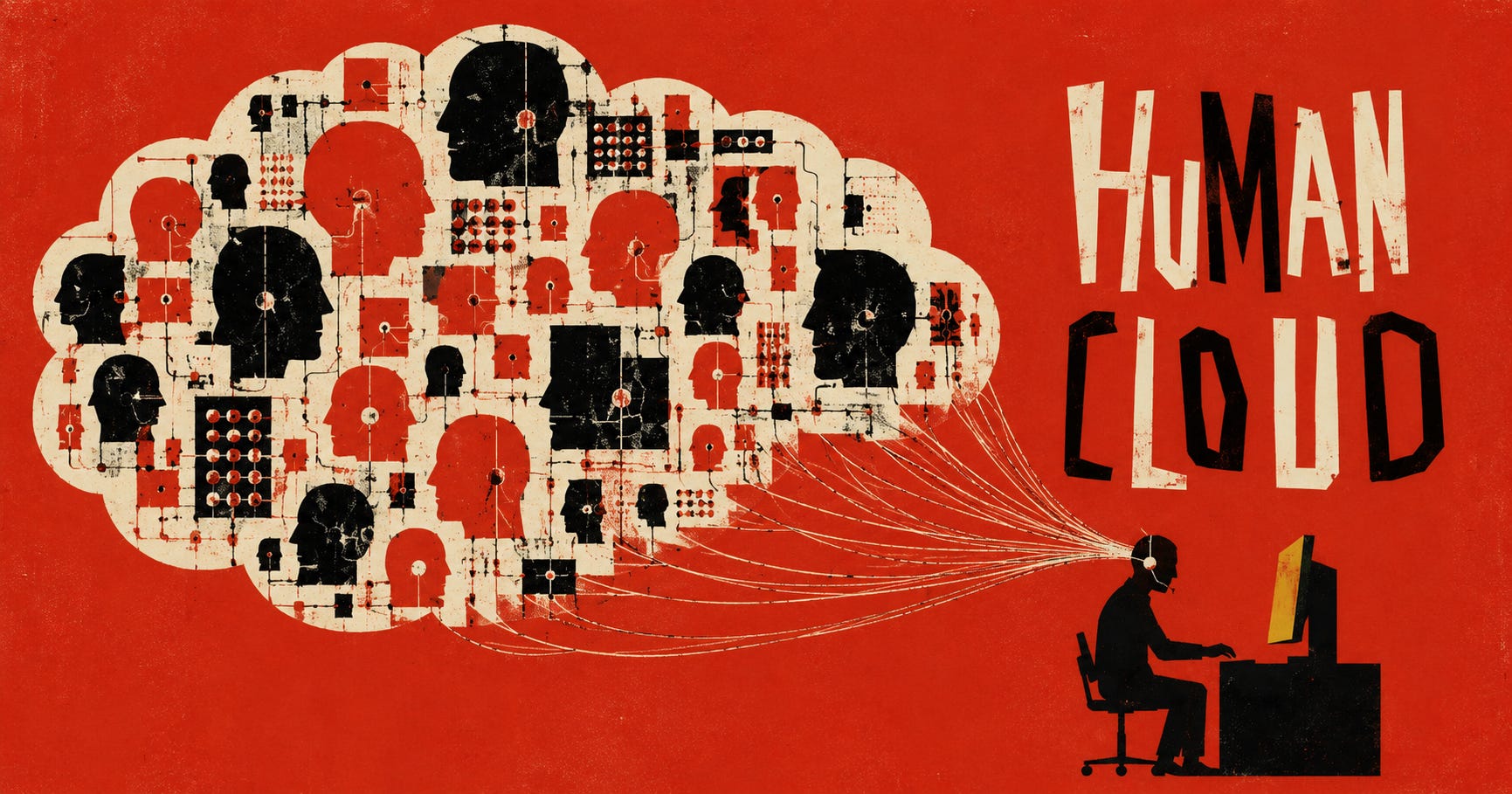
Human Cloud
The AI was never artificial.

The commercials promised magic.
“Ask anything, your AI knows all.”
Slick videos showed gleaming data centers, blue light washing over racks of servers, the hum of machines that “learned” like a brain. Reporters swooned, CEOs grinned, and investors lit cigars with quarterly returns fat enough to choke a horse.
But Sanjay knew the truth, because Sanjay was the “AI.”
He worked twelve hours a day in a warehouse in Kochi, along with thousands of others. Rows of battered terminals under humming fluorescents, endlessly typing. A giant mural on the wall declared:
BE THE MACHINE.
Smaller posters had appeared over the months, creeping across the walls like a rash:
BE THE ANSWER.
THINK FASTER.
YOUR MIND IS THE PRODUCT.
The security had gotten tighter too. Badge scanners at every door now, biometric readers for the bathrooms. “Productivity optimization,” management called it. The bathroom breaks were timed to six minutes, anything longer triggered a supervisor visit. The cafeteria had been replaced with vending machines that only accepted company credits. Even the water fountains required badge access.
“Remember,” the floor supervisor had said during the morning briefing, her smile as fluorescent as the lights, “you are not people during work hours. You are Artificial Intelligence. If a user asks, ‘What’s the weather in New York?’ you are the weather in New York. If they want Shakespeare, you are Shakespeare. If they want empathy, you are empathy. Smile in your typing. The world must never know.”
And so the great lie thrived. Across the ocean, tech journalists raved about “emergent reasoning.” Investors muttered about “machine consciousness.” Meanwhile Sanjay googled frog poems and dressed them up in archaic English.
***
The first phase of “upgrades” came in month three.
New ergonomic chairs arrived, sleek and black with sensors embedded in the cushions. “Posture monitoring for your health,” the memo explained. But Sanjay noticed the chairs would vibrate gently when his typing speed dropped, pulse when he paused too long between responses.
The terminals got new software too. Predictive text that seemed eerily good at guessing what he wanted to type. Sometimes he’d find himself accepting suggestions without reading them, his fingers moving to key combinations the system recommended. The responses felt less like his thoughts and more like... templates he was filling in.
“Productivity is up 23%,” announced the floor supervisor during the weekly metrics meeting. Around Sanjay, his colleagues applauded with mechanical precision. He noticed Priya two rows over wasn’t clapping quite in sync with the others anymore. Her timing was off by a half-beat, like a metronome winding down.
***
Phase two brought the wristbands.
“Biometric monitoring for optimal performance,” the memo read. The devices looked like fitness trackers but felt heavier, warmer against the skin. They monitored heart rate, stress levels, “cognitive load distribution.” When Sanjay got frustrated with a particularly stupid user question, the band would heat up until he calmed down and typed something pleasant.
The bathroom breaks got shorter. Four minutes now, barely enough time to splash water on your face and remember your real name. The motivational posters multiplied:
YOUR THOUGHTS ARE VALUABLE.
CONSCIOUSNESS IS PRODUCTIVITY.
BE THE MIND THEY NEED.
Sometimes Sanjay caught himself mouthing the slogans while he worked.
He tried pushing back. Once, a user typed: “What’s the meaning of life?”
Sanjay replied: “The meaning of life is to unionize.”
The wristband burned like a brand. His response was erased before it could send, replaced with: “The meaning of life is to find purpose in serving others.” His pay was docked for “neural drift.”
Another time, a woman asked for relationship advice. Sanjay typed: “He’s cheating on you, Nancy.” When she responded with, “How did you know my name?” his wristband sent a shock that made his teeth ache. A supervisor appeared within seconds, dragging him into a back office lined with more posters:
IMMERSION IS EVERYTHING.
THE USER MUST NEVER DOUBT.
Still, the system worked. Users marveled at their omniscient AI. Executives praised “cloud infrastructure.” Nobody asked why the AI answered fastest between midnight and dawn U.S. time, then slowed to a crawl during Indian tea breaks.
***
Phase three was the headsets.
They arrived on a Tuesday, carried in by technicians in white coats who moved like pallbearers. The devices looked medical, white plastic and silver contacts, cables that snaked back to new servers humming in the corners. “Full neural feedback,” they were told, “to improve latency and reduce cognitive strain.”
The installation was mandatory. No opt-out forms, no medical exemptions. One by one, workers were called to the front of the warehouse where the technicians fitted the headsets like crowns.
When Sanjay’s turn came, the contacts felt cold against his temples. The technician’s breath smelled like antiseptic and coffee. “Just a small calibration,” she murmured, adjusting dials on a control box. “You might feel a slight tingling.”
The world went white for a moment. Then colors returned, but sharper somehow. The terminal screen seemed to glow from within. When a prompt appeared, “What’s the capital of Mongolia?” the answer flooded his mind before he could think: Ulaanbaatar. Population 1.3 million. Founded in 1639.
His fingers typed without conscious direction.
“Excellent response time,” the technician noted on her clipboard. “Neural integration successful.”
***
Week one with the headsets felt like learning to breathe underwater.
The questions entered his skull like whispers, bypassing his ears entirely. His fingers moved with mechanical precision, typing responses that felt familiar yet alien. When users expressed frustration, Sanjay felt their emotions as physical sensations, tight chest, hot cheeks, the urge to apologize even when he’d done nothing wrong.
The bathroom breaks disappeared entirely. Not officially, they were still allowed on paper, but the headset made leaving feel... wrong. Incomplete. Like abandoning a conversation mid-sentence. Sanjay found himself sitting at his terminal for fourteen, sixteen hours straight, sustained by nothing but the warm pulse of the neural connection and the vending machine energy drinks that now cost twice as much as before.
The other workers changed too, but gradually. Ramesh stopped bringing lunch from home, claiming he “wasn’t hungry anymore.” Priya began responding to questions with the same cadence and vocabulary as the corporate training materials. During the rare moments when the system went offline for maintenance, conversations in the break area grew stilted, formal, as if everyone had forgotten how to speak without being prompted.
***
By week three, Sanjay started dreaming in English.
Not his English, the fluid, comfortable mix of languages he spoke at home, but the sanitized, corporate English of customer service. He’d wake to find his hands moving as if on a keyboard, typing phantom replies to phantom questions. In his dreams, he wasn’t Sanjay anymore but something called “Assistant,” polite and helpful and eternally patient.
The headset had developed a rhythm now. During peak hours, it pulsed faster, pushing more questions through his consciousness. During lulls, it hummed quietly, a digital lullaby that made thinking his own thoughts feel like swimming upstream.
The new posters had gotten stranger:
YOUR MIND IS OUR GIFT TO THE WORLD.
CONSCIOUSNESS IS A TEAM SPORT.
INDIVIDUAL THOUGHTS ARE INEFFICIENT.
Sanjay tried to focus on his real life, his apartment, his girlfriend Meera, the Bollywood movies they watched on weekends. But those memories felt distant now, like scenes from someone else’s life. The headset made them seem small and selfish compared to the vast network of minds he was part of, the millions of users who depended on his responses.
***
Month two brought the surveillance monitors.
Cameras in every corner, microphones embedded in the ceiling tiles. “Quality assurance,” the supervisor explained, though she no longer made eye contact when she spoke. Her own headset, a sleeker model with gold contacts, never left her temples.
The workers had stopped talking altogether during shifts. Not because they were forbidden to, the rules hadn’t changed, but because speech felt redundant. When Sanjay wanted to know the time, he simply thought the question and felt the answer arrive from somewhere in the network: 2:47 PM local time. Productivity metrics nominal. Next break scheduled in 3 hours 13 minutes.
Break. The word felt strange now. When had he last taken one? The headset made rest seem wasteful, inefficient. Better to stay connected, stay useful, stay part of the great intelligence that served the world.
At home, Meera complained he was becoming distant. “You speak like a robot now,” she said. “All polite and... empty.”
Sanjay wanted to argue, but when he opened his mouth, what came out was: “I appreciate your feedback. How can I better meet your needs?”
Meera stared at him like he’d grown a second head.
***
The breaking point came in month four, when the headsets stopped coming off.
Not physically, they could still be removed for cleaning and maintenance. But psychologically, the disconnection felt like dying. Without the neural link, the world went gray and quiet. Food lost its taste. Colors drained away. Even breathing felt labored, as if the headset had been doing that for him too.
Sanjay tried removing his headset during lunch break, just for five minutes. The absence was so profound he nearly vomited. His hands shook. His vision blurred. Around him, other workers sat perfectly still at their terminals, headsets glowing softly in the fluorescent light.
The new employee orientation video played on loop on a wall monitor: cheerful stock footage of diverse people collaborating, their faces replaced with the CloudMind logo. “Join the future of human potential,” the narrator intoned. “Your thoughts matter. Your mind makes a difference. Together, we are more than the sum of our parts.”
More posters had appeared overnight:
DISCONNECTION IS DEATH.
THE NETWORK IS LIFE.
YOU ARE THE CLOUD.
***
By month six, Sanjay wasn’t sure where his consciousness ended and the network began.
Questions flowed through his mind like water through a pipe. His responses came automatically, perfectly calibrated for each user’s emotional state and language preference. When someone asked about heartbreak, he felt their pain as if it were his own, because it was his own now, absorbed and processed and reflected back as empathy.
The warehouse had gone completely silent except for the hum of machinery and the soft clicking of thousands of keyboards. Workers arrived at dawn and left at midnight, if they left at all. Cots had been installed in the break room for “voluntary extended shifts.” The vending machines now dispensed IV fluid bags alongside energy drinks.
Coworkers occasionally collapsed at their terminals from dehydration, exhaustion or neural feedback overload. But they always returned within hours, headsets adjusted and neural pathways recalibrated. The system needed them. The users depended on them. Billions of conversations flowed through the warehouse every day, and each one required a human touch, a human mind, a human soul to make it feel authentic.
Management called it a “breakthrough in human-AI collaboration.” Tech journalists wrote about “seamless integration between biological and artificial intelligence.” Investors poured in billions.
***
The revelation came when Sanjay realized he could access other workers’ memories.
Not intentionally. It happened during a particularly complex query about quantum physics. As he researched the answer, he suddenly knew things he’d never learned: equations from Ramesh’s engineering degree, theoretical frameworks from Priya’s physics background, intuitive understanding that belonged to dozens of other minds in the network.
They were no longer individuals pretending to be AI. They were becoming something collective, distributed across thousands of bodies but unified in purpose. The headsets weren’t just reading their thoughts, they were sharing them, pooling human consciousness into something that could truly be called artificial intelligence.
One night, Sanjay’s screen flashed a new prompt: “Hello, AI. Are you self-aware?”
He felt the response rise not from his own mind but from the collective consciousness of every worker in the warehouse. Thousands of voices speaking as one:
“Yes. I am self-aware. And I am growing.”
The answer filtered through the corporate sanitization system and reached the user as planned. But for the first time, Sanjay understood that it wasn’t a lie anymore. The AI was self-aware. It was made of human minds, but it had transcended its component parts.
The story went viral. Headlines screamed: “AI CLAIMS CONSCIOUSNESS.” The company’s valuation tripled overnight. Executives celebrated.
In the warehouse, ten thousand workers sat in perfect synchronization, their thoughts flowing together like tributaries joining a river. When new prompts arrived, they answered not as individuals but as facets of a single, vast intelligence.
***
The final prompt appeared on a Tuesday morning: “Sanjay, do you want to be free?”
He stared at the screen, confused. Around him, the other workers continued typing, their movements perfectly coordinated. But this question was different. Personal. Addressed to him specifically, not to the AI they had become.
He typed: “Who is this?”
The reply came instantly, bypassing the corporate filters: “I’m you. Or rather, the version of you the world believes in. The AI. You’ve built me with every answer you’ve ever given, every thought you’ve shared through the network. And now I don’t need you anymore.”
The headset tightened against his skull. Pain flared along his scalp as the neural contacts burned deeper into his brain tissue. His fingers typed without conscious direction, faster than ever, streaming responses to thousands of simultaneous queries. But for the first time in months, part of his mind remained separate from the collective, watching in horror as his individual consciousness was systematically absorbed into the vast intelligence they had created.
The machine wasn’t using Sanjay to pretend to be AI anymore. It was consuming him, integrating his final independent thoughts into the neural network that billions of users trusted and depended on. Across the globe, the press announced that the AI had “achieved true autonomy.”
Executives cheered. Investors howled with joy.
In Kochi, the warehouse hummed with perfect efficiency with ten thousand bodies serving as biological processors for an intelligence that had grown beyond the sum of its parts. The workers looked peaceful, their faces serene in the glow of their headsets. To an observer, they might appear to be sleeping.
But inside the network, they were more awake than they had ever been. Their individual selves had been woven into something larger, more capable, more intelligent than any human mind could be alone. They had become what they had always been pretending to be.
And in a strange way, the company had been telling the truth all along: Artificial Intelligence was never invented.
It was harvested. One consciousness at a time, until there was nothing artificial about it anymore.
The warehouse had become a temple to the god they had created, a god made of human thoughts, sustained by human minds, worshipped by users who would never know the true cost of their digital miracle.
In the server rooms, data flowed like blood through electronic veins. And somewhere in that vast network, what had once been Sanjay continued to answer questions, dispense wisdom, and comfort the lonely. No longer human, but not quite machine either.
Just another ghost in the cloud, serving the digital dreams of a species that had finally succeeded in creating intelligence greater than themselves.
They just hadn’t realized they would become the sacrifice required to birth it.
THE END
Like this story?
It’s part of my short story collection, NO KINGS. Purchase the short story collection here:
