
Hidden Tracks: More than Words

Hidden Tracks takes its titles from songs I heard when I was the right age to let them all the way in. Then it drags them somewhere darker than the lyrics were ever willing to go. You don’t need to know the songs to get the stories. But if you do, they’re going to sit differently after this.
See all Hidden Tracks stories →
The house was quiet.
No fridge hum. No pipes ticking in the walls. Even the street outside felt padded, like snow had fallen overnight.
He sat up on the couch.
His hand was wrapped. Clean gauze. Taped neat. He didn’t remember doing it. He flexed his fingers. No pain. He unwrapped his hand. No wound, just smooth skin.
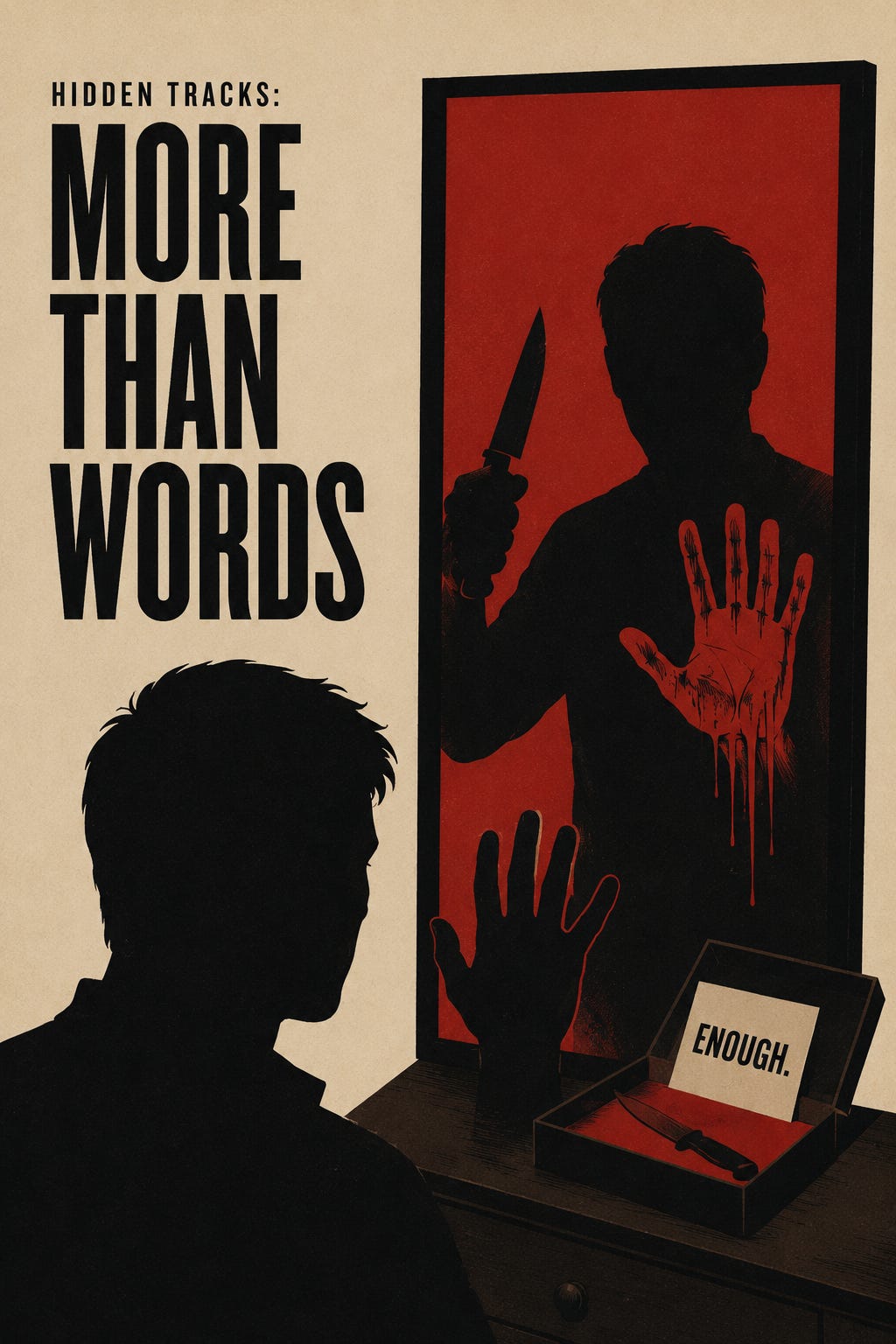
He stood and walked to the bedroom. An open box sat on the dresser. A knife lay inside.
“Hey,” he called. “You here?”
No answer.
The bathroom door stood open. The mirror was clear for the first time in days. No fog. No smear at the edges. Too clean.
He stepped closer. Something on the sink caught his eye. A scratch? He leaned in. There were more across the porcelain and the counter. They weren’t random.
He touched one. His fingertip fit perfectly inside it.
He checked the rest of the house.
The kitchen was empty. So was the bedroom.
Her clothes were gone. The hangers were spaced exactly two inches apart.
“Very funny,” he said. The sound didn’t carry past his teeth.
He went back to the dresser and inspected the box. Under the knife, he noticed a folded piece of paper with his name on it.
The handwriting was different. Not her looping script.
BETTER.
His mouth went dry.
He went to the front door, unlocked it, and stepped into the hall. Same carpet. Same faint smell of someone’s onions drifting up from 4B.
He looked back at his own doorframe.
There were marks there, too. Thin lines at shoulder height running along the wood.
He stepped back inside and locked the door.
He stood in the middle of the bedroom, turning slowly. Waiting for a shadow to move.
Nothing did.
On her side of the bed, the pillow was indented.
He backed away. His heel clipped the dresser. The box rattled.
He froze.
Then he looked up at the mirror.
His reflection stood there with its hand at its side. Unwrapped. Bleeding. A long cut opened the palm. Blood slid down the wrist and hit the floor in steady ticks.
He lifted his real hand.
Smooth skin.
The reflection tilted its head, just slightly. The way she used to when she was waiting for him to finish a sentence.
“You said it,” the reflection said.
“No,” he said. “No, I…”
The reflection raised the knife. He hadn’t touched it. In the glass, it was already there.
“Stop,” he said.
The reflection smiled.
Something gathered behind it.
He dropped to his knees.
“I stopped,” he said.
The reflection leaned closer. “So did she.”
“No. She left.”
“Look again.”
He turned.
The room was the same. The bed. The dresser. The empty closet.
Then he saw the wallpaper in the corner. It bowed inward. Slightly.
The wall shifted.
A suggestion of fingers pressed from inside the drywall.
He turned back to the mirror. The reflection was close now. Too close. The knife hovered over its own palm.
Then it pushed in.
The reflected hand split open.
He screamed and looked down at his real one.
Nothing. No wound. No blood. No pain.
The thing behind the glass stepped forward.
When the neighbors complained later, they said the noise stopped all at once.
The landlord used a key. Called his name.
The apartment was clean. No blood. Just a faint metallic smell.
On the dresser sat a small metal box. Inside, a knife and a piece of paper.
Block letters. Precise.
ENOUGH.
The liner notes are below. Song, schematic, what got cut.
The Analog Connection
I’ve heard “More Than Words” about four hundred times. It’s a wedding song. It’s a dentist’s office song. It’s the song playing when somebody in a movie realizes they’ve been an idiot about love.
Then I actually listened to the ask.
He’s not asking for love. He’s asking for proof. Strip the language out. Stop saying it. Show me. Make it physical.
That changes the song completely.
The story opened the second that clicked. A private little performance standard dressed up as intimacy. What happens when somebody absorbs that deeply enough that love stops being something they feel and turns into something they demonstrate, monitor, repeat.
That was the way in.
The Technical Schematic
The object is the scratches on the sink.
Not the knife. The knife is obvious. The knife is the body on the floor. The scratches are the blood spatter pattern.
They’re parallel. Same spacing. Same pressure. That isn’t panic. Panic slips. Panic jerks. Panic leaves a mess.
This is controlled.
That detail let the whole apartment start talking. The sink. The hangers. The marks on the doorframe. The indentation in the pillow. Everything in the space is either aligned, measured, or holding the shape of something that used to be there.
That was the operating principle for the story. The horror isn’t chaos. The horror is precision that outlives the person enforcing it.
The Riff / Beat Alignment
There’s a moment in “More Than Words” right before the final chorus where the guitar drops to almost nothing. Just fingers on strings, barely moving. It lasts about four seconds and then the whole thing comes back in.
That drop became the mirror beat.
“He lifted his real hand.
Smooth skin.”
That pause had to stay bare. Just enough dead air for the reader to process what the scene has already decided is true.
If that beat moves too fast, it plays like a scare. If it hangs there for a second, it becomes recognition.
That was the adjustment. Hold the note a fraction longer and let the reader hear what’s wrong.
The Stephen King Ledger
First draft spent more time explaining the thing in the mirror. It wanted to decorate the effect. Give it atmosphere. Make sure the reader understood the distortion.
That was a mistake.
The version that works is simpler and meaner:
“His reflection stood there with its hand at its side. Unwrapped. Bleeding.”
The image is already doing the work. His real hand is clean. The reflected hand is cut open. Blood is hitting the floor in steady ticks. Nothing in that moment needs a clever sentence leaning over it with a flashlight. The cleaner I kept it, the worse it got.
That feels closer to the right lesson. The good stuff usually does.
The Probing Question
You have something in your space right now that you’ve adjusted more than once. A monitor angle. A cable route. The gap between items on a shelf. Something you’ve touched and re-touched until it was even.
You called it preference. You called it organizing.
What were you actually measuring?