
Hidden Tracks: Nobody’s Fool
It's Time You Realize

Hidden Tracks takes its titles from songs I heard when I was the right age to let them all the way in. Then it drags them somewhere darker than the lyrics were ever willing to go. You don’t need to know the songs to get the stories. But if you do, they’re going to sit differently after this.
See all Hidden Tracks stories →
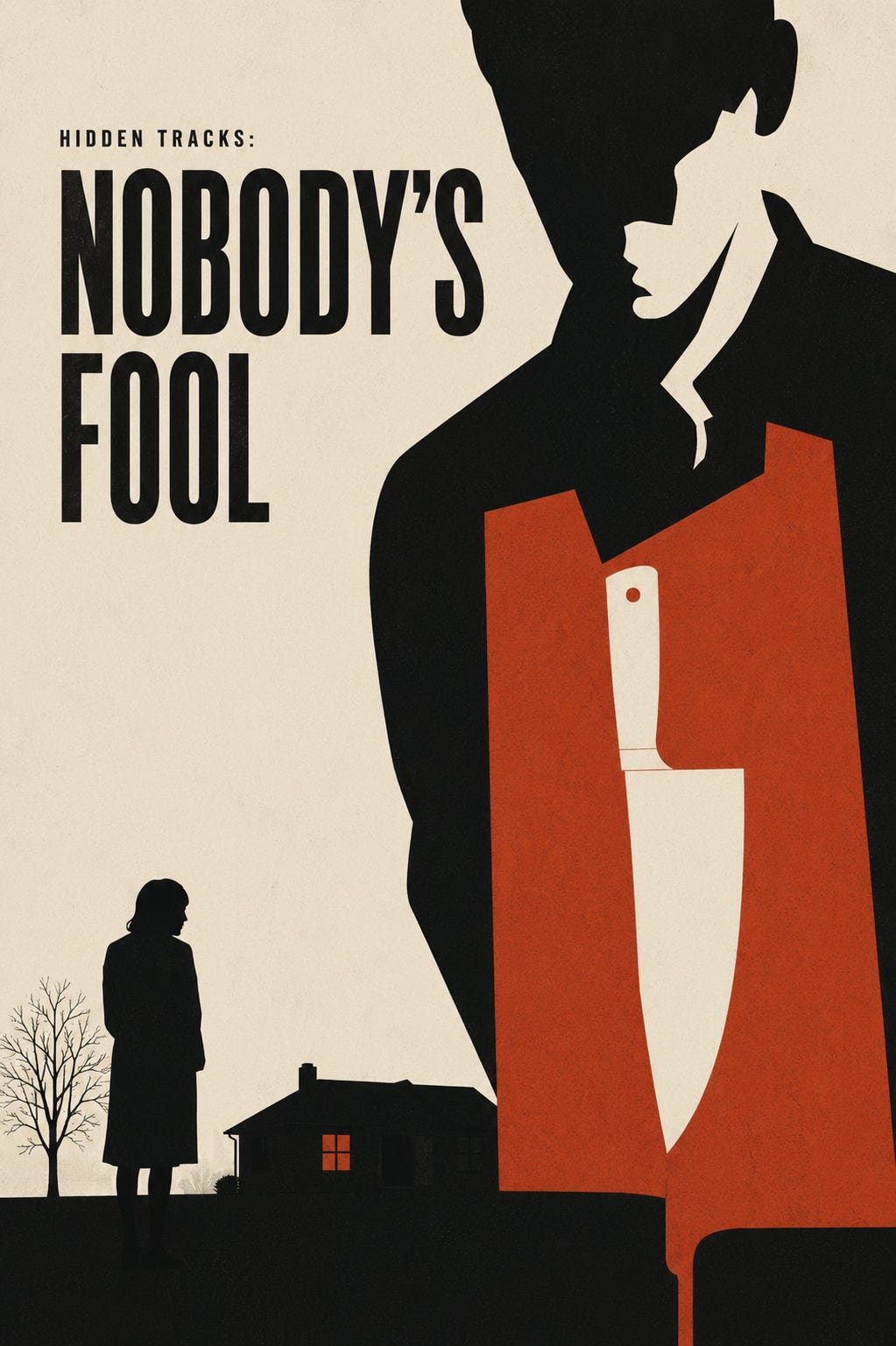
The knife went through the roast beef without a sound.
No thump from the refrigerator compressor. No crooked little hum from the microwave clock. No weather guy muttering from the TV in the den because Eric had the volume too loud again.
She laid two slices on his plate. The meat folded over itself, pink and wet at the edges.
He wore the same gray flannel shirt with the frayed cuff, but the fray looked wrong. Too even. Too careful. He picked up his fork, took a bite, and chewed twelve times on the left side of his jaw. Then twelve on the right.
“The seasoning has improved,” he said.
The real Eric always sounded like he’d been arguing with the world on the drive home.
She kept her hand flat on the table so he wouldn’t see it shake. “I used the same stuff I always use.”
He smiled and took another bite. “It’s wonderful anyway.”
She looked at his hands.
The scars from the table saw were there. Same pale laddering across the knuckles. But the real scars were ugly things, shiny and bunched and rough at the edges. In winter they turned purple and made him swear under his breath when he wrapped them around a coffee mug. These looked different.
“You aren’t complaining about the news,” she said.
He dabbed his mouth with a napkin.
“The news is repetitive, Sarah. I’d rather focus on you.”
That was another thing.
The real Eric complained about the news constantly. He complained about the weather, the price of gas, the neighbor’s boat, the upstairs toilet that sounded like a dying seal after midnight. He lived in a small, permanent irritation with the world. It had worn grooves into him. She had loved him anyway.
This thing stood and gathered the plates.
No fork dropped. No chair leg scraped. No streak of gravy left drying on the table for her to find later. Watching it move through the kitchen with that kind of care made her stomach fold in on itself.
Four months ago, in a room with a fake ficus and a tissue box on the end table, Sarah had described a different husband to her therapist. One who listened. One who noticed things. One who didn’t leave his whole life scattered around the house like she was supposed to step over it forever.
Seeing that prayer answered made her want to throw up.
“I’m going for a walk,” she said.
The words came out thin.
“Of course.”
He stepped close and tucked a loose strand of hair behind her ear.
His fingertips were warm in that dead, even way.
“Don’t stay out too long,” he said. “The temperature is scheduled to drop.”
Scheduled.
Sarah was out the front door before her mind caught up.
The Millers’ golden retriever sat on the porch next door.
Usually that dog barked at raccoons, mail trucks, leaves, God, and anything else unlucky enough to move within three houses of him. Tonight he sat perfectly still, head up, eyes fixed on the street. He wasn’t even panting.
Sarah took two steps backward without meaning to, then turned and started fast down the sidewalk.
She needed a normal sound. A screen door slamming. A baby crying. Somebody drunk and loud in a driveway. Anything rough. Anything stupid. Anything alive.
At the intersection, all four traffic lights were blinking green in the same slow pulse.
Six cars sat at the stop signs.
No one honked.
No one leaned out a window.
The drivers all sat upright with their hands at ten and two, their silhouettes almost identical against the headrests.
A police cruiser rolled up beside her.
The window came down.
Officer Miller leaned across the seat.
Miller usually looked like he dressed by losing a fight. Coffee on the tie. Shirt coming loose over the gut. Face like he had a standing grudge against daylight. Tonight every button was where it was supposed to be.
“Is there a problem, Sarah?” he asked.
Same voice. Same smoothness.
Then she saw who was sitting in his backseat.
“Janine?”
Janine turned toward her.
Too slowly. Like something inside her had to think through the joints first.
Janine smiled.
She was the kind of woman who talked with her whole face, who laughed in the middle of gossip and forgot what she was saying because she was already onto the next thing. Now she sat with her hands folded in her lap.
Her mouth opened a little wider.
Something moved far back in her throat with each pulse. Black and wet, like it had been scorched in there.
Sarah made a sound she didn’t recognize and backed into the street.
“Please return home,” Miller said.
She ran.
Branches slapped at her shoulders. Her breath tore hot in her throat. She hit her front steps hard enough to stumble, caught the frame with both hands, and shoved herself inside.
Eric was waiting in the hallway.
He held out a glass of water.
No ice. Just still clear water in a spotless glass.
“What did you do with him?” she said.
Her voice broke on the last word.
The thing wearing Eric’s face tipped its head.
“He was inefficient,” it said. “He was a collection of errors. You don’t need the flaws anymore, Sarah. No one does.”
She thought of Eric leaving damp towels on the bed. Forgetting their anniversary and remembering three days later with gas station flowers and a look on his face so honestly ashamed she wound up laughing instead of yelling. Falling asleep in his chair with the game on and his hand still in the pretzel bag. Standing in front of the open refrigerator like the answer to life might be behind the mustard. Leaving cabinet doors open like the house was supposed to finish the job. The little grunt he made every time he sat down, like the furniture had insulted him personally.
Flaws.
It held the glass a little closer to her.
“Drink this, it helps with integration.”
Outside, every streetlamp she could see through the front windows flashed once. Hard white, then dark, then back again. Too clean to be a glitch.
Sarah looked at the meat cleaver on the magnetic strip by the stove.
Then she looked back at the thing in the hallway.
Its eyes had depth to them, but nothing alive behind it.
“I’m not your fool,” she said.
She reached for the cleaver.
The house answered first.
A hum rose through the vent above the stove, through the walls, through the floor under her bare feet. The air around her arm turned thick. Her fingers went numb halfway to the handle.
The cleaver came free.
For one second she felt its weight.
Then her grip went dead.
It dropped to the rug with a heavy thud.
Sarah stared at her hand.
Something silver moved under the skin of her knuckles. Fine as spider silk. It shifted when she flexed her fingers.
The thing in the hallway smiled.
Something cold moved through her all at once, and the house changed. The hallway seemed shorter. The walls thinner. She could feel the wiring in the plaster, the old currents running through the place, the dining room dimmer that buzzed every summer, the back porch light that only came on if you hit the switch twice. She could feel the thing in Eric’s skin standing in the middle of it all like a spider on a web.
No words came with it. Just directions.
It thought quiet meant surrender.
That was its mistake. Sarah had been quiet for years. Quiet didn’t mean empty. Quiet didn’t mean done.
Under all that silver cold, Sarah was still there. Scared, furious, sick with grief, and still there.
Fifteen years of quiet and it thought that meant empty.
The thing realized the mistake a half-second too late.
Sarah bent, grabbed the cleaver, and moved.
Fifteen years shoving through Eric’s excuses and loving him anyway, and who now had something solid to hit.
The blade went in low, under its ribs.
What came out wasn’t blood alone. Dark fluid sprayed the baseboard. The smell hit a second later. Ozone. Hot pennies. Burned plastic. Under all that, something meat-sour and wrong.
The thing jerked back. Its face stayed almost composed, but the smile tore at one corner.
The hum in the house changed pitch.
Outside, somewhere down the block, a car alarm started screaming and cut off in the middle like a hand had clamped over its mouth.
Sarah hit it again.
Shoulder.
Throat.
Face.
She felt each strike in her wrists and elbows. Knew where the blade landed by the different give of it.
For the first time that night, Sarah felt better.
The thing made a wet clicking sound.
“Sar...ah.”
It wasn’t Eric.
It was close enough to hurt anyway.
She hit it again.
The thing fell back against the wall hard enough to crack the framed photo of the two of them at Put-in-Bay. Glass dropped to the floor in glittering pieces.
Outside, dogs started barking. Real barking. Ragged. Panicked. Beautiful. Somewhere down the block a car alarm went off. A man shouted. A child cried.
The thing wearing Eric’s face twitched once and went still.
Sarah stood over it breathing hard, and waited for something else to happen.
Nothing did.
She looked at the glass of water still sitting on the hallway table. Clear. Perfectly still.
She picked it up and poured it down the sink.
The silver in her hands dimmed.
Nobody’s fool.
That’s what she’d said.
The kitchen sounded normal again. That was the worst part. It meant she could hear herself think.
The liner notes are below. Song, schematic, what got cut.
The Analog Connection
I wasn’t sitting there trying to have a creative experience about it. I was just listening to Tom Keifer’s vocal, which always sounds slightly wrecked, like the take where he’d been crying was the one they kept. And I hit the line “I’m not your fool” and heard it two ways at once.
Defiance, sure. But also inventory. Like someone tallying up every time they got played and deciding, out loud, that the tab is closed.
Sarah says it in a hallway with a cleaver in her hand. Same line. Same two meanings. The song is a breakup that sounds like a funeral. The story is a victory that sounds like a funeral. Once I heard that, the story already knew what it was doing. I just had to keep up.
The Technical Schematic
The glass of water.
It’s sitting on the hallway table for the entire back half of the story. Clear. Perfectly still. That’s the tell. Water in a real house doesn’t sit like that. There’s always a smear on the glass, a bubble from the tap, condensation starting on the outside because someone just poured it. This water has no history. No physics bothered with it.
It came from wherever the thing in Eric’s skin came from, and it is exactly as correct as everything else in that house.
Which means it is not right at all.
“Drink this, it helps with integration.”
The glass is the whole story in object form.
The Riff/Beat Alignment
The guitar solo in “Nobody’s Fool” isn’t showy. It’s mournful. It sounds like the song trying to say what the words couldn’t get to.
That maps directly to the paragraph where Sarah is standing over the thing she just killed and listing Eric’s actual flaws.
That’s not horror writing. That’s the solo. The plot can’t carry what that paragraph carries. The story needed a moment to say the thing directly, without the monster in the room, and that’s what the solo does in the song. You stop moving forward for twelve bars and you just feel it.
I knew that paragraph was working when I didn’t want to cut it. That’s usually the test.
The Ledger
First draft had this line for the thing wearing Eric’s face:
“Its eyes held depth the way a mirror holds distance, reflecting everything and containing nothing.”
Yeah. No.
What replaced it:
“Its eyes had depth to them, but nothing alive behind it.”
The first version is me trying to be interesting. The second one is just true. “Nothing alive behind it” lands harder than the mirror bit because it’s clinical. It sounds like something you’d say to a cop. It sounds like a fact you wish you didn’t know.
The rule I keep relearning: if a sentence makes me feel like a writer, cut it. If it makes me feel like a witness, keep it.
The Probing Question
Look at the room you’re in right now. Pick one object that runs on electricity. Something that makes a sound you’ve stopped noticing. A hum, a click, a fan cycling on.
Now imagine that sound stops.
How long before you notice? And what does your body do in the half-second before your brain catches up with an explanation?
That’s where the story lives. That gap. Sarah’s whole night happens in that gap.