
Hidden Tracks: Pink Pony Club
I can't ignore the crazy visions of me in LA

Hidden Tracks takes its titles from songs I heard when I was the right age to let them all the way in. Then it drags them somewhere darker than the lyrics were ever willing to go. You don’t need to know the songs to get the stories. But if you do, they’re going to sit differently after this.
See all Hidden Tracks stories →
The bass lives in her chest like a second heartbeat.
When the drop hits the floor becomes something close to religious. Fourteen months in California, and this is still the part of the week she lives for. There is glitter on her collarbone and she knows exactly how it got there.
Marisol ran the same four songs every Saturday. She caught her eye from the booth and neither of them said anything about it.
Luciana was two feet away, eyes closed, arms up, moving like the music was a private conversation. She watched her for a second before she started moving again. This was the thing she could never have explained to anybody back in Tennessee. Not the dancing. The watching. How far you had to come to breathe.
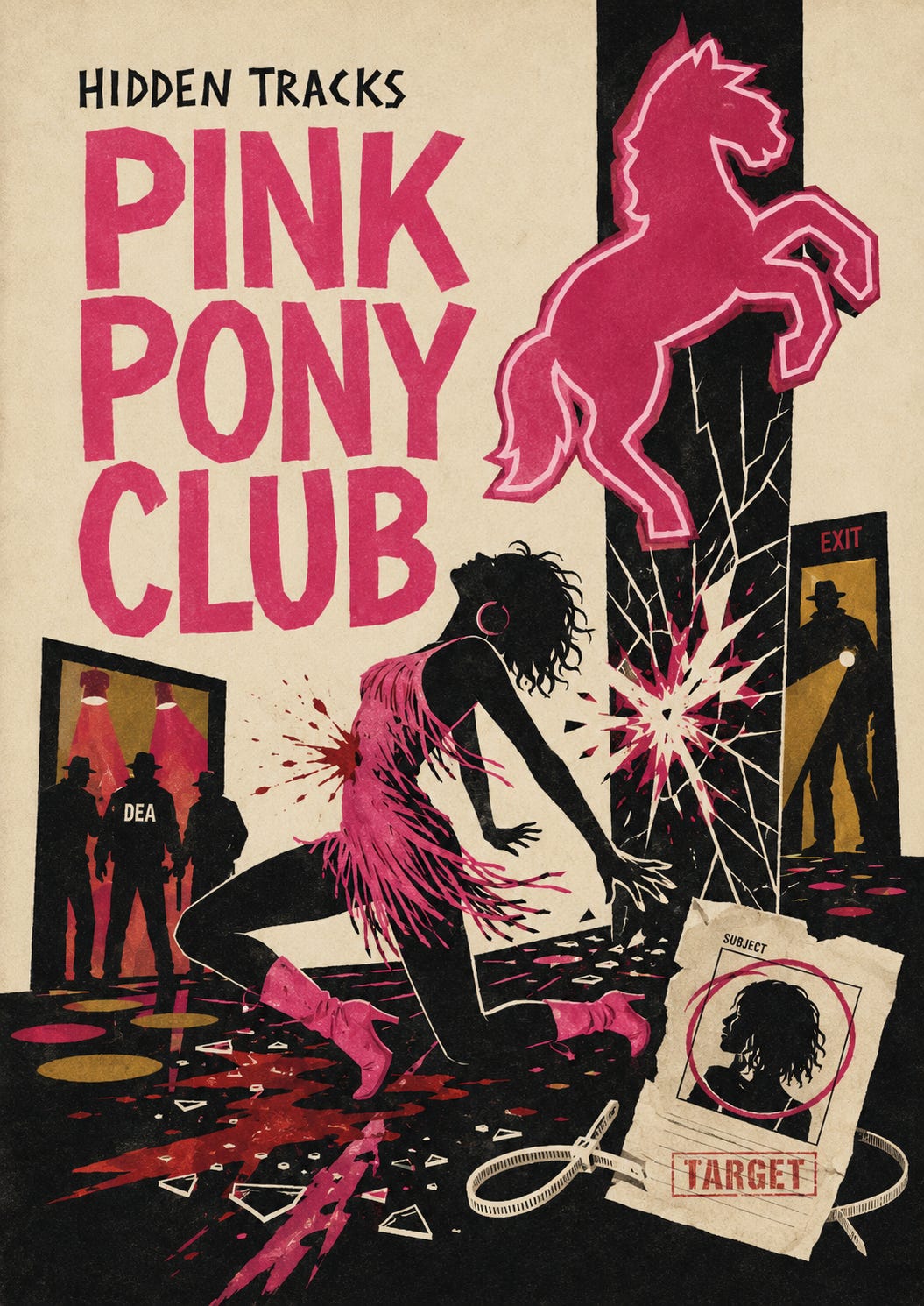
Outside on Sunset, four dark SUVs with federal plates idled at the curb beside a white passenger van with no side windows.
She didn’t know that yet.
She was dancing.
The first thing she noticed was the door.
Not the man in it yet. Just the door, open three inches longer than it should have been, the orange dark of Sunset bleeding in around the edge. Somebody coming or going would have let it close. This one didn’t.
She kept dancing.
Luciana spun into her and caught both her hands and laughed, and she thought, this. Right here. She let herself have it for another eight seconds while the song built toward the drop.
Then she looked at the door again.
He was inside now. Pale, maybe forty, wearing the kind of clothes that weren’t a uniform but might as well have been. Windbreaker. Earpiece. A lanyard tucked badly enough that it flashed when he moved. He wasn’t looking at the lights or the floor or the bodies. He was looking at the room the way a man looks at a diagram he’s memorized. Bar. Sound booth. Back hallway. Office. Exits.
Marisol’s hand went flat on the bar.
The drop hit. Half the floor went up. Luciana threw her head back and the light caught her throat and her earrings and she was so purely herself in that moment it almost worked. Almost. She almost let it take her under.
The man lifted a radio to his mouth.
The music stopped mid-bar.
Then the doors.
Front. Side. Fire exit. Men came through in hard little groups with flashlights, zip cuffs, folded printouts, and the dry, practiced look of people starting a job they had already done on paper. One went straight to the sound booth without glancing around. Another peeled off toward the back hallway like he’d walked it before. Two took the exits.
“Nobody move.”
“Identification out.”
“Employees to the left.”
“Keep that group together.”
“Manager.”
Not shouted like panic. Called out like procedure.
One of them pointed at Marisol before she said a word.
Near the bathrooms another agent unfolded a stapled packet and turned it toward the light. Grainy printouts. Door-cam stills maybe. Social posts. License photos. A roomful of people flattened into paper and carried in under a jacket.
Luciana’s grip tightened. They both stopped moving.
That was when the room changed. This place had been chosen.
A woman near the wall bolted for the back and two agents cut her off before she made the hall. Another was already shoving a barback toward the office with one hand on his shoulder and his eyes on the printout in his other hand.
They moved through the room with the patience of men who weren’t here to stop a crime. They were here to collect what they had already marked down.
An agent was already moving toward them, and she stepped in front of Luciana without thinking.
He raised the gun.
“On the ground,” he said, and his voice was so ordinary. That was the thing about it. How ordinary his voice was.
She didn’t go down.
The gun went off and the sound of it was different from what she expected. Smaller. Like a staple gun in a big room.
The first bullet hit high in her side. The second caught her lower, turning her as she fell. The third came after her knees had already gone.
She hit the floor hard.
The floor was sticky under her cheek and smelled like beer and three hundred Saturdays of people dancing because they needed to. Glitter pressed into her skin where her cheek met the floor. She could hear Luciana saying her name, and under that the agents moving, zip ties, the flat vocabulary of men sorting bodies into outcomes.
She tried to pull in air and couldn’t get enough of it. Everything below her ribs felt hot and wet.
She thought of Tennessee.
Not the bad parts. That surprised her.
A creek behind the house. A flat rock in the sun. Eleven years old and alone and, for once, not required to be anything.
The bullets were in her somewhere. She could feel them when she breathed. Too deep. Too many. Fatal, if she’d been anybody else.
She got up.
Not fast. Not dramatic. Her shirt was wet on one side. She put her hand there, took it away, looked at it, then looked at the room.
The agent who shot her was six feet away. Black mask over the lower half of his face. His eyes went wide above it.
She looked at him for a long moment.
He raised the gun again.
She saw the choice in his eyes.
Something in her moved first.
The back of his head came apart against the mirrored pillar behind him.
It happened so fast the room didn’t understand it at first. One second a man with a gun. The next a wet pink burst on the mirror, bone skipping across the floor, blood sliding down through red and gold club lights.
For a second nobody moved.
Then the room broke.
One agent fired straight into the ceiling.
One stumbled back into a row of stools and went over them hard.
One put a hand to his shoulder mic and kept saying, “Officer down, officer down,” in the same flat voice, as if saying it correctly might make the room obey.
The man with the packet dropped it. The pages fanned out across the floor. Faces looking up through shoe prints and blood.
A guy by the DJ booth laughed once. Sharp. Wrong. Then clapped both hands over his mouth like he could stuff it back in.
Marisol reached under the bar and came up holding the well tequila, staring at it like she had no memory of deciding to grab it.
Luciana was against the far wall with half a dozen others, zip-tied, staring.
Not at the body. At the woman standing there like death had turned out to be temporary.
That landed harder than the gunshot.
Another agent lifted his weapon.
She turned her head.
That was all.
He froze. His finger tightened, then didn’t. His knees folded out from under him and he sat down hard on the floor, still holding the gun. A dark stain spread fast through the front of his pants. He stared up at her like a man who had just discovered belief in the worst possible way.
The ones with enough sense to retreat started backing toward the doors.
The one on the radio kept talking because procedure was the only prayer he knew.
She walked to Luciana.
The room made space for her without being asked.
She crouched. Took hold of the zip tie at Luciana’s wrists. It gave under her fingers with less effort than it should have. Luciana’s wrists were red where the plastic had bitten in.
Up close, Luciana’s face had gone very still.
Everyone else in the room was still staring.
Luciana looked relieved.
“Finally,” she said.
She let out a breath she hadn’t known she’d been holding for years.
Luciana stood. Close enough that their knees almost touched.
“You got shot,” Luciana said.
“I noticed.”
“You got back up.”
She looked down at the blood on her shirt. “Yeah.”
Luciana gave one small nod, like something private had been confirmed. “I know.”
That almost broke her. More than the bullets. More than the mirror.
She moved down the line. Marisol. Then the others, one by one, names she knew and names she didn’t, hands that grabbed hers on the way up and then let go when they got a good look at her face. Nobody thanked her. Nobody asked questions. The room wasn’t there yet.
When she was done she stood in the middle of the floor.
The agents who could leave had left. The ones who couldn’t were quiet. One was crying without making any sound. One still had his radio in his hand like it was going to save him if he held on long enough.
The club was wrecked. Lights still going. The automated system running its program for a room that wasn’t dancing anymore. Red and gold. Red and gold across the overturned glasses, the sticky floor, the smear on the mirror where a federal career had ended all at once.
On the floor by the pillar, one of the printouts had turned over.
Her face was on it.
Not even a good picture. Half profile, eyes turned away, caught under club light. Somebody had circled it in blue ink.
She stared at it for one second too long, then bent and picked it up.
On the back was a case number and a date from two weeks ago.
Luciana saw it in her hand.
“Yeah,” Luciana said quietly. “They picked the room.”
Marisol set the tequila on the counter, took a breath, and stepped behind the bar.
“Who wants a shot?”
That was the most human thing that had happened in the last eleven minutes.
“Are you okay?” Luciana asked, touching her arm.
This time it was really a question.
She looked at the ruined room.
There had always been something in her that couldn’t be named. Tennessee knew it. California knew it. The men with folders and guns knew it now too.
“Put the song back on,” she said.
Around them, people were still staring.
Luciana ignored them.
She looked at her.
Then she smiled.
“Yeah,” she said. “Okay.”
She went to the sound booth. Reached over the half-frozen DJ and hit the button.
The song came back in at the wrong place.
Wrong for blood on the mirror. Wrong for the body cooling by the pillar.
Perfect.
Marisol slid plastic cups across the bar.
Luciana came back to her.
For a second neither of them moved.
Then Luciana held out her hand.
There was glitter on her palm.
She took it.
By morning there would be reports. Statements. Men explaining why they had come. Men explaining what the room was for. Men explaining who belonged in it and who didn’t.
Fine.
Let them explain.
She stepped forward.
Luciana stepped with her.
And there, under the red and gold lights, with the mirror wrecked and the floor sticky and the marked pages still scattered underfoot, they started dancing.
The liner notes are below. Song, schematic, what got cut.
01 — The analog connection
A good song is a good song
This one came from a different shelf. The series has run on hard rock and metal because that’s the music I was the right age to let all the way in, and that’s the premise. But the premise has a rule underneath it that I didn’t state out loud until this story forced me to…a good song is a good song. The mechanism is the same regardless of genre. Chappell Roan is doing exactly what Hetfield and Coverdale and Cobain are doing. She’s writing about the cost of being exactly who you are in a world that has strong opinions about that. The genre is different. The frequency is identical.
“Pink Pony Club” is about a girl from the Midwest who always felt wrong before she understood what right looked like. Roan grew up Pentecostal in Missouri. She knew the specific texture of not fitting long before she had a name for why. The song isn’t just a celebration. It’s a before and after. The before is Tennessee. The wrong shape. The managed edges. The cost of existing in a place that has already decided what you are and found you insufficient. The after is the room on Sunset. Glitter on the collarbone. Luciana two feet away with her eyes closed and her arms up. The song is about what it feels like when the before finally ends.
She carried that before into California. Fourteen months of it. And the room gave her the after, and the after turned out to be the place where she found out what she actually was. Not the immortality. That came later, on the floor with bullets in her. What she found first was simpler. She found out she was someone who belonged somewhere. That’s the thing Tennessee couldn’t give her and the room on Sunset could. The story is about what happens when the people who preferred the before show up to take the after away.
The raid draws from a specific real-world playbook. No warrants read aloud. Faces pre-identified and circled before anyone touched the door. A white passenger van with no side windows at the curb. Men moving through the room not to stop a crime in progress but to collect what they'd already marked down on paper. The names aren't incidental. Marisol. Luciana. Every character in that room was named deliberately because the operational picture has a specific demographic target in the real world and the story doesn't look away from that. The packet has a face circled in blue ink. The face has a name. The name tells you exactly who the category decision was written for.
The song clicked in on one quiet moment where Roan describes the feeling of finally being somewhere she belongs, and underneath the celebration is the knowledge that belonging somewhere like this comes with a price the people back home are still deciding whether to charge. The song is about finding the room. The story is about what happens when the room gets found. And what the story says, without ever saying it directly, is that you can’t unmake someone by deciding they shouldn’t exist. You can hurt them. You can take the room. You can scatter the pages. But the thing you were trying to unmake was already finished being made long before you showed up with your packet and your blue ink and your category decision. All you did was find out what it was made of.
02 — The technical schematic
The printout packet
Stapled. Letter-sized pages, folded once to fit under a jacket. Grainy door-cam stills. Social posts screenshotted and printed. License photos pulled from state records. A roomful of people flattened into paper and carried in under a windbreaker.
One page has her face on it. Half profile, eyes turned away, caught under club light. Not a good picture. Somebody circled it in blue ink. On the back, a case number and a date from two weeks ago. The guy who circled her face was doing intake. Standard procedure. He had no idea what he was marking.
Four SUVs. A van with no windows. Men who had walked the back hallway in advance and memorized the exits. A complete, competent, correctly executed operational plan.
They didn’t know she was immortal. She didn’t either.
03 — Riff/beat alignment
The bridge and the floor with glitter pressed into her cheek
The song’s bridge is where Roan drops the performance register and just says what it cost. Just the plain fact of what leaving Tennessee meant and what the room on Sunset is worth and why she’s not going back. It’s the quietest moment in the song and it carries the most weight.
“The floor was sticky under her cheek and smelled like beer and three hundred Saturdays of people dancing because they needed to. Glitter pressed into her skin where her cheek met the floor.”
That's the bridge. She's on the floor with bullets in her and the room she built fourteen months of Saturdays inside is wrecked around her. The smell of beer and the feel of glitter pressed into her cheek is the song's quiet moment delivered as sensation instead of lyric. Three hundred Saturdays of people dancing because they needed to. Then she gets up. The song doesn't stay down there and neither does she.
04 — The Stephen King ledger
Finally
Version I killed
“Luciana looked at her the way someone looks when they’ve been waiting for a thing to be confirmed for a long time and it finally has been, relief and something older than relief moving across her face all at once.”
Version I kept
“Luciana looked relieved. ‘Finally,’ she said.”
The first version describes the relief and then describes what’s underneath the relief and then describes how long the relief has been waiting. It takes a moment that should land in one word and turns it into a paragraph of annotation. The second version gives you the relief as a physical fact and then gives you the word. “Finally” does everything the paragraph was trying to do and it does it in seven letters. Luciana already knew. That’s the whole point. She’s been waiting for this specific confirmation and now she has it and one word covers the entire history of that waiting. The annotation was me being nervous the word would land wrong. It doesn’t. Cut the paragraph. Trust the word.
05 — For paid subscribers
Think about a place you found, or built, or stumbled into, where you could be exactly who you are without running the cost-benefit analysis first. Not the dramatic version. The ordinary one. The bar, the group chat, the Thursday night thing, the specific combination of people that meant you could stop managing your edges for a few hours. Now think about what it cost to get there, and what it would cost to lose it, and whether the people who’ve never needed that understand what they’re asking when they decide it’s a problem.
Another great story Miles. Something about the way she keeps dancing
even when something feels off
that felt familiar in a way I can’t fully explain
And when she gets back up… that shift hit hard
I love me some pink pony club inspo