

Hidden Tracks: Psycho
Maybe I'm the one

Hidden Tracks takes its titles from songs I heard when I was the right age to let them all the way in. Then it drags them somewhere darker than the lyrics were ever willing to go. You don’t need to know the songs to get the stories. But if you do, they’re going to sit differently after this.
See all Hidden Tracks stories →
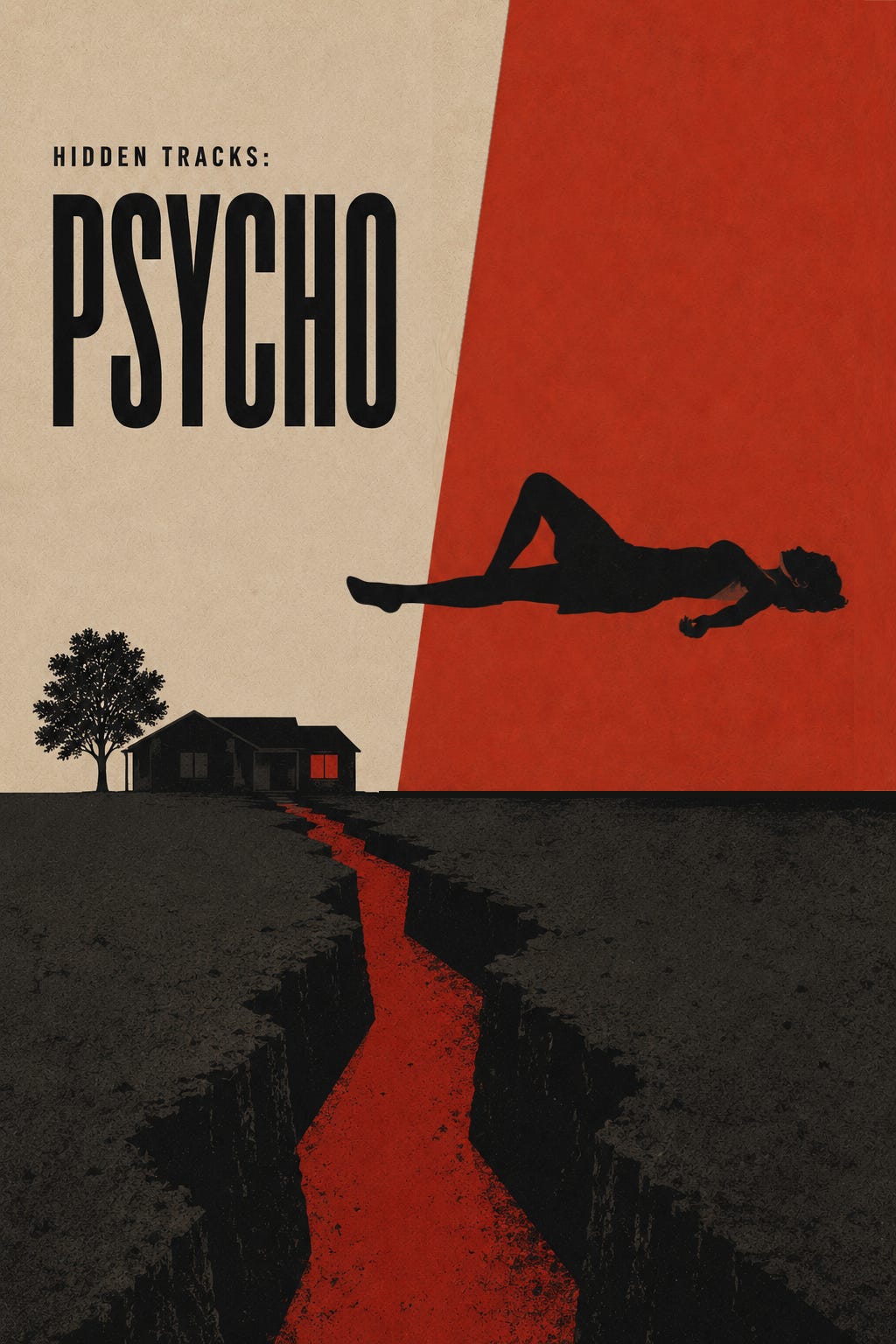
Junie Styles was laid out on the fresh lawn in front of Lot 14 like she’d been rolled there with the sod.
The grass had gone down that morning. I knew because I’d signed off on it at 10:12 with a coffee in one hand and a clipboard in the other, listening to the sprinkler guy explain pressure ratings like he was curing cancer. By three-thirty the water was on, the dirt underneath still raw and dark, and Junie was on her back in a pale dress with one knee bent, one sandal off, and the side of her face turned into the new green.
For a second I stayed in the truck and watched her through the windshield.
Maybe I’m the one, I thought.
Not in some big philosophical way. Just simple. Maybe I’m the one seeing things on a Tuesday after too much sun and not enough lunch. Maybe I’m the one who still can’t drive through Arrow Creek without dragging seventeen behind me like a tin can on a wedding bumper.
Then she turned her head and looked right at me.
That smile was the same. Like she had caught me cheating at something stupid.
I killed the engine and got out.
“Junie.”
She didn’t move.
The sprinklers clicked. Water hissed over the lot next door. Her bare foot was dirty at the heel. Grass clung to one cheek. She used to do that when we were young, drop flat on whatever was under her. Fresh lawn. Gym floor. The hood of a car. Sidewalk warm from the day. She could make anything look magical from a distance.
“Get up,” I said. “Somebody’s gonna see you.”
A car came around the bend too fast. I stepped back and lifted a hand to slow him down.
When I looked back, Junie was gone.
The fresh lawn lay there shining with water. No girl. No sandal. No dent in the sod.
I stood there long enough to get my shoes wet.
On the drive home the radio found an old station by accident and started playing songs from our senior year. Not the good ones. The kind they use now to sell pickup trucks and cholesterol drugs. I changed it twice and it kept slipping back between stations, all static and old choruses, like the whole truck wanted to rewind.
By the time I pulled onto Maple, I had myself halfway calmed down.
Mrs. Norwood next door was hauling her trash can up the drive in house shoes and a sweatshirt from some grandkid’s college.
“You look pale, Robbie.”
“Long day.”
She nodded like she didn’t believe me and kept walking. Mrs. Norwood had seen me come home drunk enough times in my twenties to develop a permanent expression of cautious disappointment.
Inside, the house smelled like nothing. Good. I like nothing.
I stood in the kitchen with the lights off. On the counter by the microwave sat the gray shoe box I kept meaning to throw away. County fair wristband. Motel keycard. Three Polaroids curled at the corners. One of Billy Raines with his shirt open and his middle finger up. One of my truck backed down by Fairview Lake. One of Junie in that same pale dress, laughing with her head thrown back, cigarette in two fingers, one knee muddy.
I put the lid on the box and went into the living room.
At 12:14 I saw her again.
She was stretched along the sidewalk outside my front window with her hands folded over her stomach.
One sandal on. One off.
Hair spread over the concrete.
I stood up too fast and barked my shin on the coffee table.
“Jesus.”
Junie turned her face toward the glass. She looked calm. Just a girl resting where no one rests.
I opened the front door and stepped onto the porch.
“What do you want?”
“You keep asking that,” she said.
Her voice sounded thin and old, like it had been left in heat too long.
“You need to stop coming here.”
She smiled a little.
A dog started up somewhere down the block. The porch light buzzed over my head. On the sidewalk, Junie lifted one shoulder like she was getting comfortable.
“You can’t lay there,” I said. “Somebody’ll call the cops.”
“You always worry about who’s watching.”
That stung because it was the kind of thing she would have said, back when we were young and every sentence between us was either flirting or bloodsport. I took a step down off the porch.
“Get up.”
“You first.”
A car rolled through the stop sign at the corner. I glanced over on reflex.
Empty sidewalk.
There was a damp shape on the concrete where her head had been.
In the morning I told myself I’d dreamed it. That held until ten-thirty.
Then Vince from the site trailer stuck his head into my office and said, “You got company.”
Officer Neal stood by the copier with his hat under one arm. We had played JV ball together before he got tall and I got bored.
“Mrs. Norwood says you were outside after midnight,” he said.
“So?”
“Says you were talking.”
“I talk to myself sometimes.”
He looked around my office. Framed permit. A fake fern somebody had given me three Christmases ago.
“Anybody else there?”
“No.”
He kept looking at me. “You hear about Carol Styles?”
My mouth dried out. “No.”
“She passed Sunday.”
I looked past him at the blinds.
“Figured you knew her daughter back in the day.”
“Everybody knew Junie.”
He nodded. “Hell of a thing.”
He left it there, which was worse. In a town this size, silence is where people keep the real versions.
That afternoon I drove out to Mercer Road for no good reason. Carol’s house sat back from the road under two big maples with the porch sagging in the middle. Dark windows. No car. The place looked smaller than I remembered.
On the way back into town I saw Junie in the median by the old bank.
She was lying in the strip of crabgrass and dirt between eastbound and westbound like she was sunbathing in traffic. Pale dress. Dirty foot. Hair spilling out dark around her. Horns blew as I locked up the truck and threw it into park half on the shoulder.
A guy in a van yelled something at me I didn’t catch. I crossed two lanes with my heart trying to punch out of my shirt.
“Junie.”
She opened one eye.
“You can’t be out here.”
“Can’t I?”
Cars rushed by on both sides, making her hair move a little. She didn’t seem to notice. Up close I could see the mark on her throat better now.
I stared at it too long.
Her mouth twitched. “Maybe you’re the one?”
I stepped back. “What?”
She rolled her head toward me and the old bank behind her. “Maybe you’re the one who’s crazy here.”
A horn screamed. Somebody shouted. I flinched.
Gone.
Just median grass pressed flat in the shape of a body.
I started seeing her everywhere after that.
On the sidewalk behind St. Luke’s with leaves stuck to her hair.
In the outfield grass behind the middle school, laid out under the lights after a storm.
By the car wash on Route 9, half in gravel, dress hem dark with water.
Always down low. Always on earth or concrete. Never standing. Never in a doorway, never looking out from a car, never upstairs, never framed. Just laid down. Fresh lawn. Sidewalk. Median. Field. Ditch. Shoulder.
And every time I saw her I told myself the same thing. She was alive. She was drunk. She was making a scene.
Maybe I’m the one, I’d think.
But I never finished the sentence the same way twice.
Maybe I’m the one losing sleep.
Maybe I’m the one getting sick.
Maybe I’m the one who still wants her to come back.
That last one I hated.
Friday afternoon Vince radioed me from the far end of Phase One. Utility crew had opened the old retention basin to reroute drainage before the pool went in. He needed my signoff on the trench. I almost told him no. Then he said, “You there?” in the voice people use when they already suspect something’s wrong, and I said I was coming.
The basin sat behind a stand of torn-up dirt and orange fence where the first field used to be before Arrow Creek put up its fake pond. The whole place smelled like wet clay and roots. Excavator marks striped the walls. Exposed pipe jutted out of one side like bone through skin.
At the bottom of the cut, Junie lay curled on her side in a puddle of mud.
Hair wet. Dress smeared brown from hip to hem. One arm folded under her head.
I stopped on the lip of the trench and something in me quit pretending.
Because that field. That exact field. That was where the night had gone bad. Not in the broad, shared, romantic way I had edited it for years. Not some two-person trainwreck with matching guilt. Just me, Junie, a bottle, a fight, and the part of me that had always mistaken fear for being challenged.
She opened her eyes and looked up at me.
“You know,” she said.
Not angry. Not sad. Tired.
The memory came back in pieces first. Then all at once.
Her lying down on the new sod outside the first model home because she was dizzy and laughing and telling me to quit pacing.
Her saying she was done with me.
Her saying she was going to tell Amy what I’d done last week. What I got like when I drank and somebody told me no in the wrong tone.
Me telling her to shut up.
Her telling me, clear as church bells, “You’re the one, Robbie. You’re the one who does this. Not me.”
I had forgotten that. Or buried it. Or filed it under things I could not survive hearing twice.
Maybe I’m the one.
Maybe you’re the one.
Maybe everybody’s crazy.
Maybe nobody’s to blame. Small town absolution. Buy one, get one free.
But the truth sat in the middle of it like a cinder block.
She had lain down because she was tired and drunk and wanted me to stop towering over her.
I had dropped on top of her to scare her.
My hands found her throat.
Her eyes went from furious to confused to frightened.
Her right sandal kicked off in the mud.
A truck came up the road.
I dragged her over the sidewalk into the dark cut of the basin because it was there, because I was seventeen, because holes in the ground have been helping cowards for centuries.
Afterward I told myself she ran.
Afterward I told myself she’d come back when she felt magical, the way she always did, bright and reckless and impossible to pin down.
Afterward I told myself we were both loaded guns.
That was the lie I loved best. It made us sound equal. Made the violence sound airborne. Random. Ready to go off at any minute.
At the bottom of the trench, Junie rolled onto her back.
The same pose as the first lawn. One knee bent. One arm over her head.
“We were gonna win again,” she said.
Not her phrase. Mine.
The words hit me so hard I had to grab the fence post to stay standing.
Winning. Christ. What a word. What I had really meant all those summers was no consequences yet. No cops yet. No blood that counted. No one making me say the verb out loud.
Junie lifted one hand and pointed toward the wall of the trench beside the exposed pipe.
Something pale curved out through the clay under a web of roots.
At first my mind tried to call it trash. PVC. A broken fitting. Some leftover piece of the job.
Bone makes no speech about itself. Bone just waits to be recognized.
I climbed down on legs that did not feel assigned to me.
Beside the pale curve was a greened buckle and the cracked strap of a white sandal.
My stomach turned inside out. I bent over and made a sound I had not heard out of myself since I was seventeen and trying not to cry behind the wheel.
When I looked up, Junie was gone.
The radio hissed. Vince’s voice crackled over the radio at my belt, asking if I’d fallen in.
Then Neal, maybe. Somebody close now. Somebody hearing something wrong in my breathing.
I took out my phone. My hand shook so hard I missed the screen twice before I got the call through.
The operator picked up.
I gave her the subdivision address first. Phase. Lot. Basin access road. My voice sounded almost normal.
Then she asked what had happened.
I looked at the bone in the mud. The white sandal strap.
For years I had told it every other way.
That she ran.
That she was unstable.
That she still came around.
That we had been terrible together.
That maybe she was the one who pushed too far.
That maybe nobody could know now.
There are a lot of maybes available to a man who wants to live inside a lie.
I looked into the trench..
“I killed Junie Styles,” I said. “I put her here.”
The liner notes are below. Song, schematic, what got cut.
The Analog Connection
“Psycho” came on and I didn’t think about horror. I thought about the lyric “maybe I’m the one who is the schizophrenic psycho,” which is possibly the most dishonest honest sentence in post-grunge radio history. The narrator knows. He’s telling you he knows. And then he keeps going anyway, because knowing doesn’t cost him anything yet.
That’s Robbie’s whole story in one line.
The song has this quality where the self-awareness functions as cover. The guy isn’t confessing. He’s pre-explaining. He’s building the “maybe I’m crazy” defense in real time, out loud, to music. By the time the chorus hits you’ve already let him frame it as a psychological curiosity instead of a thing he did to another person.
I heard that and thought: what if a guy spent twenty years doing exactly that. What if “maybe I’m the one” was a sentence he never finished the same way twice because finishing it the right way would end him.
That’s the story.
The Technical Schematic
The retention basin.
Retention basins exist to manage runoff. They sit at the low point of a development site, collect what drains off everything above them, and hold it. That’s the whole job. A hole in the ground that catches what the rest of the site can’t deal with.
Arrow Creek built a fake pond over the first field. The basin got buried under engineered drainage and orange construction fence. The pipe jutting out of the wall when the crew reopens it isn’t a malfunction. It’s the system working exactly as designed. You put things in the low point and the low point holds them.
Robbie has been the retention basin for seventeen years. He is not complicated. He is infrastructure.
The Riff/Beat Alignment
The drop after the second chorus in “Psycho” goes almost quiet before Wes Scantlin delivers “yeah yeah yeah yeah” like a man trying to talk himself down from something. The band pulls back. The guitar gets small. It’s the only moment in the song where the performance cracks a little.
That maps to this:
Maybe I’m the one losing sleep. Maybe I’m the one getting sick. Maybe I’m the one who still wants her to come back. That last one I hated.
The story had to pull back there. Had to let Robbie almost say it before he swallowed it again. The whole middle section is that quiet drop. He’s doing laps around the real sentence, getting closer each time, and the structure of the song told me how long to let that run before the final chorus hits.
The trench is the final chorus.
The Stephen King Ledger
First draft had this line when Robbie remembers the night in the field:
The truth returned not as memory but as verdict, each detail arriving to take its place in a jury box he had spent seventeen years keeping empty.
I actually liked that one. That’s the problem. It’s too assembled. It sounds like a man processing his guilt in literary terms, which is exactly what Robbie would not do.
What replaced it:
The memory came back in pieces first. Then all at once.
This does more damage than the jury box because it sounds like a concussion. Like something structural giving way. Robbie doesn’t have the vocabulary for verdict. He has the vocabulary for impact.
The Probing Question
Think about the last time you said “maybe I’m the one” about something. Not out loud. Just the internal version. The moment you introduced uncertainty into a situation where you actually knew.
Why were you not finishing that sentence?
The gap between the maybe and the period is where people live for years. Some of them build subdivisions there.