

Hidden Tracks: Sister Christian
What's you price for flight?

⚠️ CONTENT NOTE: This one deals with the organized exploitation of minors. No graphic violence but the dread is load-bearing.
Hidden Tracks takes its titles from songs I heard when I was the right age to let them all the way in. Then it drags them somewhere darker than the lyrics were ever willing to go. You don’t need to know the songs to get the stories. But if you do, they’re going to sit differently after this.
See all Hidden Tracks stories →
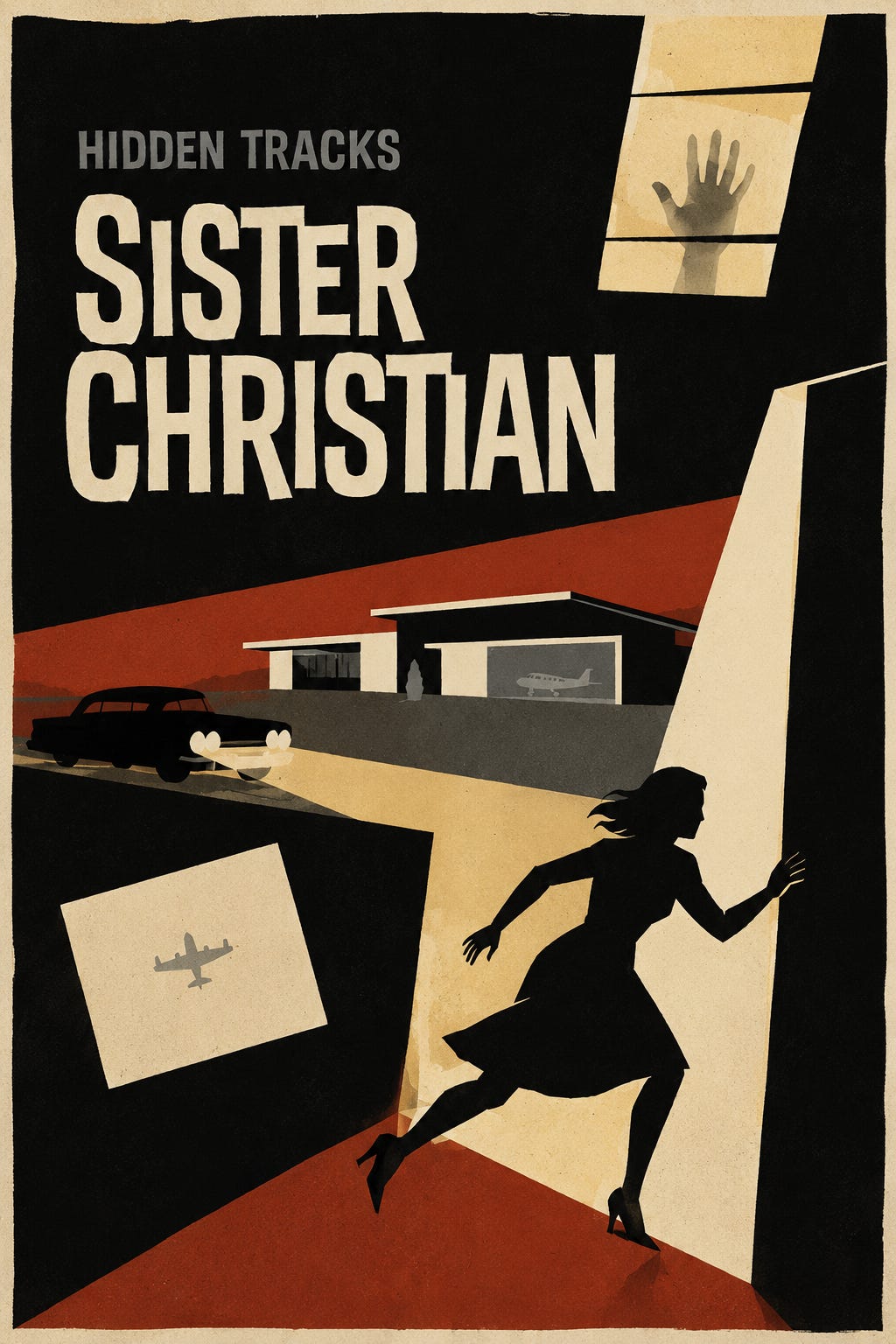
The car was early.
It sat at the curb with the engine running, headlights washing over the chain-link fence across the street. Christy stood in the kitchen in her socks and watched it through the gap in the blinds.
Her mother kept her hands busy. Spoon to counter. Ashtray to table edge. Gas bill under the church flyer, then straight again when the corner showed. The cigarette sagged between her fingers, ash growing long and pale.
“He’s early,” Christy said.
Her mother nodded.
The kitchen smelled like old coffee and cigarette smoke and the pork chops they’d had two nights ago. The window over the sink had a crack in one corner, a white branch running through the glass. Christy had looked at it all her life. Tonight it looked staged. Like a set somebody had built to make the rest of this feel normal.
On the table sat her phone, her house key, and a cream card thick as a matchbook cover, the edges beveled, a small silver airplane stamped into one corner. In the middle was a phone number. Nothing else.
Christy looked at the number, then at her mother.
Her mother crushed the cigarette out without answering.
The car stayed at the curb with the engine running. Not impatient. Certain.
Christy picked up the phone. No new texts. She checked anyway. Tara had sent one at 8:14.
u going?
Christy had never answered.
She set the phone back down.
Her mother finally looked at her. “You don’t have to go.”
The line came out too fast. Like it had been waiting behind her teeth all evening.
Christy almost laughed.
That was how it worked around here. The words always showed up late, after the choice had been made, after the nice blouse had been ironed, after somebody’s friend of a friend had made a phone call, after the electric company had left the final notice on the door.
You don’t have to go.
Right.
She looked down at herself. Black skirt. Cream blouse. Low heels she’d borrowed from her cousin Denise, who’d worn them to prom three years ago and then to family court. The heel straps rubbed the back of her ankles raw. She’d put a little makeup on in the bathroom with the bad light and the rust stain in the tub. She looked older than she was from the neck up and younger from the neck down. There was something unfinished about her. Something the clothes couldn’t fix.
The engine outside kept running.
Christy looked at the card again.
Nobody called it the same thing twice. That was part of how it stayed alive.
An internship.
A dinner.
A trip.
A party.
A favor.
A chance.
Christy turned the card over in her fingers.
“I talked to a woman,” her mother said.
Christy looked up.
Her mother kept her eyes on the counter. “She said you’d be looked after.”
Looked after.
There it was.
Christy laughed this time, once and sharp. “That’s what we’re calling it?”
Her mother turned around so fast the chair legs scraped. “What would you like me to call it?”
The kitchen went still.
Christy had heard her mother yell before. At bills. At men. At herself in the mirror when she thought nobody was listening.
Her mother lowered her voice. “You think I don’t know what people say?”
“Do you?”
“You think I don’t know what this town does to girls with no money and no fathers?”
Christy swallowed.
A horn tapped once outside. Her mother flinched.
Christy set the bent card back on the table.
At the door her mother said, “Christy.”
She turned.
Her mother’s face had gone pale around the mouth. “If you feel sick, say you feel sick. Don’t try to be polite.”
Christy stared at her. “You sound like you’ve done this before.”
Her mother didn’t blink. She looked past Christy, toward the car.
“No one told me that part.”
The driver got out before Christy reached the curb.
He was older, gray at the temples, dark suit without a tie. He opened the rear door and stood back. He didn’t smile. He didn’t look her over. He checked his watch as if she were a flight behind schedule.
“Miss Keagy,” he said.
The leather was cold through her skirt. The inside of the car smelled like a hospital hallway.
As the door shut, she looked back. Her mother’s hand was a flat white shape against the kitchen glass.
Then they pulled away.
For the first few minutes neither of them spoke. The neighborhood slid by in pieces. Pawn shop. Closed laundromat. Church sign with half the letters dead. The gas station where Tara’s brother worked nights. A stray shopping cart tipped into a ditch.
Christy watched the driver in the mirror.
He kept both hands on the wheel. Ten and two. No ring. Clean nails. His face looked practiced.
Finally she said, “How far?”
“About forty minutes.”
“Where?”
“Outside Ashbury.”
She didn’t know Ashbury well. Rich houses. Horse property. Roads with no sidewalks and names like Fox Run and Hunt Club. Places where people paid extra not to hear their neighbors.
“Who’s hosting?”
“A private gathering.”
Christy looked out the window again. “That’s not an answer.”
“It’s the one I have.”
She almost pushed then. Almost asked whether he did this every week.
Instead she took out her phone and opened Tara’s text.
u going?
Christy typed back.
yeah
The dots appeared almost immediately. Then stopped. Then appeared again.
u need me to call?
Christy stared at that.
The car turned off the main road.
No streetlights out here. Just black fields and the occasional wash of a porch lamp in the distance.
She typed:
not yet
Then another message came in.
my cousin said if there’s a lady named lorna don’t let her fix your makeup
Christy’s thumb froze on the screen.
She looked up at the driver.
He was watching the road.
Slowly she locked her phone and slipped it into her bag.
Twenty minutes later they turned onto a long private drive lined with bare trees. The headlights caught trunks white as bone and a split-rail fence running beside them. At the end sat a low house spread wide across the dark like it had grown there on purpose. Not a mansion. Worse. Tasteful. Stone front. Warm windows. A detached garage big enough for a family to live in. Beyond it, set back and low, she could just make out the shape of a small hangar.
Her stomach dropped.
The driver pulled beneath the covered entrance and got out.
By the time her door opened, a woman was already there waiting.
She was maybe forty-five. Blonde hair pinned back hard. Long dark coat. No nonsense shoes. Not beautiful. Not trying to be. She had the kind of face that could have worked a hospital desk or a funeral home.
“Christy.” She smiled, but only with her mouth. “I’m Lorna.”
There it was.
Christy got out carefully, one heel catching on the floor mat before she found the ground. Gravel ticked under her shoes.
Lorna reached up and smoothed a strand of hair behind Christy’s ear before Christy could step back.
“You look lovely,” she said. “Come in, sweetheart. It’s cold.”
The word hit her harder than the hand.
Inside, the house was warm enough to make her skin prickle. Somewhere deeper in, music played low. Piano and something brushed and soft behind it. The entryway smelled like lilies. Fresh ones. There was a table under a mirror with a silver tray laid out on it, little chocolate mints in a dish and a crystal bowl for keys.
She led Christy down a hall into a powder room bigger than Christy’s bedroom. Marble counter. Soft hand towels. A candle burning beside the sink. There were two other girls inside.
One was sitting on the closed toilet seat, knees together, scrolling her phone with both thumbs. Younger than Christy by a year or two, maybe. The other stood at the mirror in a blue dress, rubbing at something under one eye.
Neither looked up.
Lorna opened a drawer and took out a lipstick tube and a packet of blotting papers. “Just a touch,” she said. “You’ve got a pretty face. No need to hide it.”
Tara’s text flashed in Christy’s head so hard it almost felt spoken.
Christy stepped back. “I’m okay.”
Lorna paused. Then smiled again. “Of course.”
She set the lipstick down with great care.
That was when Christy saw it.
A row of phones in the open drawer. Seven, maybe eight of them, all dark. One had a cracked case with little pink kitty ears on the corners.
Lorna saw where she was looking.
“For privacy,” she said. “Some of our guests are high profile.”
Christy closed her hand around the strap of her bag.
Lorna held out her hand. “Phones stay with me.”
Christy didn’t move.
Lorna’s smile stayed where it was. “You’ll get it back when your driver brings you home.”
Christy looked at the other girls. The one in blue was still rubbing under her eye. The younger one started to reach for the phone that wasn’t there, then folded both hands neatly in her lap.
Down the hall, a man laughed. Another answered. Glass touched glass.
Lorna put a hand at the small of Christy’s back and guided her toward the door. “We’ll just do introductions first. Then dinner.”
Christy let herself be moved into the hall, but her body had already begun separating things into what they were and what they were called.
Introductions meant inspection.
Dinner meant waiting.
At the end of the hall hung a framed photograph of a man Christy didn’t know shaking hands with the president in front of a plane. The president grinned for the camera. The man looked pleased without looking surprised.
The house hummed around them. Soft music. Dishes from another room. Men talking in low voices that never had to rise because nothing in their lives had ever required it.
Christy looked at the front door.
Through the glass, she could still see the headlights washing the drive.
Not the photograph. Not the voices. Not Lorna’s hand at the small of her back.
The car.
It would not wait forever.
Something in her chest went tight.
Christy stepped sideways out from under Lorna’s hand.
Lorna’s smile thinned. “Christy.”
Christy was already moving.
She turned and ran for the front door.
The liner notes are below. Song, schematic, what got cut.
The Analog Connection
The real Sister Christian was written by Night Ranger drummer Kelly Keagy about his actual sister, Christy.
The song came on a playlist I wasn’t paying attention to and I was maybe three sentences into the mother scene when motoring hit and my hands stopped on the keyboard. Not because it was pretty. Because it was wrong in exactly the right way. The song is a brother watching his sister rev up for something he can’t stop. That’s not a metaphor for this story. That’s the load-bearing wall.
The Technical Schematic: The Card
Cream card. Beveled edges. Small silver airplane in one corner. Phone number, nothing else.
Here’s what’s wrong with it physically. Cards don’t have beveled edges unless someone paid extra for that. The bevel is pressure-cut, which means a machine spent time on the corners of a thing designed to be handed to a seventeen year old girl. The airplane isn’t a logo. There’s no company name. No address. Just a stamp, like a watermark on currency. The card is thick as a matchbook cover, which means it has weight. You feel it when you pick it up. Someone engineered that. Someone decided the card should feel like something solid when a girl closes her hand around it.
That’s the whole machine in 3x2 inches.
The Riff/Beat Alignment
Go to the 3:00 mark. The guitar solo is winding down, and there’s that sequence of heavy, deliberate piano chords before the final chorus “motoring” explosion. I used that exact spacing for the moment Lorna opens the phone drawer. Each phone in that drawer, the cracked screen, the one with the cat ears, is a piano chord. Thud. Thud. Thud. It’s the pacing of a trap closing.
The “Stephen King” Ledger
Original line, cut:
“The house held its warmth like a kept secret, drawing her in with the particular cruelty of comfort.”
Killed it. Killed it with a shovel.
What replaced it:
“Inside, the house was warm enough to make her skin prickle.”
Skin prickle. That’s it. The body knows. The body doesn’t editorialize.
The Probing Question
Look at the device you’re using to read this. Think about the “Terms and Conditions” you clicked “Accept” on without reading. If someone knocked on your door right now and cited paragraph 12, sub-section B, demanding you hand over your phone and get in a car, what is the one specific, mundane object in your room: a stapler, a coffee mug, a frayed charging cable, that would suddenly look like a prop on a stage you can’t leave?
Loving the new look to the graphics.