
Spoiling Meat
The bleach stops at the skin.

We stopped using names for the dead after the third winter. Not out of cruelty. Efficiency. Names slow things down.
The bodies didn’t mind.
They moved the way anything moves when you don’t interfere. Forward, uneven, hungry. No hate in it. Watching them was like watching mold take a loaf you already stopped wanting.
People used to argue about when it started. The bite. The fever. That moment the eyes go flat.
Comforting lie.
You start dying the day you’re born. Infection just speeds it up.
We cleared the storefront by noon. Two inside. One collapsed in the canned vegetables like it had decided the aisle was as good a grave as any. The other stayed upright, cautious, testing each step before it committed weight.
Later, Evan sat on the curb and scrubbed his hands with a bottle of bleach until his knuckles shone raw. It didn’t matter. Rot isn’t something you clean. It’s a process. You only notice it when it’s ahead of you.
I stayed in the doorway and watched him work at it. My hands smelled the same. I’d stopped reaching for the bottle two weeks back.
“You’re going to get septic,” Evan said, drying his hands on a rag that used to be white. “Hygiene is the firewall. If we lose that, it’s game over.”
He stood up with a wince, yanked his boot off. The sock peeled away wet.
“Pack the gear,” he said. “Distribution center by sunset. The log says broad-spectrum antibiotics. Fresh boots.”
I looked back at the thing in the aisle. It was wearing a tie. The silk had fused to the neck meat.
“Sure,” I said. “Fresh boots.”
The heat came off the highway in waves. Asphalt soft enough to hold a print if you stood still and argued with it.
“Don’t stop moving,” Evan said. “Gets tacky in heat like this. You stand still, you’ll lose the tread.”
I kept walking. He’d told me before.
He walked with a hitch.
We reached the distribution center at five. The loading dock was empty.
Evan checked the manifest clipped to the wall. He ran a finger down the page. The paper crumbled at the edges.
“Row G,” he said. “Pharmaceuticals. Maintenance supplies. Cold storage.”
We walked past rows of dog food. Bags had split. The kibble was brown paste and smelled like yeast and wet fur.
“Watch your step,” Evan said. “Slick.”
I slipped, boot skidding through the muck, and grabbed for the rack. The metal bent under my weight. Didn’t break, just buckled.
I stared at the orange dust on my palm. Rust, dry as old blood. Evan would still call it a threat.
“Keep moving,” he said without looking back.
We reached the thick cold storage doors. Evan grabbed the handle.
“On three,” he said. “One. Two. Three.”
He pulled but the bolt snapped and the handle came off in his hand.
“Shit,” Evan said. “Need a pry bar.”
Sweat ran down his temple.
I looked back at the rows we’d passed. Nothing we could use. Then I saw the manager’s office.
“Maybe there’s one in there,” I said, pointing.
We overturned the desk. Nothing but mouse droppings and a foam stress ball.
I pushed the desk back against the wall.
Evan slumped in the swivel chair, trying to bandage his blister. The tape wouldn’t stick. The adhesive crumbled.
I sat on the floor and took off my boot. My foot was pale and wrinkled from sweat, but solid.
“The tape’s no good,” Evan muttered, throwing the roll. It bounced off the wall and clattered into the corner. “Everything in this place is garbage.”
“Let’s go back,” I said.
“We need more antibiotics,” Evan said.
“Evan, it’s just a blister.”
“It starts with a blister.” He stood.”Then it’s gangrene. Then it’s rot. Then you’re them.”
He pointed at the window. “Just spoiling meat.”
I looked out. The yard was full of them.
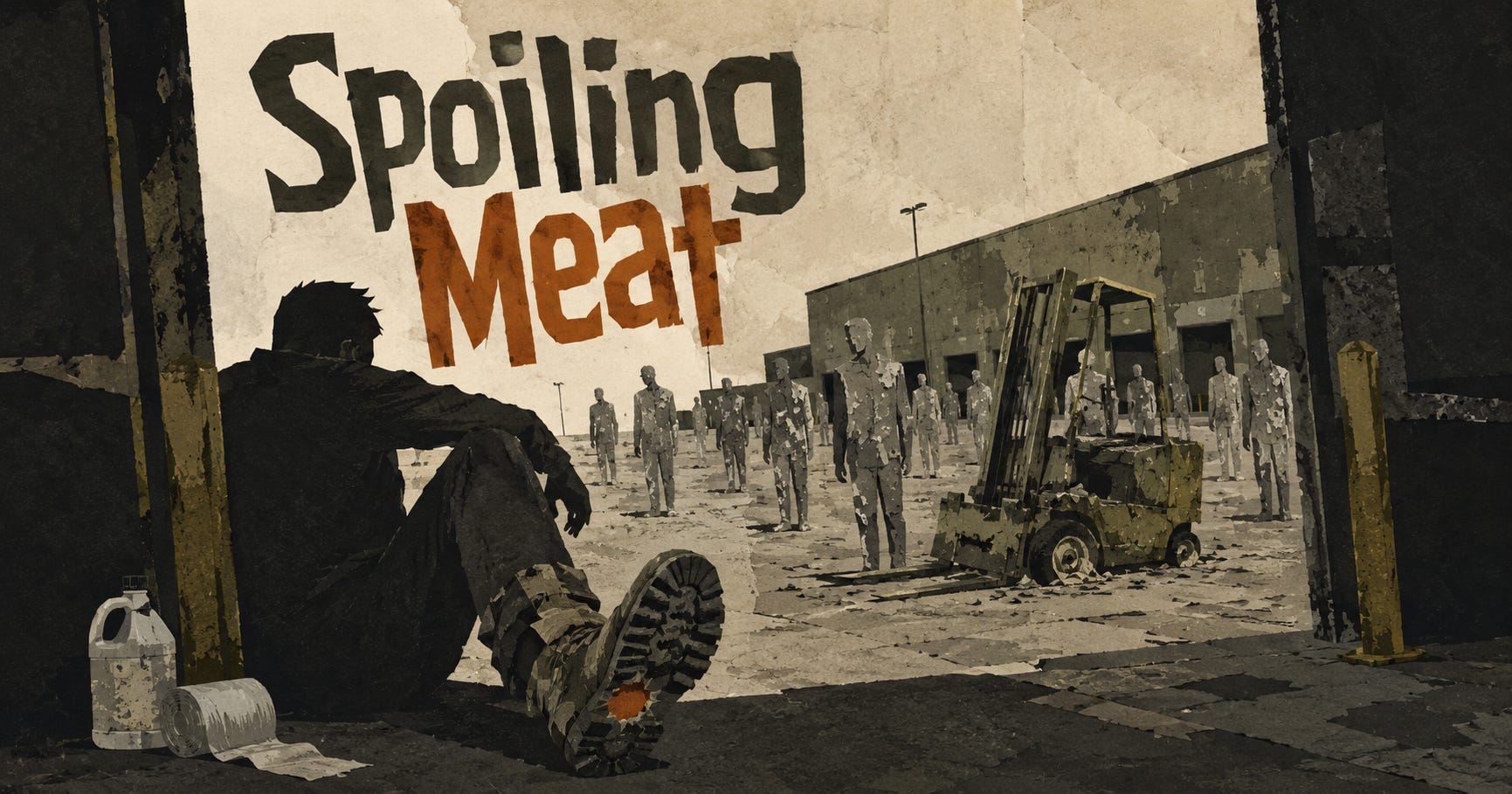
They weren’t attacking. They were just standing. One leaned against a forklift that leaned too, the frame sagging. Where they touched, both were the same color. Grey. Flaking.
The tires were cracked rubber clumps on the crumbling asphalt.
“They’re waiting,” I said.
Evan grabbed a letter opener from the desk and stabbed it into the wood. It sank in easy.
“Evan.”
“I’m going to see if there’s a hardware section,” he said. “Stay here. Hold the perimeter.”
He walked to the door and pushed without touching the knob. The wood bowed outward and tore.
I waited.
The sun went down. Purple light came in. The office smelled of mildew and old copper.
Then he screamed.
I ran toward the sound.
I found him at the end of Row G.
He wasn’t bit. He wasn’t surrounded.
He was stuck.
He’d tried to climb a shelving unit to reach the top tier. The unit had collapsed under his weight.
He was pinned.
“Get it off!” Evan yelled. “It’s touching me! It’s all over my skin!”
I grabbed the nearest beam. It crumbled in my hands, a hollow shell. I tore at the debris.
“Hurry!” Evan yelled.
I freed his arm. Then his head.
He was covered in dust and black mold, clawing at his face, scraping at his skin.
“Get it off,” he said. “Where’s the bleach?”
“Evan, you’re fine. It’s just rust.”
“It’s not fine!” He pointed at his legs.
I looked down.
When the shelving collapsed, the bolts had torn through the floor. The debris had landed in a crater of broken concrete and exposed rebar. The underlayment was grey sludge.
Evan’s legs were buried in rubble up to the knees.
Three pieces of rebar lay across his shins at different angles. Worse, a jagged slab of the floor, easily two hundred pounds, had settled on top of the bars, pinning everything in place.
“I’m going to move the rebar,” I said.
I grabbed the first piece, thick and pitted, got leverage under it. It wasn’t under the main block. It came free with a grinding sound and I threw it aside.
Evan gasped. “Okay. Keep going.”
I grabbed the second piece. Heavier. It ran straight under the slab. I braced my foot against a chunk of concrete and pulled.
It shifted. Half an inch. Then it stuck.
From somewhere in the warehouse, I heard the shuffle. Wet. Dragging. Multiple sources.
I froze.
Evan heard it too.
“How many?” he whispered.
I looked over my shoulder. The aisle was dark, but shapes moved in the shadows. Five. Maybe six. They weren’t running. They never ran.
I looked back at Evan’s legs. The second piece of rebar. The slab holding it down.
“Keep going,” Evan said, his voice shaking. “You can get it. Just keep going.”
I pulled at the rebar again. The slab didn’t move.
The shuffling got louder.
Six of them. Spread across the aisle. Thirty feet away.
I looked at the rebar. The slab. The rubble burying them both.
I looked at the dead. Twenty feet away now, moving slow but steady.
Evan stopped pulling against the rubble. He looked at the things coming toward us, then at me.
“I can’t be this,” he said quietly. “I did everything right.”
“I know.”
The dead were fifteen feet away. Close enough to smell. That thick, sweet smell that didn’t wash off.
Evan reached for the pistol on his belt but his hands were shaking. He couldn’t get a grip on the holster snap.
I took the gun from him. The metal was pitted but solid.
“Now,” Evan whispered.
The dead were ten feet away.
“Close your eyes,” I said.
He closed his eyes and stopped pulling against the rebar. His hands went still.
I squeezed. The trigger grated, grinding on rust, before it snapped.
The sound was loud. Sharp.
The dead didn’t react. They just kept coming, reached the rubble pile and stopped. Standing there, swaying slightly.
They looked down at Evan. They looked at me.
They didn’t try to dig him out. They didn’t try to feed.
They just stood there.
I walked past them. They didn’t follow.
Outside, the purple light was fading. The forklift had collapsed while I was inside. The dead thing that had been leaning against it was on the ground now, half-buried under corroded metal.
It didn’t try to get up.
I walked back to the highway. My boots stuck in the soft asphalt. I pulled them free, testing the step.
Like this story?
It’s part of my short story collection, Farrago: Volume 1. Purchase the twenty-two story collection here:

The tie fused to the neck meat. The dead thing and the forklift turning the same color. That's where this piece is strongest; when decay isn't a metaphor, it's just physics. The world rotting at the same rate as the bodies is a better idea than most zombie fiction earns in a whole novel.
Loved this. Very solid stuff.