
The Trope Eater

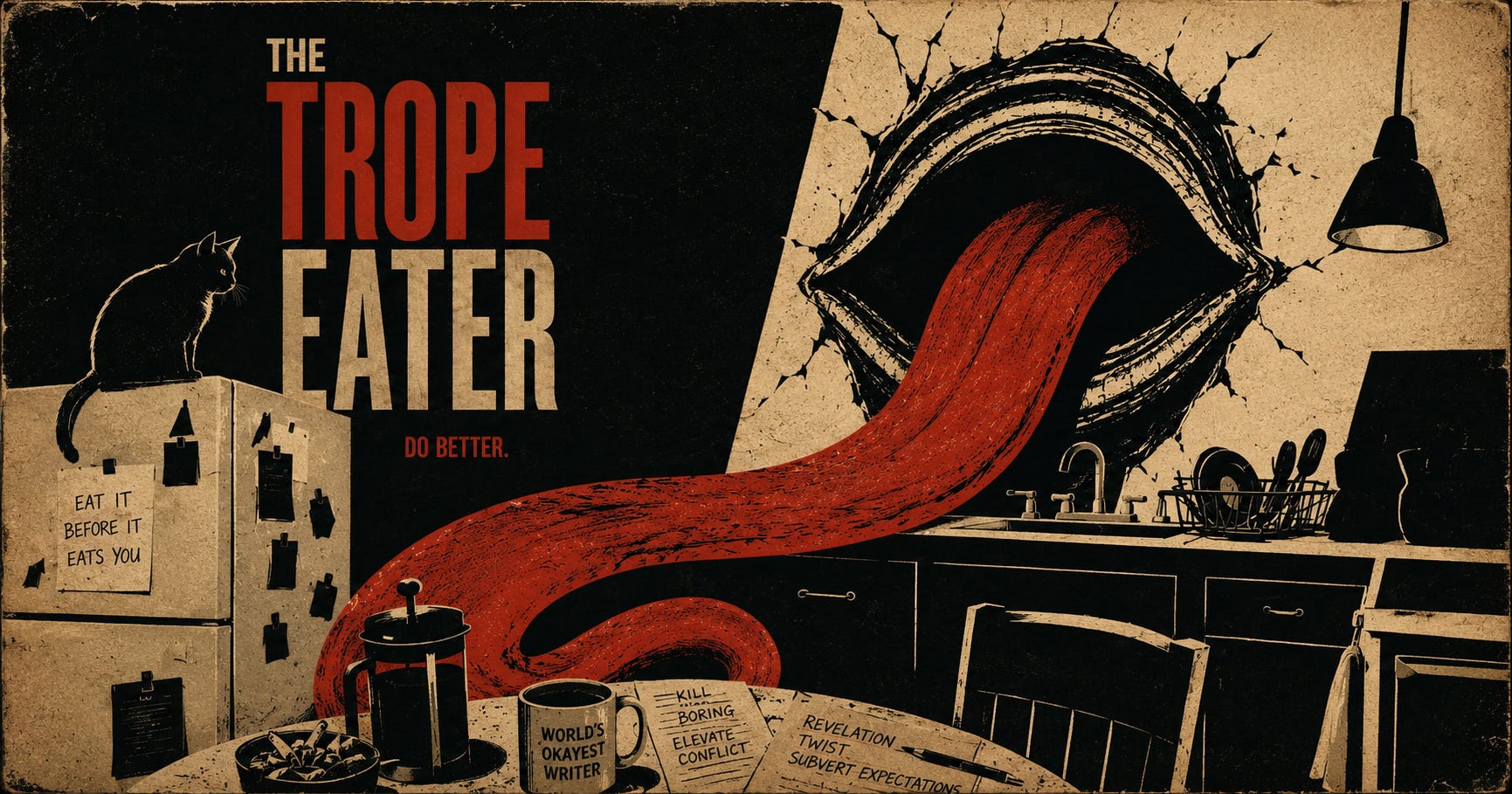
The first thing it ate was the cat.
Not my cat.
The real Mr. Pickles was alive, obese, and wedged inside an Amazon box labeled SMALL FRAGILE ITEMS, which felt optimistic.
The thing ate the part where the cat knows.
In the draft, the closet door creaked open at 3:17 in the morning. Mr. Pickles was supposed to freeze, lift his head, and stare into the dark with ancient animal terror.
Instead, he looked at the closet, looked at me, and went back to cleaning his business with one leg in the air.
On the screen, the sentence deleted itself.
Mr. Pickles hissed at something Connor could not see.
Gone.
In its place appeared two words.
DO BETTER.
I stared at the screen.
Mr. Pickles farted.
That part stayed.
I sat in my office at 2:14 in the morning with a cold cup of coffee, three overdue bills, and a haunted house novel that had started rotting in the middle. The working title was The House on Blackwater Hill, which my agent said sounded “comfortably market aware.” That meant it was bad, but in a way people might recognize from airport paperbacks and streaming thumbnails.
The novel had a grieving widower. A daughter who drew things she shouldn’t know about. A house with a locked room. A priest with a drinking problem. A basement full of jars.
Not good jars either.
You know the kind.
I knew it was crap.
I had written every sentence with the dull, professional shame of a man assembling office furniture from missing instructions.
But rent did not care about art. Rent wanted a haunted house. The electric company wanted a creepy kid. My student loans wanted at least one doll with an eye that moved when nobody was looking.
The cursor blinked after DO BETTER.
I blinked back.
“Excuse me?” I said.
The laptop fan kicked on. Something inside the machine made a wet little chewing sound.
I leaned closer.
A bite mark appeared in the paragraph above. Not metaphorically. The text buckled inward. The words ancient animal terror wrinkled, folded, and vanished like something with tiny teeth had pulled them through the glass.
A second later, something burped.
It came from the speakers.
A small burp. Almost polite.
Mr. Pickles stopped cleaning himself and looked at the laptop.
“Now?” I said. “Now you have instincts?”
He lowered his leg.
The screen flickered.
Another sentence vanished.
Connor felt the temperature drop.
Gone.
In its place:
LAZY.
“Hey,” I said. “People like temperature drops.”
The cursor blinked.
Then:
PEOPLE ALSO LIKE HITTING THE ELEVATOR BUTTON TWELVE TIMES.
I should have closed the laptop. I should have unplugged it, thrown it out the window, buried it in the yard, salted the earth, and moved to a place without Wi-Fi or creative writing programs.
Instead, I said, “Who are you?”
The screen went black.
My reflection stared back at me. Forty-one. Puffy. Beard doing less “rugged horror author” and more “man who knows the good gas station burritos by region.”
Behind me, the office closet stood open.
It had not been open a minute before.
A sound came from inside.
Chewing.
Not loud. Not dramatic. No bone-crunching wet symphony. Just a nasty little mouth working through something soft.
I turned around.
The closet was packed with the usual failures. Tax records. Printer paper. A plastic skeleton from a Halloween reading I had done at a brewery where ten people showed up and one of them asked if I knew Joe Hill. A banker’s box full of unsold author copies sat on the floor, quietly absorbing my self-esteem.
Something moved behind the box.
“Mr. Pickles,” I whispered.
Mr. Pickles had already left.
The box shifted.
A thin gray hand slid over the edge. Then another. The fingers were too long and jointed badly.
The thing pulled itself into view.
It was about the size of a toddler, if the toddler had been assembled from damp book covers, VHS tape, and bad decisions. Its skin was the color of old oatmeal. One eye was bright blue and huge. The other was a black button. Its mouth ran sideways across its face, packed with tiny square teeth.
It wore a little bib.
The bib said NOM NOM in red stitching.
We looked at each other.
It held up a page from my manuscript.
On the page, I could read:
The little girl stood at the top of the stairs in her white nightgown.
The thing made eye contact with me and chewed the page slowly.
It swallowed.
“Nightgown kid,” it said, and gagged. Its voice sounded like a podcast played through a clogged drain. “Always with the nightgown kid.”
“You can talk.”
“Better than you write, apparently.”
I stood up too fast and bumped my knee on the desk. Pain shot down my shin. Real pain. Specific pain. The kind nobody writes unless they have recently met furniture.
It sniffed the air.
“Specificity,” it said.
“Get out of my closet.”
“Make me, midlist.”
That hurt worse than the knee.
“I’m not midlist.”
The creature smiled.
No one should smile with that many teeth unless they are about to sell you a timeshare in Hell.
“You have a Goodreads average of 3.6 and a panel at ScareCon called The New Shape of Fear in Ballroom C at 10:15 Sunday morning.”
“How do you know that?”
“I eat tropes, Cal.”
“Then why are you here?”
It pointed at the laptop.
I looked back at the screen.
My chapter was bleeding deletions.
The widower paused at the basement door.
Gone.
Something whispered his dead wife’s name.
Gone.
The flashlight flickered.
Gone.
The little girl drew a picture of the house before they moved in.
Gone.
Under each missing sentence, the creature left comments.
NO.
TIRED.
CRIMES AGAINST STAIRS.
STOP MAKING WOMEN WHISPER “HELLO?” INTO DARK ROOMS.
That last one stung because it was correct.
I grabbed the manuscript pages from the printer tray and held them against my chest.
“These are mine.”
The creature stared at me.
Then it opened its mouth wider than its head should allow and said, “For now.”
I threw the coffee mug at it.
The mug passed through the creature and shattered against the closet wall.
The creature looked mildly impressed.
“Nice. Classic thrown object. Emotional but ineffective. Crunchy mouthfeel.”
Then it sucked in air.
The broken mug pieces trembled. The moment trembled. The whole sad little performance of a frustrated writer throwing a mug because he could not throw his life cracked loose from reality.
The creature inhaled it.
The broken ceramic reassembled itself on the floor, then slid back onto my desk. The coffee returned to the mug, still cold, still terrible.
I no longer felt like a man who had thrown something.
I felt like a man holding a prop after rehearsal.
“What did you just eat?”
“Impulse.”
“That was my impulse.”
“It was derivative.”
“I’m calling the police.”
It laughed so hard its button eye rattled.
“You’re going to call the police and tell them a monster is eating your haunted house novel?”
“Yes.”
“Wonderful. Do that. Maybe they’ll send the skeptical cop two days from retirement.”
I picked up my phone.
No service.
The creature gave me a look.
“No,” it said. “I didn’t do that. That’s you. You wrote that three pages ago.”
I looked at the laptop.
Sure enough, there it was.
Connor pulled out his phone. No signal.
I hated myself with the hot clarity of a man seeing his own browser history projected at a funeral.
The creature climbed onto my desk. It moved badly. Too many joints. Not enough respect for furniture. It sniffed the laptop and licked the H key.
“You have talent,” it said.
That was somehow worse than an insult.
“Don’t do that.”
“But you keep wrapping it in discount-store fog machine juice.” It tapped the screen. “Dead wife. Creepy kid. Cat as paranormal radar.”
“It’s commercial.”
“It’s mulch.”
It reached into the screen.
I saw its fingers pass through the glass and into the document. It rummaged around like a kid digging through cereal for the marshmallows.
“No,” I said.
It pulled something out.
A tiny black shape writhed between its fingers. It looked like a plastic spider made of punctuation.
“What is that?”
“Jump scare.”
It popped the thing into its mouth and chewed.
On the screen, the scene changed.
The closet door opened.
Connor did not gasp. Did not drop his flashlight. Did not say, “Who’s there?” like a man auditioning for natural selection.
He backed out of the room, shut the door, dragged a dresser in front of it, took his daughter to a hotel, and called a realtor in the morning.
I stared.
“That’s actually better.”
The creature licked its lips.
“Obviously.”
The next morning, I sent the revised chapter to Bonnie.
I did not tell her about the trope eater. That felt premature. Also, Bonnie had once told me a possession subplot needed “more sex appeal,” so I wasn’t confident in her crisis instincts.
She called me twenty-seven minutes later.
“Cal,” she said. “What happened?”
“Good morning to you too.”
“No. Don’t do that. Don’t be cute. What happened to the book?”
I looked at the closet.
The door was closed.
Something inside hummed “Mr. Sandman” with its mouth full.
“I revised it.”
“You revised it?”
“Yes.”
“This is good.”
I sat down.
Bonnie Bell did not use the word good unless she was ordering sushi or describing another writer’s sales numbers while destroying your afternoon.
“How good?”
“Annoyingly good.”
“That sounds a lot like praise.”
“It is. I’m proud of you and resentful. There’s tension now. The characters are making intelligent choices, which is deeply unsettling.”
“That’s what I was going for.”
“No, it wasn’t.”
No, it wasn’t.
“The cat thing is great.”
I glanced at Mr. Pickles. He was sitting beside his empty bowl, staring at me with the dead-eyed patience of a landlord.
“Yeah,” I said. “The cat thing works.”
“The daughter doesn’t.”
I sat up straighter.
“What?”
“She’s still a weather vane with bangs. She exists to point at plot. Fix her or lose her.”
From inside the closet came a muffled, “THANK YOU.”
I covered the phone. “Shut up.”
Bonnie paused. “Was that your cat?”
“He’s going through something.”
“Aren’t we all. Also, no creepy singing children. We are past that as a culture.”
I hung up.
For three days, “Bibby” and I worked.
That’s not true. For three days, I wrote garbage and Bibby ate the worst parts. He was an efficient red-liner. He ate the thunderstorm. He ate the protagonist refusing to leave the house because “we have nowhere else to go,” even though he had a functioning credit card and a sister in Columbus.
Bibby ate every mirror scare. He ate the priest entirely, except for his shoes.
When I asked why the shoes stayed, the toddler-sized pile of book covers shrugged.
“Good shoes,” Bibby said.
By Friday, The House on Blackwater Hill had become something leaner, meaner, and harder to describe. The dead wife stopped whispering warnings and started leaving practical notes.
DON’T OPEN THE WALL.
THE CONTRACTOR LIED.
CHECK THE CRAWLSPACE, BUT WEAR A MASK. THERE IS RACCOON FECES.
The daughter stopped drawing prophetic pictures and started taking videos for evidence.
The house was no longer evil because a family had died there in 1893. It was evil because a developer had built over a sealed municipal tunnel after bribing three inspectors and mislabeling the concrete reports.
Bonnie loved the tunnel.
“Bureaucratic evil,” she said. “Very now.”
“That’s what I thought.”
“Don’t sound pleased. You’re one clever paragraph away from writing a TED Talk with mold in it.”
“Noted.”
“Good. Keep the rot. Cut the speech.”
Bibby preened.
By Saturday afternoon, it had opinions about my author photo.
“Too much wall,” it said.
“I’m standing in front of a wall.”
“Exactly.”
“You want me in the woods?”
“I want you to stop looking like you host a podcast about bourbon.”
“Everybody looks like that now.”
“Tragedy has many faces.”
It had grown too.
At first it could hide behind the banker’s box. Now it filled the closet doorway when it stood up, all elbows and bib and wet little teeth. Its skin had picked up details from whatever it ate. One arm was stitched like a doll’s. A strip of black hair hung over one eye. Its left foot wore a clown shoe.
I asked about that.
It wiped its mouth.
“Dessert.”
I should have been afraid.
But fear gets complicated when the monster is helping your career.
Bonnie called again Sunday morning and used the word “auction” in a tone that made me sit on the edge of the bed and forget how ankles worked. Three editors wanted the manuscript. One wanted a call. Another had used the phrase “genre-defining,” which meant nothing and cost extra if you put it on a book jacket.
The trope eater listened from the closet.
When I hung up, it clapped.
Its hands made a damp sound.
“See?” it said. “You’re welcome.”
“You ate half my book.”
“I ate the parts holding the book hostage.”
“You ate Father Brennan.”
“Father Brennan drove drunk to an exorcism with a tragic backstory and a secret flask. He had breath mints for a soul.”
“Still.”
Bibby leaned close.
Its breath smelled like old paper and microwave popcorn.
“You know what your problem is, Cal?”
“I have several. My knee still hurts.”
“You think clichés are the enemy.”
“Aren’t they?”
“No. Cowardice is the enemy. Clichés are just cowardice with tenure.”
That sounded good enough that I almost wrote it down.
The creature saw my face.
“Don’t.”
I didn’t.
By evening, I needed coffee, cat food, and the peanut butter cups I only bought when pretending I wasn’t buying them. The creature wanted to come.
“No,” I said.
“I can wear a hat.”
“You’re not wearing a hat.”
“I ate a mysterious drifter. I have range.”
“You’re staying here.”
It sulked in the closet and chewed through three dream sequences while I got my keys.
Outside, the sky was flat and gray. No storm. No wind. No moon caught in bare branches. Just a regular Ohio evening with damp pavement and a neighbor dragging trash cans to the curb in basketball shorts.
I drove to the BP near the county line.
The clerk was elderly, thin, and arranged behind the counter like a warning in human form. He had white hair, cloudy glasses, and a face that looked carved from a potato that had seen combat.
Perfect horror gas station clerk.
I set my coffee on the counter.
He looked at me.
I waited.
This was the moment where he was supposed to say something like, “Road’s closed past Miller’s Creek,” or “You don’t wanna go up that way tonight,” or “Folks been hearing things out by the old slaughterhouse.”
He rang up the coffee.
“Anything else?”
I waited harder.
He scratched his neck.
“Sir?”
“You don’t have anything to tell me?”
“Bathroom’s out of order.”
“That’s it?”
He glanced toward the hallway.
“It’s pretty bad, honestly.”
“No ominous local knowledge?”
He stared at me for a long second.
Then his face changed.
Not much. Just enough.
His mouth opened. His eyes went soft and empty, like somebody had unplugged a lamp behind them. A faint chewing sound came from somewhere overhead.
The clerk blinked.
“What was I saying?”
“Bathroom,” I said.
“Right. It’s a war crime back there.”
Outside, the streetlight flickered.
That was when I understood.
The creature had gotten out.
I drove home too fast, which would have been a bad idea except the road was well-maintained, the weather was clear, and nobody stepped into my headlights wearing a nightgown.
That almost made it worse.
The town looked ordinary. That was the problem. Horror had rules. Bad rules, sometimes. Dumb rules. Rules that left teenagers wandering into barns without flashlights. But rules.
Now the rules had teeth marks.
At the corner of Maple and Granger, Mrs. Albright’s old Victorian should have looked haunted. Everybody knew it. Three stories of peeling paint and windows that watched you like a collection agency.
Tonight, the house was a crisp, offensive white. The landscaping was lush and manicured. Through the dining room window, I could see a family at the table. They were laughing over a roast. They looked like people who had never had a bad thought in their lives.
It looked like a detergent commercial with the sound turned off.
I stopped at the light. To my right, tucked into the dark gravel lot by the cemetery entrance, a sedan sat idling. A teenage couple sat in the front seat. They were fully clothed. They both had their seat belts on.
No masked figure watched from the tree line.
No hook scraped the roof.
I almost drove into a mailbox.
By the time I got home, my hands felt too tight on the steering wheel.
The closet door was open.
Bibby sat on my desk, twice as large as before, licking red ink off its fingers.
My laptop was open.
The screen showed a blank page.
At the top, in bold, were three words:
REALITY NEEDS EDITS.
I stood in the doorway with a gas station coffee in one hand and a bag of peanut butter cups in the other.
Bibby looked at the candy.
“Are those for me?”
“No.”
“Selfish.”
“You ate the gas station guy.”
“No, I edited the gas station guy.”
“He was supposed to warn me.”
“He had a GED, sciatica, and a shift ending at eleven. Let the man live.”
“You can’t just eat reality.”
Bibby climbed down from the desk. Its bib had changed. Now it said SECOND DRAFT.
“I don’t eat reality,” it said. “I eat shortcuts.”
It opened its mouth.
Somewhere far away, a woman decided not to investigate a noise.
Somewhere else, a car started on the first try.
A group of teenagers canceled their cabin weekend after reading the reviews.
Bibby breathed in and shuddered with pleasure.
“I eat the parts you keep using because you’re afraid to write something real.”
I swallowed.
It sniffed.
“Careful, Cal. That felt like character development.”
Then the lights went out.
For half a second, I thought it had eaten the power outage too.
Then Mr. Pickles growled from the kitchen.
A real growl.
Not ancient animal terror.
Not genre business.
Low and continuous, from somewhere in his chest. The sound a cat makes when it has looked at something and done the math and doesn’t like the answer.
Bibby turned its head.
Its smile faded.
From the kitchen came a second sound.
Chewing.
Bigger than Bibby’s.
Wetter.
Slower.
Bibby whispered, “No.”
I stared at it.
“What?”
It backed toward me.
For the first time since it crawled out of my closet, it looked scared.
“Cal,” it said. “What did you write before the haunted house book?”
I thought about lying.
Then I remembered the drawer.
Bottom left of the desk.
The unfinished manuscript inside it.
The one I had abandoned because it was too weird, too personal, too hard to sell. No house. No dead wife. No creepy kid. Just a man who found a mouth growing in his kitchen wall.
At first he fed it scraps.
Then photographs.
Then memories.
By page ninety-three, it knew his name.
By page ninety-four, I stopped writing.
The working title was Mouthfeel.
Bonnie had called it “brave,” which meant unsellable.
From the kitchen came a soft pop, like old paint pulling loose from plaster.
I ignored it. Homeownership was mostly ignoring noises until they became invoices.
Mr. Pickles growled again.
Bibby grabbed my pant leg.
The kitchen table scraped across the floor.
Something laughed.
It sounded nothing like a trope.
Bibby looked up at me with its mismatched eyes.
I opened the door.
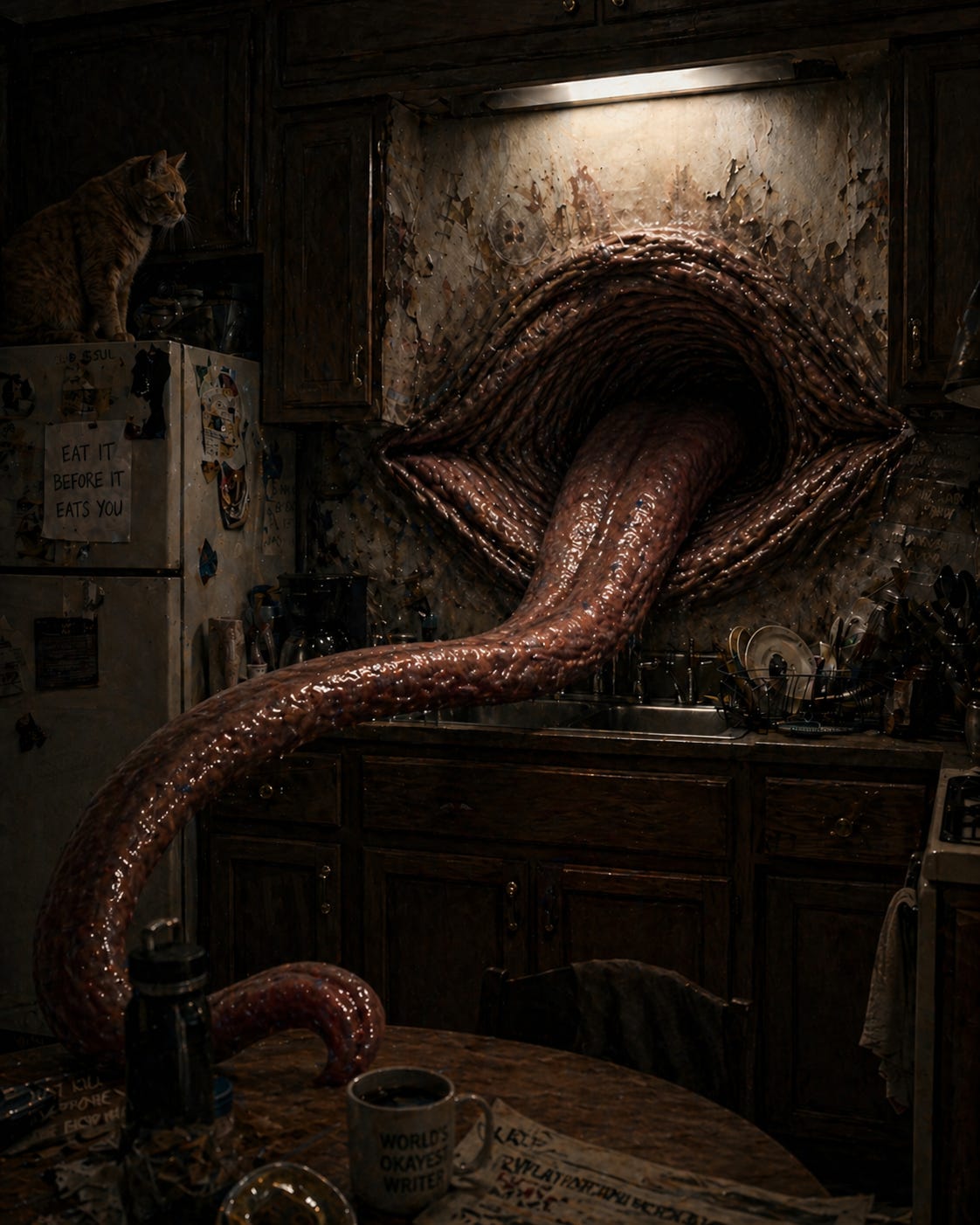
It filled the space above the sink now, a wet seam in the plaster stretched from cabinet to cabinet. The wallpaper around it had puckered and browned. The refrigerator hummed beside it like nothing in the room had violated zoning law.
Mr. Pickles sat on top of the microwave, fat and rigid, tail puffed to twice its usual size.
The mouth opened.
Inside were no teeth.
Just more mouth.
Bibby backed into my shin.
“No,” it said. “No, no, no. This is not happening.”
The mouth laughed.
The sound came out in my voice.
Bibby made a small sound. Not fear exactly. Something lower. Something with its shoes off.
“Cal,” it said.
Then the mouth took it.
Not all at once.
The first bite got the clown shoe and most of the left leg.
The second took the doll arm, the black hair, the button eye.
The third took the bib.
The bib went last.
For a moment, the red stitching hung between the mouth’s lips.
SECOND DRAFT.
Then it slid inside.
The mouth closed. The seam in the wallpaper didn’t vanish, but it stopped pulsing. It looked like a bad DIY patch job. The lights hummed back to life, flickering once before catching.
My laptop chimed in the office.
Mr. Pickles hopped off the microwave. He trotted to his bowl and sat.
He didn’t look at the wall. He didn’t look at me.
I walked to the desk. Bonnie’s name on the screen. They want the book. Call me.
I looked at the email.
The mouth in the wall chewed once. Swallowed. A single, heavy sound that moved through the floorboards.
I should call her now. West Coast editors, the time difference, she’d want me to call tonight.
The mouth spoke.
“Do better.”
I set the peanut butter cups on the counter.
I put the phone face down on the desk.
THE END
I loved this so much! Now go feed your wall.
This was so fun.