

Hidden Tracks: Unskinny Bop
What's been going on in that head of yours?

Hidden Tracks takes its titles from songs I heard when I was the right age to let them all the way in. Then it drags them somewhere darker than the lyrics were ever willing to go. You don’t need to know the songs to get the stories. But if you do, they’re going to sit differently after this.
See all Hidden Tracks stories →
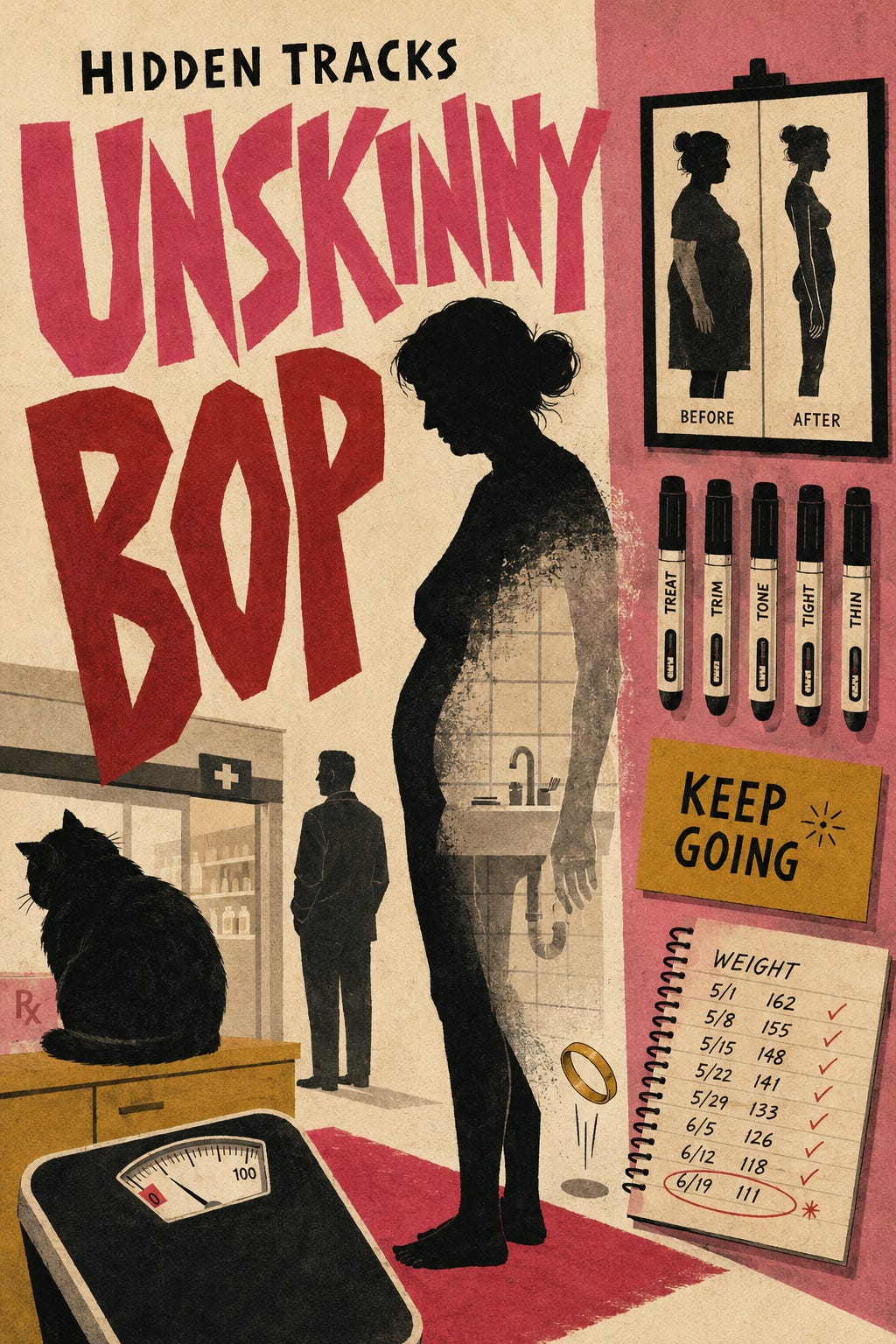
The first person to say it was her husband, and he was smiling when he did.
“Honey,” Rob said, one hand around his coffee mug, “I can see right through ya.”
He meant it as flirtation. Or maybe a joke.
Mindy touched her ear.
Rob grinned over the mug. “You keep this up, you’re gonna turn sideways and disappear on me.”
He laughed. He had that easy way of making even his own meanness sound shared. He was already halfway out the door for work, tie loose, keys in hand, talking around a mouthful of toast. “Looks good, though.”
That part landed.
It had been landing for months.
You look good.
You look amazing.
Whatever you’re doing, keep doing it.
I almost didn’t recognize you.
At first those comments had felt like revenge. The women at work who used to speak to her in that soft careful voice they saved for pregnant people and the very large now asked for her lunch order and leaned in when she talked. Men who had once looked past her in line held doors open and smiled like they had discovered manners last week. Her mother, who had spent twenty years saying she was beautiful and then buying her clothes in black, cried in a Marshall’s fitting room when she zipped a size ten dress over Mindy’s hips.
The clinic called the drug Ascendra because every real thing had to be ruined by branding first.
The waiting room had white boucle chairs, fake eucalyptus, and a refrigerator full of lemon-cucumber water. Women sat with little paper cups of supplements in their laps and tried not to look at each other while looking at each other. The receptionist wore scrubs tight enough to count ribs through. The nurse weighed Mindy every Thursday and turned the scale a little so she could see.
Down nine.
Down fourteen.
Down twenty-three.
Down thirty-one.
Each number came with praise.
“Your body is responding beautifully,” Kelsey the nurse said.
Beautifully. Like there was grace in it.
At six weeks Mindy noticed the wedding ring slipping. At eight weeks her bra strap started riding up. At ten weeks she caught herself in the dark TV after work and saw a face she barely recognized. She leaned closer and saw the hallway lamp glow faintly through the point of her chin.
She told herself it was just a reflection.
At twelve weeks the skin at the inside of her wrists gave her pause. Holding her hand over the bathroom vanity bulbs, she could make out a wash of brightness behind the blue road map of veins. She turned the bulbs off and on three times. It stayed.
At thirteen weeks she asked Kelsey whether anybody had ever had their skin turn, she almost said transparent, then didn’t.
“Dry?” Kelsey asked.
“Kind of.”
“You need electrolytes. Most women underdo water when their appetite drops. Add sodium.”
Mindy held out her wrist. “I mean, look.”
“You’ve got fair skin. Plus you’ve lost volume in your forearms. You’re probably just noticing structures more.”
Structures. That was the word.
Mindy went home with a peach-flavored electrolyte powder packet and a card that said KEEP GOING. YOUR FUTURE SELF IS THANKING YOU.
That night she stood in the bathroom in her underwear and held her belly flat with both hands. The flesh there was softer than the rest of her now, a stubborn little apron from forty-one years of being alive and eating food and sitting down. The overhead light made a pale coin of her navel. When she leaned close, she could see the dark grout line between the floor tiles through the lower curve of her stomach.
It was faint.
It was there.
She sat on the closed toilet lid until her legs went numb.
Rob knocked once and came in anyway. “You okay?”
She pointed.
He looked where she pointed then he looked at her face.
“Mindy.” He gave a little breath through his nose. “Come on.”
“Look at my stomach.”
“I am.”
“No. Look.”
He bent, squinted, straightened up. “You’ve been staring at yourself too much.”
She laughed once. The sound came out dry and hard.
“I’m not saying that shitty,” he said. “I’m saying you’ve lost a lot fast.”
He kissed the top of her hair like he was sealing an envelope. “You look incredible.”
That was the end of that conversation.
At work, April from payroll cornered her by the Keurig and asked what dose she was on.
“I’m thinking of starting,” April said. “I need a jumpstart. I’ve got my niece’s wedding in June.”
Mindy had not liked April for six years. April once called a plus-size blouse “brave” in front of three people. But there she was now, hand on Mindy’s forearm, smiling like they had been girls together.
“Don’t,” Mindy said.
April blinked.
Mindy took her own wrist between finger and thumb and pressed. The flesh gave like warm deli meat. “I’m having a side effect.”
April’s smile wobbled, then recovered. “Everything has side effects.”
“I can see through my skin.”
April laughed because the alternative was work. “Honey, that’s the dream.”
By then Mindy was down forty-seven pounds.
The clinic took before-and-after photos against a cream wall with a ring light and a little taped X for your toes. In the first photo, taken in January, she looked angry. In the second, taken in May, she looked startled and expensive. Her jaw had come out sharp. Her collarbones made two hard parentheses under her throat. The cream wall showed through her upper arms just enough that Mindy’s stomach turned.
Kelsey held up the tablet. “Look at that.”
“I am looking at it.”
“No, really look.”
Mindy did. The woman on the screen looked expensive and trapped.
“Can I get a copy?” Kelsey asked. “We only use if you sign off, obviously. But this is really striking.”
Mindy stared at her.
Kelsey tucked a piece of hair behind one ear. “As a transformation. I mean.”
That afternoon Mindy threw away the next pen.
Two days later she stopped taking the shots.
Nothing happened.
That was not true. Things happened. She got hungry in weird pockets. Three crackers at ten-thirty. Half a grilled cheese at midnight. A spoonful of peanut butter standing barefoot at the counter. She could eat ice cream and feel the cold and sugar and none of the old unclenching that used to come after the third bite.
The scale kept dropping.
Not fast. Steady.
A pound in five days.
Another in six.
Another by the following Wednesday.
She bought a battery scale because she decided the old one was wrong. The new one agreed.
She scheduled with the doctor at the clinic instead of the nurse this time. Dr. Weller came in wearing white sneakers and a watch that probably cost a decent used car. He smiled the way men do when they want credit for delivering hard truths gently.
“You discontinued without taper guidance?” he said, scrolling her chart.
“It’s still happening.”
“What is?”
“I’m still losing weight.”
He nodded like that was information from a neighbor about mulch. “Weight can continue trending for a period as your body re-equilibrates.”
“I can see through myself.”
He stopped scrolling then. Looked up.
There was a pause. Not long. Just long enough for Mindy to know exactly what would happen next.
“Have you struggled with body image before?” he asked.
She laughed again. Dry. Hard. He flinched like she had coughed blood on his shoes.
“I’m not saying I’m worried I’m still fat.”
“I didn’t say that.”
“You were about to.”
He folded his hands and gave her the look. Clinical concern. Expensive patience. “Mindy, with rapid body change, some patients experience derealization, hyperfocus, even dysmorphic features in how they interpret visual input. I’d like to run a basic panel, maybe loop in behavioral health if you’re open to that.”
She held her hand up in front of the exam room lamp.
The bones showed first. Then the blurred stem of the lamp through the meat of her palm.
Dr. Weller looked at it. The corner of his mouth went flat. Then he looked back at the chart.
“Sometimes thinner tissue transmits light more readily,” he said.
She sat very still.
He gave her the office smile again. “Which is not uncommon.”
Not uncommon.
She thought about leaning across the little desk and biting his cheek to see whether the light came through there too.
At home Rob said, “Maybe you should stop going on the forums.”
“I’m not on forums.”
“You know what I mean.”
She did. He meant obsession. Spiral. Female internet unwellness. He meant whatever would get him back to his game on the couch with the least paperwork.
She stood in the doorway in one of his old T-shirts. He could see the lit rectangle of the hallway through the fabric over her stomach where it draped against her.
“Do I scare you?” she asked.
Rob muted the television.
There it was. The first real thing either of them had almost said in weeks.
He rubbed his mouth. “Sometimes, yeah.”
“Because I’m disappearing?”
“Because you won’t stop with this.” He gestured vaguely. “Whatever this is.”
Mindy waited.
Rob looked up at her. Tired. Defensive already. “You got what you wanted.”
The room went quiet in a way that made the refrigerator suddenly sound industrial.
“What did I want?”
He did not answer fast enough.
She nodded once. “Right.”
He stood like he might go to her, thought better of it, and sat back down.
After that they learned how to pass each other around the kitchen without touching.
By July strangers were nicer to Mindy than anyone she knew.
Men smiled in line at Kroger. A barista wrote a heart on her cup. A woman outside Old Navy stopped her to ask what she’d done because whatever it was, it was working. Her mother kept buying her shirts one size too small by accident because every week the guess changed.
The photographs got worse.
Phones underexposed her at the edges first, shoulders and thighs fading into whatever was behind them. In a group shot at work the American flag lapel pin on Randy from compliance showed through the side of Mindy’s neck. She deleted every picture she was tagged in and started sitting with the bathroom door closed and the lights off.
Automatic doors at the pharmacy failed to open for her twice in one week.
The cat, a fat gray thing named Donna, started finding her by voice instead of sight. Mindy would come into the bedroom and Donna’s head would not track her until she said the cat’s name. Then the ears would turn. Then the pupils.
That one hurt.
She tried to gain weight on purpose. Fast food. Donuts. Peanut butter by the spoon. A whole Stouffer’s lasagna in one sitting just to prove there was still a mechanism between effort and body. The scale dipped anyway. Not every day. Most days just enough that denial needed reading glasses.
Two-tenths.
Point six.
Another half.
She started writing the numbers in a spiral notebook from the junk drawer. Date on the left. Weight on the right. Under that, one sentence of evidence.
July 11. Lamp through left hand.
July 14. Could see tile through hip in morning light.
July 18. Rob looked past me when I was standing in kitchen.
July 21. Cat didn’t notice until I knocked on dresser.
July 24. Another pound.
Rob moved into the guest room in August without calling it that.
He carried a pillow and charger down the hall after midnight and said, “I’m not sleeping good.”
“Because of me.”
“Because I’m tired.”
“That too,” Mindy said.
He stood there in the hall with the pillow under one arm and the charger cord wrapped around his fist.
“You need to talk to somebody,” he said.
She almost asked who. A priest. A lawyer. A mortician. Instead she said, “Would you know if I was gone?”
He looked at her then. Really looked. The shape of her in the doorway. The darkness of the room visible in weak patches through the shirt on her ribs. The shine of her eyes.
“Mindy,” he said, and his face did something she had not seen on it in a long time. It softened. “You’re right here.”
It was the kindest lie he had left.
The clinic sent an email asking whether she wanted to enroll in maintenance.
The subject line said: YOU’VE COME SO FAR.
She laughed until she cried, then answered it with one sentence.
How far do your patients usually get before they stop casting a full shadow?
No one wrote back.
September came in hot. Ohio heat hung around like it had missed an exit. Mindy went to the grocery store at eight-thirty at night because there were fewer mirrors. In produce a little girl pushing a child-sized cart stopped and stared straight through Mindy’s stomach at the apples stacked behind her.
The girl frowned.
“Mama,” she said, tugging on a sleeve. “That lady’s broken.”
Her mother hushed her without looking up from avocados. “That’s rude.”
Mindy stood there holding a bag of spinach and felt her pulse knocking around inside her like a loose thing.
At checkout the teenage cashier glanced up, smiled automatically, then did a tiny double take when the gum rack showed pale through the side of Mindy’s face.
“You okay?” he asked.
It was the first honest question anyone had asked in months.
“No,” Mindy said.
The kid nodded once, like she had told him paper or plastic, and went back to scanning.
That night she found the before photo on her phone and set it next to the most recent one.
January and September.
Same bathroom.
Same bad vanity light.
Same expression, almost.
The woman in January was broad in the face, tired in the eyes, one hand planted on the sink like she expected the room to tilt. The woman in September looked cleaner. Narrower. Behind her, through the place where her waist should have blocked it, the chrome toilet paper holder came through in a warped silver line.
Mindy put the phone down.
She stepped on the scale.
Ninety-six point four.
She stepped off. Waited. Stepped back on.
Ninety-six point four.
At one time in her life that number would have felt impossible, then thrilling, then dangerous. Now it just looked unfinished.
She went to the bathroom mirror and lifted the hem of her shirt.
The tile showed through her lower belly more clearly than it had last week. Not by much. Enough.
Mindy lowered the shirt.
In the bedroom Donna was asleep in a square of moonlight, fat paws tucked under, body complete and solid and dumb as bread. Mindy stood in the doorway and watched the cat breathe.
Then she went to the kitchen table, opened the spiral notebook, and wrote down the date.
She wrote the weight beside it.
Under that she wrote, Tile clearer tonight.
She sat there a while with the pen in her hand, doing the subtraction on the back of an electric bill. Half a pound every five or six days. More on the bad weeks. Less on the others. She did it twice because numbers lied less when they had company.
By Christmas, if nothing changed, there would be almost nothing left worth naming.
Mindy set the pen down.
She reached over and turned off the porch light.
The liner notes are below. Song, schematic, what got cut.
Maximum appeal, zero content
“Unskinny Bop” is a song that doesn’t mean anything and knows it and doesn’t care. Bret Michaels has said in interviews he wrote it as pure nonsense energy, a title that sounded good and went nowhere in particular and became a massive hit anyway. The culture it landed in rewarded exactly that. All surface. No substance. The perfect pitch for a room that wasn’t listening to the words.
The clinic named their drug Ascendra. Because every real thing has to be ruined by branding first. The waiting room has white boucle chairs and fake eucalyptus and lemon-cucumber water in a refrigerator. The song and the clinic are running the same operation. Maximum appeal. Immaculate surface. The horror is what happens when it keeps going after you stop taking it seriously.
The spiral notebook
From the junk drawer. Cheap spiral binding. Date on the left. Weight on the right. One sentence of evidence underneath:
July 11. Lamp through left hand.
July 14. Could see tile through hip in morning light.
July 18. Rob looked past me when I was standing in kitchen.
July 21. Cat didn’t notice until I knocked on dresser.
July 24. Another pound.
Every other document in the story is designed to manage Mindy’s perception of what’s happening. The chart. The before-and-after photos. The clinic email. All of it paperwork built to process Mindy into a manageable outcome and keep the machine running. Her notebook is the only honest document.
Date. Weight. Evidence.
No interpretation. Just the record.
The song that won’t stop and the scale that won’t stop
The song’s defining quality is momentum. It just keeps going. Verse to chorus to verse, no real bridge, no resolution, no moment where it considers stopping. It’s propulsive in a way that feels mechanical after a while, like something that was designed to run and runs until someone physically intervenes.
“Two days later she stopped taking the shots. Nothing happened. That was not true. Things happened. The scale kept dropping. Not fast. Steady.”
That’s the song’s momentum made literal. Mindy intervenes and the machine keeps running anyway. The drug was supposed to be the mechanism, but something else is running now and it has the same relentless forward energy as the song. It taught me the story didn’t need a dramatic acceleration. It needed the opposite.
The kindest lie
Version I killed
“Rob looked at her in the doorway, really looked, and she could see him trying to find something true to say and coming up empty, and what came out instead was the last kind thing he had available to him, which was also the least honest.”
Version I kept
“It was the kindest lie he had left.”
The first version explains the lie, explains why it’s a lie, explains that Rob tried and failed to find something better, and then labels it. Eight clauses to do what eight words do. The second version gives you the kindness and the lie simultaneously, in the same breath, and the word “left” does the heaviest lift.
One sentence. Three pieces of information. No receipt.
Think about something you were told was good for you that came with a waiting room and a before photo and a card that said keep going. Not the dramatic version. The ordinary one. The program, the plan, the system, the thing everyone agreed was working because the numbers were moving in the right direction. Think about what the numbers were measuring and what they weren’t measuring, and whether anybody in the room with the ring light ever asked about the second thing.