
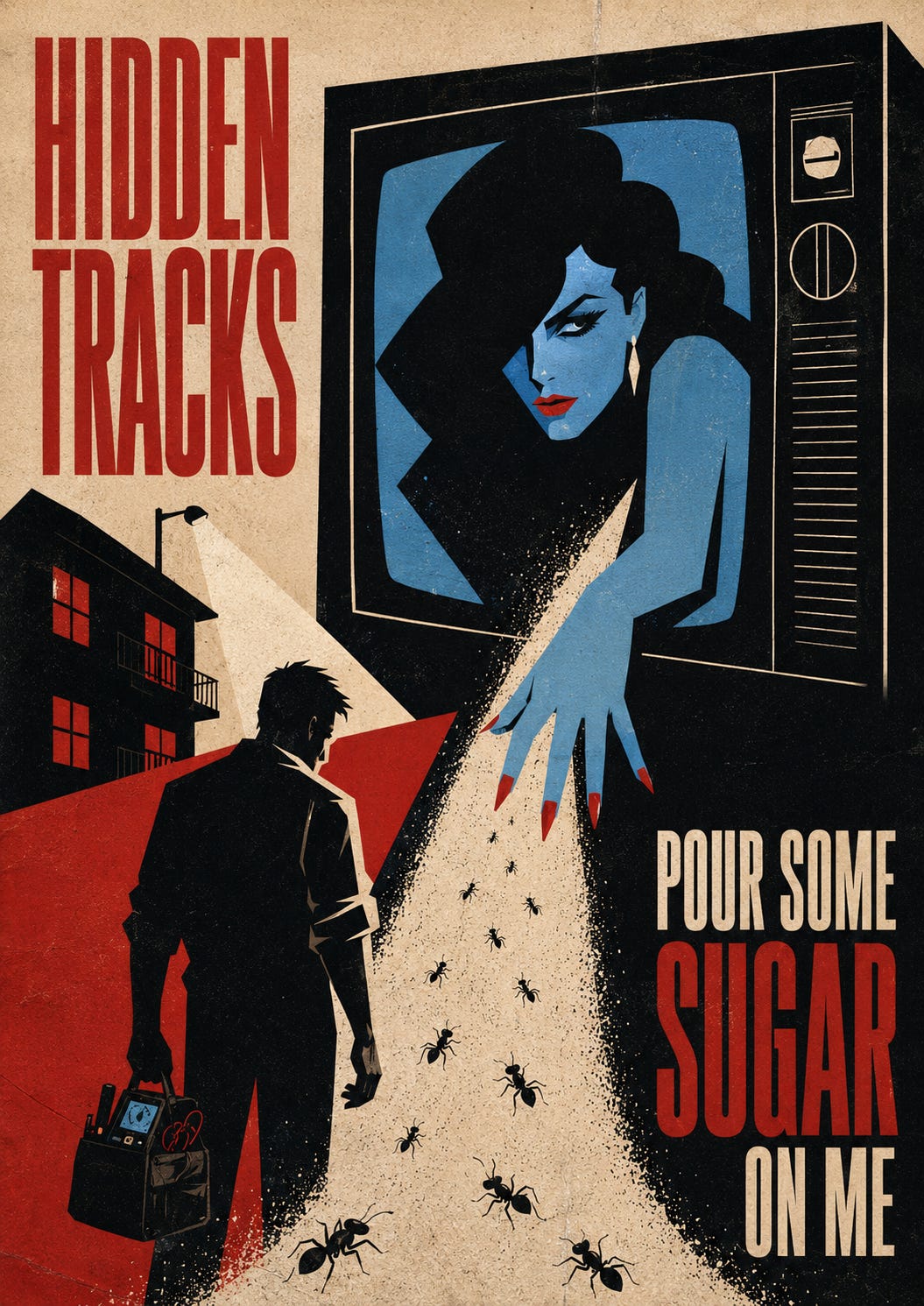
Hidden Tracks: Pour Some Sugar on Me
A late-night service call, a dead local station, and a man who checked the wrong box.

Hidden Tracks takes its titles from songs I heard when I was the right age to let them all the way in. Then it drags them somewhere darker than the lyrics were ever willing to go. You don’t need to know the songs to get the stories. But if you do, they’re going to sit differently after this.
See all Hidden Tracks stories →
The call came in just as Joe Clark was thinking maybe he could get back to the yard, stretch out on the mildew-smelling cot in the break room, and steal three hours before the next shift started making noise.
The note on the screen said:
BULK ACCOUNT SERVICE. MAPLE CREST APARTMENTS. BUILDING C. MULTI-UNIT SIGNAL EVENT.
Standard enough.
Then he saw the dispatch note:
CUSTOMER STATES WOMAN INSIDE TELEVISION
All caps. Somebody in dispatch having a little laugh.
Joe snorted, picked up his coffee, found it cold, drank it anyway, and pulled the van out onto Broad.
Maple Crest Apartments. Building C.
He knew the place. Every cable guy knew the place. Bad lines. Bad management. Roaches that had unionized. The kind of building where a loose connection in one unit meant half the hall got snow on Channel 5 and porn audio bleeding over the Weather Channel.
Rain had come through earlier and left the streets slick. Joe pulled into the Maple Crest lot and sat there a second. Cigarette butts floated in rainwater by the curb. Somebody had smashed a pumpkin in one parking space and it had gone to mush.
He parked under a security light. It blinked every few seconds with a dry, electric snap.
Tool bag. Meter. Flashlight. He took the iron stairs two at a time.
He got to 3B and raised his hand to knock. The door opened before he touched it.
The guy standing there was shirtless, in sweatpants, maybe mid-forties. He had the soft look of a man who lived on beer and burritos. His chest shone with sweat.
Joe felt the draft from the hallway hit his own neck, but the guy didn’t shiver.
“You with cable?” the guy asked.
Joe looked past him into the apartment. “Depends what kind of cable problem you got.”
The guy smiled too fast. There was something white in the corners of his mouth.
“She was on eight first,” he said. “Now she’s on all of ’em.”
Joe caught the smell and his stomach did a slow, heavy roll.
Sugar. Hot electronics. The stale funk of an ashtray. Underneath it all, something wet and animal.
The apartment was hot as a mouth. Joe wiped his forehead with the back of his hand and felt the humidity clinging to his skin.
No lamps. No kitchen light. The TV flickered, casting a dead blue wash over the room that turned the guy’s skin the color of a bruise.
A couch sat against the far wall with one cushion sunk flat. An ashtray overflowed with lipstick-smeared butts. Fast-food wrappers were mashed into the carpet. On the coffee table, a pizza box sat open, three slices going stale. Ants worked the crusts in a solid black line.
Joe set the tool bag down. He didn’t look at the floor. He didn’t look at the guy.
A woman stood in the static.
She looked like she was trying to crawl through the glass. The signal tore her to strips and stuck her back together. Legs first. Smile second. Hair last.
Red mouth. Black-shadowed eyes. Bare shoulders. A smear of collarbone.
A wash of old studio light flattened her. She was late-night local TV from thirty years ago. The kind of woman who sold hot tubs or lingerie after midnight on a station nobody watched sober.
Joe’s stomach did a slow, cold drop.
“What’s your name?” Joe asked.
“Denny.”
“How long’s this been going on?”
Denny kept staring at the television. “It started last night, maybe. Maybe a little before. Thought it was a commercial at first. Then she started talking to me.”
Joe crouched by the cable box. Old reflexes kicked in. Check the line. Check the feed. Rule out stupidity before you started looking for mystery. Ninety-nine times out of a hundred, mystery was just stupidity wearing a hat.
Joe reached behind the box and yanked the power cord from the wall.
The green LED went black.
The picture stayed.
Joe’s hand stayed on the cord, his knuckles white against the black rubber.
The woman on the screen smiled at him.
Not through him. At him.
Something cold slid down the center of his back.
Behind him, Denny said, very quietly, “See?”
The woman took half a step closer to the screen. Static crawled over one cheek and popped in little black sparks.
“Step inside,” she said.
Her voice came out of the dead speakers soft and close, like somebody talking through a bathroom door.
Denny gave a little breathy laugh. “She’s been saying stuff.”
Joe stood up too fast and banged his knee on the TV stand. He didn’t feel it. He was looking at the carpet.
Sugar.
A trail of it from the TV stand to Denny’s bare feet. More packed along the baseboards. A mound in the corner where the dust usually gathered. Ants poured out of the wall vent in a black ribbon.
Joe’s tongue stuck to the roof of his mouth.
The woman lifted one hand and pointed at the patch on his work shirt.
MetroCable.
Her smile changed.
“You used to wear a different patch,” she said.
Joe stopped breathing for a second.
The old patch had been Channel 8 Engineering.
Cheap local station. Basement studio. He’d gone in for a summer and looked up three years later.
Denny looked at him. “You know her?”
“No,” Joe said, and heard the lie rattle in his own throat.
On-screen, the woman tapped the glass from inside.
“Wrong box, Joe.”
He shut his eyes.
For one second he was back there.
August. Basement heat. The control room smelled like burnt dust, old coffee, and the cigarettes Phil Lange, the overnight supervisor, smoked under the NO SMOKING sign.
Three bad feeds crossed each other. Audio warbled. A woman on Channel 8’s after-midnight metal block sat in a fake bedroom set, eyeliner dark, hair sprayed stiff, smiling like the set wasn’t two sheets of plywood under hot lights.
Then the surge hit.
The lights snapped. The picture rolled. Something popped inside the wall with a sharp, ozone stink.
Through the headset, Joe heard a woman scream.
It wasn’t the script. It wasn’t an act.
It was a raw, jagged yell.
He looked up at the monitor and saw her banging on the studio door while her face smeared across three channels at once.
By the time the backup lights kicked in, the set was empty.
“There was somebody in there,” Joe said.
Phil didn’t turn. “It’s just bleed. Log it and dump the board.”
There’d been a form after. There was always a form after.
Three boxes at the bottom.
EQUIPMENT FAILURE
SIGNAL BLEED
INJURY
Joe checked SIGNAL BLEED.
Then he went home.
By dawn the studio had burned bad enough to gut.
After that, people talked about the fire, the lost equipment, but not the woman on the set.
Joe opened his eyes.
The woman on the screen was closer now. Her face broke into scan lines, reformed, then broke again. One shoulder looked blackened under the flicker, as if the picture itself had burned there.
“You heard me,” she said.
Denny backed away from the TV. “What the hell does that mean?”
Joe didn’t answer. He knew that voice. His stomach dropped through the floor.
Joe looked down.
Sugar had crusted into the hairs on Denny’s arm, packed white into the creases of his knuckles and the sweat at his wrist. Denny licked his lips. The skin there split further.
The TV made a sound. Thick and wet.
The woman opened her mouth. Sugar poured out. A white rush of it ran down the inside of the screen, over the edge, down the cabinet, onto the carpet. The ants broke rank and swarmed it.
Denny screamed. High and ugly.
Joe yanked the door open and ran.
He heard Denny behind him for two seconds. Bare feet on concrete. A strangled sob. Then the footsteps stopped. Denny yelled Joe’s name from the doorway.
Joe took the stairs too fast. Almost went down on the second landing, caught himself on the rail, kept moving. His lungs burned. His knee throbbed where he’d cracked it on the TV stand.
Rain smell hit him when he reached the sidewalk. So did the cold.
He dove into the van and locked the doors.
Keys out. Dropped them. Snatched them up. Jammed the brass into the ignition.
The engine turned over. Joe sat there with both hands shaking on the wheel, staring up at the third-floor window.
Behind the blinds of 3B, the TV light pulsed three times. Then every window in Building C went blue all at once.
He threw the van in reverse so hard he nearly clipped a parked Honda.
He got to the lot exit and stopped there, engine rattling under him, wipers dragging over a windshield that didn’t need them anymore.
He could call the cops.
He could drive to the yard, dump the van, and walk away from the whole business. He could even put the front end into a bridge support.
Instead, he popped the glove box.
He didn’t know why. Or he did, and he didn’t want to put it into words.
Maps. Dead flashlight. Napkins. Gas receipts. Under all of it, folded small and yellow at the edges.
He knew what it was before he touched it.
He pulled it out with two fingers and spread it against the steering wheel.
His own handwriting stared back. Ugly block print. At the bottom, an X sat dead center in the wrong square.
SIGNAL BLEED.
Below that, under remarks:
NO VISIBLE INJURIES OBSERVED.
Joe barked out one laugh. Thin and sick.
No visible injuries.
Christ.
He folded the form and shoved it back.
The work tablet on the dash chimed.
No customer name. No callback number. No account history. Just an address on the west side and a service code he’d never seen before.
INSTALL. AUXILIARY ACCESS.
Joe stared at the screen until it dimmed and woke again.
Outside, Maple Crest sat in the rearview. Dark. Dead.
He knew what the ticket was. This wasn’t some poor bastard mad about a sports package.
The radio clicked.
Just a tiny sound. Plastic. Current. Something finding its path.
Then her voice filled the cab, soft and close.
“Don’t make me tell you twice.”
Joe looked at the address.
His hands didn’t shake anymore.
He put the van in drive.
At the first red light, he thought about turning north. Gunning it for the interstate. Heading anywhere until the gas ran out.
He went straight.
A mile later, he reached for his coffee and stopped.
Sugar glittered in the cup holder.
Joe knew what the address meant.
He drove anyway.
The liner notes are below. Song, schematic, what got cut.
01 — The analog connection
The woman on stage has no name in the song
“Pour Some Sugar on Me” is about performance and consumption. The woman exists to be watched, used, poured over. She has no name in the song, no interiority, no existence outside the moment she’s being looked at. She’s spectacle. That’s the whole transaction. The song doesn’t interrogate it. It just runs the transaction at stadium volume and calls it a good time.
Joe’s woman on the set was the same thing until the surge hit and she started screaming. Late-night local TV. Fake bedroom set. Two sheets of plywood under hot lights. A woman who existed after midnight on a station nobody watched sober. Then the lights snapped, the picture rolled, something popped inside the wall, and she was banging on the studio door while her face smeared across three channels at once.
Joe had to decide in that moment whether she was real. The form gave him three boxes. He checked the middle one and went home. The song’s whole premise is the assumption underneath that decision. If she exists only to be looked at, then what happened to her is a signal problem, not a person problem. Joe made the song’s logic official and put his name on it. That’s the debt the story is collecting.
The sugar is the song’s material made literal. It follows Joe from the apartment to the van to the cup holder. The thing that was metaphor in 1987 is now physical evidence in a glove box, folded small and yellow at the edges, that he never threw away.
02 — The technical schematic
The incident report
Standard Channel 8 Engineering form. Three checkboxes at the bottom. Equipment failure. Signal bleed. Injury. The boxes are mutually exclusive by design. You check one. You file it. The form enters the system and the system decides what happened.
Joe checked signal bleed. Under remarks: NO VISIBLE INJURIES OBSERVED. Both statements were technically defensible. The equipment did fail. The signal did bleed. He did not observe visible injuries because by the time the backup lights came on the set was empty and he did not go look.
The form has been in the glove box for thirty years. Folded small. Yellow at the edges. He never threw it away, which means he always knew what it was. A man who genuinely believed he’d checked the right box throws the form away. A man who knows he checked the wrong one keeps it, because throwing it away would require deciding to throw it away, which would require admitting why. The form in the glove box is not guilt. It’s the decision Joe made and has been living inside ever since. The schematic here is a piece of paper doing exactly what it was designed to do, which is make a choice official. It just made the wrong choice official. In ink. With his signature.
03 — Riff/beat alignment
The chorus drop and “wrong box, Joe”
The song runs a long buildup before the chorus drops. Joe Elliott doing the talk-sing verse, the tension coiling, and then the whole thing comes in at once and doesn’t go back down. That’s a very specific dynamic. Low and controlled, then full volume, then the volume becomes the new normal.
“You used to wear a different patch,” she said. Joe stopped breathing for a second. The old patch had been Channel 8 Engineering.”
The story runs at low guilt for its entire first half. Joe doing his job. Joe running old reflexes. Joe telling himself ninety-nine times out of a hundred it’s just stupidity wearing a hat. Then she says “wrong box, Joe” and the chorus drops and it doesn’t go back down. Every scene after that is louder than the scene before it. Sugar in the carpet. Sugar in Denny’s knuckles. Sugar pouring out of her mouth down the screen. Sugar in the cup holder. The volume keeps coming up because that’s what a chorus does once it arrives. Joe checked a box thirty years ago to make the volume go back down. It waited.
04 — The Stephen King ledger
The cup holder
Version I killed
“He reached for his coffee and his hand stopped before it got there. In the cup holder, catching the red light from the next signal, a thin glitter of sugar sat where there had been nothing before, fine and white and patient as anything that has been waiting a long time.”
Version I kept
“A mile later, he reached for his coffee and stopped. Sugar glittered in the cup holder.”
The first version is narrating the image at the image. “Patient as anything that has been waiting a long time” is me explaining the thirty-year debt using the detail that is already explaining the thirty-year debt. The sugar doesn’t need a caption. It needs a cup holder and two sentences of Joe reaching for something ordinary and finding it contaminated. The red light detail is atmospheric furniture that slows the punch down on its way to landing. Cut the adjectives. Cut the patience speech. Joe stopped. Sugar was there. The reader has been in the van the whole time. They know what it means.
05 — For paid subscribers
Think about a form you filled out, a box you checked, a report you filed, where the available options didn’t quite cover what actually happened. Not the dramatic version. The ordinary one. The workplace incident, the insurance claim, the HR report, the survey with no good answer. Think about which box you checked and why, and what the thing you didn’t check would have cost you if you had. Then think about whether you still have the paperwork.
Miles, This is phenomenal horror writing.
The atmosphere feels humid, electrical, exhausted in the most human way possible. Joe immediately felt real to me because the story understood the quiet cynicism of somebody who has spent years inside failing systems and broken buildings. That grounding made every supernatural detail land harder.
And that final image of him driving anyway after seeing the sugar in the cup holder? Perfect ending. Truly outstanding work.
What a ride. A very natural writing style that made this bad boy flow easily.