

Mallory noticed the smile because it didn’t stop when it should have.
It happened at the courthouse. She was there to renew a parking permit. The woman at the counter had explained the system delays without apology. Without irritation. Just a fixed, pleasant smile that didn’t waver, even when she refused the application.
On the steps outside, Mallory almost stepped on a dead sparrow.
She jerked her foot back. The bird lay on the concrete, one wing bent back against itself at an angle that made her wince. Its beak hung open. Feathers disrupted, splayed out like it had thrashed.
People had been walking around it. There was a clear space in the foot traffic, a careful island of avoidance, but no one had moved it.
Mallory pulled out her phone and took three photos from different angles. Her camera roll was full of things like this. Dead birds. Odd traffic patterns. The same van parked on her street for five days. Most of it meant nothing, but she took the photos anyway.
A man walking toward her smiled.
Mallory smiled back without thinking.
The man didn’t stop.
They passed each other. She felt something between her shoulder blades. His smile was still there.
When she turned, the smile was gone. The man was already leaning against the stone railing, writing in a notebook with careful precision.
Mallory stood there longer than necessary.
She caught her own reflection in a darkened window and realized she was still smiling. She tried to drop the expression and felt resistance. Not paralysis. Something more like a preference she hadn’t chosen.
She made a note: Persistent smile. Effort to stop.
Her hand didn’t hesitate. That bothered her later, when she thought about it. It should have hesitated.
She worked tech support for a logistics company recently acquired by something larger and quieter. Nobody had announced the change. The emails had simply stopped listing names. Her manager’s signature used to read “Trent Yoshida, Operations Lead.” Now it just said “Operations.”
The calls shifted.
“I am unable to complete this process,” one woman explained, her voice carrying a strange formality, as if reading from a script she’d memorized perfectly.
Mallory wrote it down on the scrap paper beside her keyboard. The paper already had phrases on it, accumulated over months, dated and cross-referenced.
“The system is rejecting my input,” said another, apologetically, though nothing in her tone suggested actual regret.
She added it below the first.
“There appears to be an inefficiency,” a man offered, as if confessing. Then he thanked her for her time before she’d done anything.
They weren’t angry. They weren’t scared.
Mallory photographed the scrap paper during her lunch break and texted it to Jonah. He’d know what it meant. They had a system.
He replied six minutes later: Category?
She typed: Three. Maybe four.
His response came immediately: Send more.
During a team meeting, something hit her office window.
The sound made her jump. A bird, small, wings beating frantically against the glass for a moment before it dropped.
Mallory leaned toward the window. On the ledge below, the bird lay twisted. One wing bent underneath itself. Its eyes were still open.
She took a photo.
“Mallory?” Trent’s voice came through her speakers. “You’re muted.”
She unmuted. “Sorry.”
Her manager smiled through the camera.
“We’re seeing predictable responses to adjustment,” he said. “Change can feel uncomfortable, but alignment brings clarity.”
His voice stayed smooth.
Mallory started recording.
“What’s aligning?” someone asked.
Trent paused just long enough to notice.
“Our expectations,” he said.
Mallory waited for someone to push. To ask whose expectations, or what happened if you didn’t align, or literally anything.
Nobody followed up.
She muted her microphone, stopped the recording, and sent it to Jonah with a timestamp. Then she stared at her hands until the meeting ended. Her knuckles had gone white around her coffee mug. She flexed her fingers and watched the blood return.
On the ledge, the bird hadn’t moved.
A bus drifted onto the sidewalk on Thursday afternoon.
Just a grinding sound and then a dull impact that Mallory felt through her feet a block away.
She ran outside with half the block, phone already in her hand, already recording.
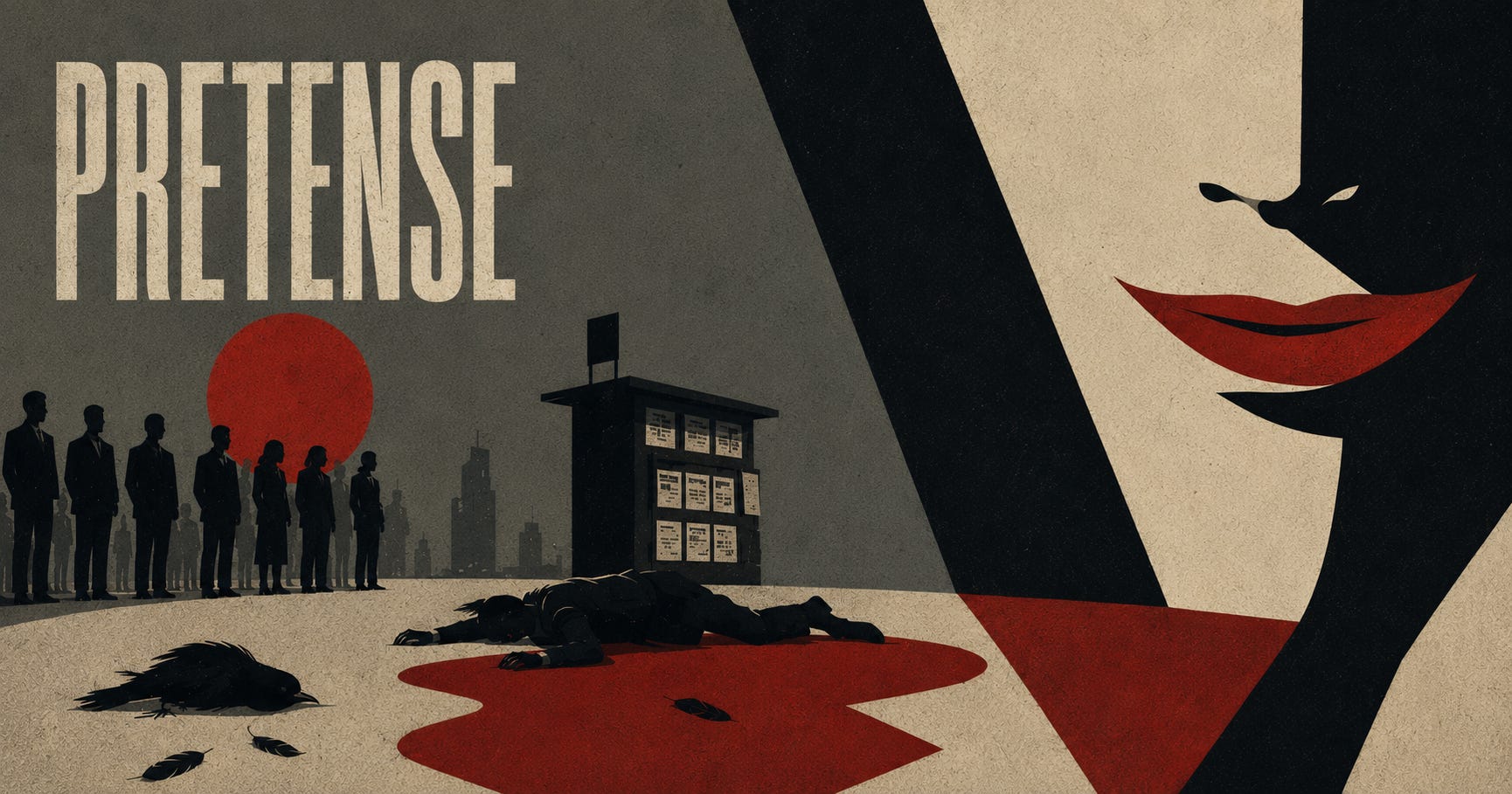
A man was pinned against a newsstand. Blood pooled beneath him, dark against the concrete, spreading in a widening circle. One arm lay at an angle that made Mallory’s stomach turn.
A crow lay three feet from his head. Its feet curled into tight claws. Head wrenched to the side. Feathers disrupted like it had thrashed.
People gathered in a loose semicircle, standing at polite distances, maintaining the kind of spacing you’d use in a checkout line.
“Emergency services have been notified,” a woman said calmly, phone in her hand but not raised, not to her ear. Her knuckles were white. “No need for further action.”
Mallory’s breath caught. She moved toward the man before she could think, stopped by the ring of bodies that wouldn’t move, wouldn’t part.
“He’s dying,” she said, and her voice cracked on the second word.
“Yes,” the woman agreed, with the same tone she might use to confirm the time. “That has been identified.”
Mallory tried to push past her, but the woman’s hand caught her elbow firmly.
“Please,” Mallory said.
“Your concern has been noted,” the woman replied.
The ambulance arrived. No siren.
Mallory kept recording.
The EMTs moved casually. One knelt, checked for a pulse, and shook his head. The other was already filling out forms on a tablet.
“This individual has expired,” he said. His breathing was shallow and careful.
No one reacted.
Except Mallory. She made a sound she didn’t recognize.
The EMT turned to her with mild concern. His face arranged itself into something sympathetic. “Your distress is understandable,” he said. “Please remain calm.”
She watched them load the body. Watched the crowd disperse. Watched people merge back into the foot traffic as if nothing had interrupted their day.
No one touched the crow.
That night, the news ran the incident in under a minute. No footage. No interviews. Just reassurance. The anchor’s face stayed pleasant throughout. “An individual experienced a transportation incident today,” she said. “Services responded appropriately. No disruption to traffic patterns occurred.”
Mallory recorded that too.
Then she sent everything to Jonah: the video, the screenshots, her notes. Searched for the man’s name until morning. Tried every combination of keywords. Bus accident, pedestrian death, newsstand, Thursday. Nothing.
She never found it.
At 6am, her phone rang.
“I got your files,” Jonah said. No greeting. They were past that.
“And?”
“This is different.”
“You said that about the water.”
“I was wrong about the water.” His voice was steady. “This is different.”
Mallory sat up. “You’re sure?”
“No. But I’m not dismissing it.”
That scared her more than anything else. Jonah dismissed everything eventually. That was his role. He was the brake. She was the accelerator. When he stopped pumping the brakes, it meant something.
“Where?” she asked.
“Usual place. One hour.”
They’d met in college. They’d been wrong about almost everything since.
The diner still took cash. The waitress knew them as “those two” and brought coffee without asking.
Mallory slid into the booth across from Jonah. He already had his laptop open, three browser tabs visible, his phone face-up on the table.
“Show me,” he said.
They went through everything. The sparrow. The window bird. The crow. The bus footage. The news clip. The phrases from her callers.
Jonah took notes in a document they’d maintained since graduation. 847 entries. This would be 848.
“I’m on the forums,” he said. “There’s threads from Madrid, Stockholm, Singapore. Same patterns.”
“Language?”
“Identical tone. And—” He turned his laptop. “Toronto mentioned eye contact issues. Berlin said ‘the birds know.’”
Mallory felt something cold in her chest.
Two booths over, a couple spoke quietly.
“I appreciate your patience,” the man said, his hand resting on the table between them, not quite touching the woman’s hand.
Mallory and Jonah both stopped.
“There is no inconvenience,” the woman replied, her voice carrying that same careful formality Mallory had heard on her support calls. “Your adjustment period is expected.”
“I’m trying,” the man said, and something in his voice caught.
“Your effort has been noted,” the woman said.
They were both typing before the couple finished. Shared document. Both adding to it. Timestamps. Recording started.
“Category four,” Mallory said quietly.
Outside, a man tripped on the curb and fell hard. His briefcase skidded into the gutter. His palms hit concrete and immediately started bleeding.
They both flinched, then immediately started recording through the window.
The man pushed himself up slowly. Blood ran into his eye from a cut on his forehead. He smiled faintly. His chest rose and fell too quickly, breath coming in short gasps.
“I am functional,” he said to no one in particular.
A woman walked past him, stepping over his briefcase.
No one stopped to help him.
He collected his things, dabbed at his eye with his sleeve, and walked on.
Jonah was pale.
“You seeing the birds?”
She looked where he was pointing.
Three in the parking lot. One looked like it had been trying to fly and just stopped mid-air. Its neck craned back at an impossible angle. Another lay near a tire, wings spread and stiff, frozen mid-struggle. The third had its beak open, one leg extended like it had been reaching for something.
“I’ve been seeing them for days,” Mallory said.
“Everyone’s seeing them. But no one’s saying anything.”
“No one ever does.”
The city changed without announcement.
Traffic smoothed. Sirens became rare. Conversations ended decisively, without the usual trailing off or promises to continue later.
Mallory noticed emails from city offices no longer used names.
Your request has been evaluated. No further action is required.
The signature lines were gone. Just blank space where someone’s title used to be.
She documented it all. Every email saved. Every phrase catalogued. Every timestamp recorded.
Mallory tried to do something irrational at work. She raised her voice. Cried during a call about billing, real tears, the kind that came from weeks of watching people sand themselves down into something manageable.
There was a pause on the other end of the line.
Then: “Please hold.”
Trent joined the call. He smiled through the camera.
“Your emotional transparency has been noted,” he said. “It will be factored appropriately.”
“Factored into what?” Mallory asked.
Trent’s smile held. “Your continued alignment.”
She hung up and immediately sent the recording to Jonah with three red flag emojis.
The quiet on Sunday morning was different.
Mallory woke to it. The low electrical hum that lived in the walls had dropped into something deeper and steadier.
Jonah was already in her living room. He’d shown up Saturday night with his laptop and three external drives. They’d been up until 2am going through everything, building the timeline, cross-referencing patterns.
“You hear that?” she said.
“Yeah.” He was already at the window.
Outside, her neighbors stood in the street.
All of them.
Mrs. Keller stood at the curb, hands at her sides, her face open and expectant. A teenager leaned against a mailbox, face down, scrolling. A man Mallory barely recognized stood near the intersection, posture loose, gaze forward.
More kept arriving. Walking out of houses, out of apartments, onto sidewalks and into the street. No one called to anyone else. No one asked what was happening.
Birds lay scattered among their feet. Dozens of them. Wings bent back. Necks wrenched. Beaks open in silent mid-screams.
No one looked down.
“Are you recording?” Mallory whispered.
“Since I got here.”
“How many cameras?”
“Four angles.”
Mrs. Keller looked up.
Mallory saw her eyes.
They were wide. Too wide.
“Jonah,” Mallory whispered.
“I see it.”
The teenager lifted his head. His thumb kept scrolling. His eyes found Mallory’s window and didn’t blink. His mouth curved slightly upward. His foot rested inches from a bird that looked like it had exploded.
The man by the intersection turned. His expression stayed neutral, patient, the face of someone waiting for a bus.
Every face in the street held the same split. Mouths arranged correctly, expressions appropriate, all the visible markers of people simply existing in public space. But their eyes were drowning.
Then it happened all at once.
Not a sound. Not a gesture. Just every body in the street dropping a half-inch at the same moment, like something had been holding them up and let go. Mrs. Keller. The teenager. The man by the intersection. The woman in the bathrobe. All of them, same instant, same degree.
“Did you see that,” Jonah said. Not a question.
“Yes.”
Neither of them moved.
Then doors opened. Cars started. Someone waved. A dog barked, late, the sound wrong after so much silence.
Life resumed easily.
The birds remained where they’d fallen.
“We need to leave,” Jonah said.
“And go where? You saw the forums. It’s everywhere.”
“Then we document. We get this out.”
“Who’s going to listen?”
Neither of them had an answer for that.
“Back everything up,” she said finally.
“Three drives. Cloud. Physical copies.”
They worked in silence for a while. The apartment smelled like cold coffee. Jonah’s fingers moved fast over his keyboard. Mallory scrubbed through footage frame by frame.
“Cloud’s rejecting uploads,” Jonah said. “Hard fail.”
“Try again later.” She already knew it wouldn’t matter.
She glanced at the window. Mrs. Keller was still there, chin tipped up, eyes on the glass. The teenager beside her. The man from the intersection. A woman in a bathrobe. Two guys in gym shorts like they’d paused mid-stretch.
Mallory turned back to her document. Scrolled up looking for the caller phrases, the exact wording, needing to cross-reference something in the forum posts.
She found the entry.
Persistent smile. Effort to stop.
The date was wrong.
Not off by a day. Not a typo. The date sat three weeks before the courthouse. Before the sparrow. Before she’d had a category for any of it.
She read it again.
Three weeks before she’d stood on those courthouse steps and decided this was the day she started paying attention.
Her stomach dropped.
She looked up.
Jonah was smiling.
Barely there. Like the first tug of a string.
“Jonah,” she said quietly. “Why are you smiling?”
He blinked, surprised, and raised his hand to his face. His fingertips touched his cheek like he was checking for blood.
“I’m not—” he started.
Then he stopped, because he could feel it too.
His hand trembled.
“I don’t know,” he said.
Mallory became aware of her own cheeks.
The muscles deciding something without asking her. Pulling upward with a slow, obedient certainty.
She tried to force her mouth down.
It resisted.
The scream rose in her throat, full-bodied and hot, pressing against her teeth.
Her lips parted.
Nothing came out.
In the darkened window, she looked pleasant and presentable.
The document was still open on her screen. The entry still there, date and all, filed between two other observations she didn’t remember making.
This story isn’t alone…
You’ll find more in Farrago: Volume 1.

Miles, This was brilliantly done. The restraint is what made it hit so hard. You let repetition, tone, and tiny behavioral shifts build the terror instead of forcing it, and that made the ending feel even more devastating. Mallory is such a strong anchor for the reader because her attention feels both obsessive and completely justified. The dead birds, the formal language, the smiles, the way concern gets translated into procedure. All of it was chilling. Excellent work. Monica