

A Study of Evil
The only thing worse than meeting a monster is becoming one.

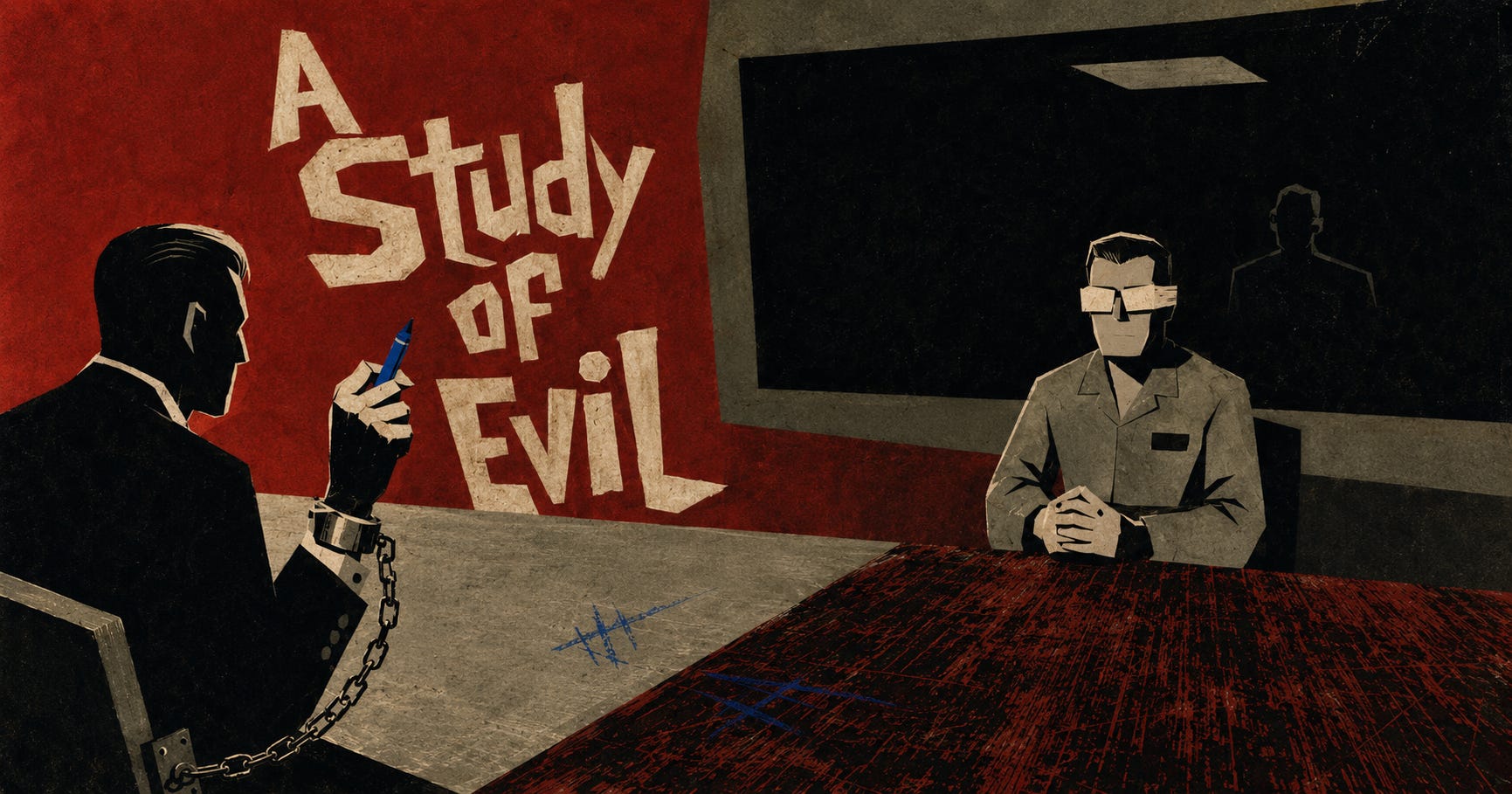
The room smelled of bleach and peppermint gum. Dr. Neil Canter hated peppermint. It masked the rot.
Canter caught his reflection in the darkened two-way mirror. His hair was slicked back with enough gel to make it look like plastic. He shot his cuffs. Gold links clinked against the steel table. He ran a thumb over the lapel of his charcoal suit. Italian wool. The fabric scratched his neck, but he liked the weight of it.
He clicked his pen. Once. Twice.
Across the steel table sat Arthur Pine.
Pine looked like a man who waited in line to return a toaster because it didn’t toast evenly. His hair was the color of dryer lint, thinning at the crown but combed over with precision. Wire-rimmed glasses sat crooked on his nose. The left arm of the frames was held together with a piece of white medical tape.
He wore a grey jumpsuit that bunched at the waist. His hands were folded on the table. They were clean.
“Tell me about the girl in the warehouse,” Canter said. He checked his watch. The heavy silver diver’s watch looked bulky against his wrist. He tapped the crystal face.
Pine sighed. It was a long, rattling sound. He pushed his glasses up with a single finger, leaving a smudge on the glass. He looked at the wall. “The warehouse was dusty. My allergies were terrible that day. I think it was the ragweed.”
Canter clicked his pen. “Not the dust, Arthur. The moment you decided she was the one.”
“I didn’t decide.” Pine scratched his nose. “It was a scheduling issue. Tuesday is usually my grocery day. But the store was closed for renovation. I had time.”
Canter wrote Lack of affect in his notebook. He pressed the pen down until the nib tore the page. “You killed a woman because the grocery store was closed.”
“Well. I had to do something.”
Canter’s eye twitched. He wanted the darkness. He wanted the twisted logic of a predator. He got a man complaining about logistics.
He clicked his pen again.
“How did it feel?” Canter asked. “When you used the hammer.”
Pine frowned. “Heavy. My wrist has been bothering me. Carpal tunnel from the data entry job. Swinging it hurt. I remember thinking I should switch hands. But I’m not ambidextrous.”
Canter stopped writing. The air conditioner hummed. A fly buzzed against the fluorescent light. Canter loosened his tie. The knot was a tight Windsor that pinched the skin of his throat.
“Arthur. You aren’t taking this seriously.”
“I am,” Pine said. He picked at a hangnail. “It’s just procedural. You want poetry. You want me to say she looked like an angel or that the blood was a sacrament. It wasn’t. It was messy. Sticky. Like spilling syrup on the floor and knowing you have to clean it up before it hardens.”
Canter gritted his teeth. His thumb found the pen. Click. Click. “You stripped the skin from her back.”
“The fabric was snagging,” Pine said. “It was cheap polyester. I couldn’t get a clean cut through it.”
Canter slammed his hand on the table. The pen rattled. “This isn’t filing taxes. You ended a life. You have to feel something. Guilt. Power.”
Pine looked up. His eyes were dull, watery blue under the glass. “Do you feel power when you squash a spider? Or do you just want it off your shoe?”
“I am not the one on trial here.”
“Aren’t you?”
Canter adjusted his tie. It felt tighter. He reached for his pen.
His thumb pressed the top of the pen. There was no resistance. No spring. No click.
The barrel felt soft. Waxy. He looked at his fingers. They weren’t holding a Parker Jotter. They held a blue crayon. The paper wrapper was peeled back in strips. A crescent of blue wax was jammed under his thumbnail.
He looked at the table.
The cool, brushed steel was gone. His palms rested on grain. It was oak. Scratched. A name was carved near the edge: KEVIN. The wood felt damp.
Canter reached for his throat to loosen the knot.
His fingers met a rough, circular collar. There was no silk. No tie. Just a thick grey seam that rubbed his neck raw. He looked at his arms. The charcoal Italian wool had dissolved into pilled fleece. The gold cufflinks were gone.
His left wrist felt heavy. He lifted it.
The silver diver’s watch was gone. A steel band bit into his radius bone. A chain pulled tight, anchoring him to the chair.
“Neil,” Pine said.
Canter looked up. The wire-rimmed glasses were gone. Pine’s eyes weren’t wet or enormous. They were sharp. He sat straight. The grey jumpsuit was a white lab coat.
“The crayon, Neil,” Pine said. “Put it down.”
“I’m the doctor,” Canter said. His voice was high. Thin. “I’m studying the evil.”
“You’re staining the table again,” Pine said. He stood up and took a file from the desk. He walked to the door and pulled a key card from his pocket. The lock buzzed. “We’ll try again tomorrow.”
Pine opened the door. Two orderlies stood in the hallway. They looked bored.
“Wait,” Canter said. He tried to stand. The cuff snapped his wrist back toward the wood. “The girl. The warehouse.”
Pine paused in the doorway. “There was no girl, Neil. It was your wife. And it wasn’t a warehouse. It was the kitchen. But you’re right about one thing.”
Canter stared at the crayon. His thumb moved to where the clicker should be.
Press. Press.
“It is messy,” Pine said. “Like syrup.”
The door clicked shut. The lock engaged. Canter sat in the silence. He looked at the blue crayon. The tip was flattened. He wrote on the wooden table. The wax barely left a mark over the other marks already there.
Subject shows lack of affect. His thumb kept moving.
Press. Press.
THE END
You want to believe Dr. Canter is just a clever plot twist. You want to believe the “Killer pretending to be the Investigator” is a hacky trope. It’s not. It’s a diagnosis.
In 2008, Vlado Taneski, a Macedonian crime reporter, captivated the country with his visceral coverage of a serial killer. He interviewed the weeping families. He speculated on the killer’s psyche. He scolded the police for their incompetence.
He was also the killer.
Read the full story of Vlado Taneski here.
Like this story?
It’s part of my short story collection, Farrago: Volume 1. Purchase the twenty-two story collection here:


"Do you feel power when you squash a spider?" is the line that stays. Pine's banality as the 'killer' is more unsettling than any explicit horror—the procedural mind treating violence like inventory management. The Taneski coda is interesting but the story doesn't need the explanation; it already speaks. Congrats!
This is so captivating - I really enjoyed reading it.